
Axios Generate

July 13, 2023
💥 Let's do this! Today's newsletter has a Smart Brevity count of 1,300 words, 5 minutes.
🎸 This month in 1979, Dire Straits released a brilliant single, with some of Mark Knopfler's best guitar work, that's today's intro tune...
1 big thing: El Niño to peak at "moderate to strong"


El Niño conditions are slowly gathering strength in the tropical Pacific Ocean, and the National Oceanic and Atmospheric Administration expects the event is likely to peak at moderate to strong intensity by the winter, Andrew writes.
Why it matters: The natural climate cycle is already boosting global average surface temperatures and contributing to unprecedented extreme weather events. These trends are likely to be even more noteworthy into next year.
Driving the news: The latest El Niño update out today from NOAA's Climate Prediction Center, shows that weak El Niño conditions are present. Still, the air and sea are not yet fully marching in lockstep across the equatorial tropical Pacific Ocean.
- Stronger air and sea "coupling," as meteorologists refer to it, would be required for the cycle to intensify.
Yes, but: The new bulletin plays down the likelihood of a "historically strong" El Niño event this year, assigning the odds of such an outcome at one in five.
- "At this point, we cannot entirely rule an event of that magnitude out, but I don't see a lot of support" for it in the observational and forecast data, meteorologist Michelle L'Heureux tells Axios in an email.
- She leads the scientists that monitor and forecast El Niño and La Niña.
Threat level: Given the growing magnitude of human-caused climate change, it no longer takes a historically strong El Niño to yield a record warm year for the planet.
- El Niño is lurching the climate further into perilous territory. Never before has an El Niño developed when global ocean temperatures were so warm at the outset, raising the possibility of unprecedented outcomes on sea and land.
- Already, the planet had its warmest June on record, and July 3-9 ranks as the warmest seven-day period ever recorded.
- North America is seeing a spate of uncontrollable wildfires in Canada along with record-breaking heat, just as more than 112 million are under heat alerts in the U.S.
- Internationally, heat waves and flooding have broken longstanding records, and the extra heat and moisture from El Niño is likely playing a role.
What's next: El Niño tends to have a lag between its peak intensity and the highest global temperatures. This likely means that 2023 will set a global record that is then surpassed in 2024.
2. Head of COP28 climate summit details priorities

Photo illustration: Tiffany Herring/Axios; Photos: Karim Sahib/AFP/Getty Images; John Macdougall/AFP/Getty Images
Sultan Ahmed al-Jaber, who will lead the COP28 climate summit in the United Arab Emirates, laid out the most detailed look yet at his country's priorities for success at the meeting, Andrew writes.
Why it matters: The UAE’s goals for the talks may shape the summit’s outcomes.
The big picture: Al-Jaber, who occupies a triple-hatted role in the UAE government as the head of the state oil company, its top renewable energy official and climate envoy, called for tripling renewable energy output, and doubling energy efficiency and global hydrogen production by 2030.
- Al-Jaber sought to use his experience to his advantage. “As I’ve said many times, the phase down of fossil fuels is inevitable."
- “It is in fact essential,” he said. “We must take a holistic approach that brings together both the supply and the demand side in an integrated response.”
Between the lines: The agenda for the summit later this year, detailed in a speech in Brussels Thursday morning, features a heavy emphasis on:
- Comprehensive climate finance reform.
- Keeping the Paris Agreement’s 1.5°C temperature target within reach
- Working with all industries, including oil and gas, to change the way they do business.
3. Exxon buys Denbury in CO2 pipeline-focused deal
🛢️Breaking Thursday: ExxonMobil is acquiring the oil producer Denbury — which has a very large CO2 pipeline network — in an all-stock deal valued at $4.9 billion, Ben writes.
Why it matters: Exxon called the deal an important way to profitably expand its carbon capture and storage business.
Zoom in: The acquisition provides ExxonMobil with the largest U.S. CO2 pipeline network at 1,300 miles, and 10 onshore sequestration sites, the company said.
- A significant amount is in the Gulf Coast region, where Exxon has been striking CO2 capture deals with industrial heavyweights.
4. Trimming the sails of oil demand growth

Illustration: Shoshana Gordon/Axios
The International Energy Agency lowered its 2023 global oil demand growth estimate for the first time this year, Ben writes.
Why it matters: The change is small, but nonetheless a proxy for global economic challenges.
Zoom in: IEA trimmed its estimate by 220,000 barrels per day. It sees demand averaging 102.1 million barrels daily this year — still a record.
The big picture: IEA cited "persistent macroeconomic headwinds" in its monthly market snapshot.
- The view on China — the second largest economy — is mixed.
- Its recovery is "losing steam," but oil demand growth "continues to surprise to the upside."
Elsewhere on our petro-radar...
➡️ Another U.S. liquefied natural gas project is proceeding.
- NextDecade announced a final investment decision on its Rio Grande LNG project in Texas.
- The company said it has $18.4 billion in financing and customers including TotalEnergies, Shell and Exxon. Bloomberg has more.
5. An ambitious climate fund aims to break the mold

Illustration: Aïda Amer/Axios
Today brings the unveiling of a $239 million climate tech investment fund with an atypical structure — and ambitious goals, Ben writes.
Driving the news: Azolla Ventures, launched out of the nonprofit Prime Coalition, focuses on early-stage hardware startups with outsized impact if their tech scales.
- It's designed to back firms that can "significantly alter the trajectory of climate change, but are overlooked by traditional capital sources," they said.
- Thursday brings the first details about Azolla's size and structure.
How it works: It blends "catalytic, charitable capital" — think grant-making arms of philanthropies and corporations, to name two — with traditional sources like endowments and family offices.
- It's focused on "impact-first" investing, which has more risk tolerance and a longer time horizon for commercial success.
Zoom in: Prime works with Azolla to assess potential investments' emissions-cutting potential and the (low) likelihood of attracting support from conventional investors. Then, it helps bring in philanthropic capital.
- Capital amounts will vary, but Azolla co-founder Johanna Wolfson says initial investments will average in the $1 million to $2 million range.
Why it matters: Azolla is thinking big as it stakes very small players. Investment criteria include solutions that can ultimately cut or remove emissions at the gigaton scale.
- Plus, attracting finance can be tough for hardware firms.
Catch up fast: The first six investments include Heaten, which is developing high-temperature heat pumps to drive industrial processes without fossil fuels; and Funga, which is "optimizing the forest microbiome for improved carbon storage."
The bottom line: “We have a lot of solutions out there that are supported by finance-first investors, but what are we leaving on the table by not bringing that impact-first mindset?" Wolfson tells Axios.
- "That's what we're here to identify, nurture and support."
6. Two oil giants go big on European offshore wind
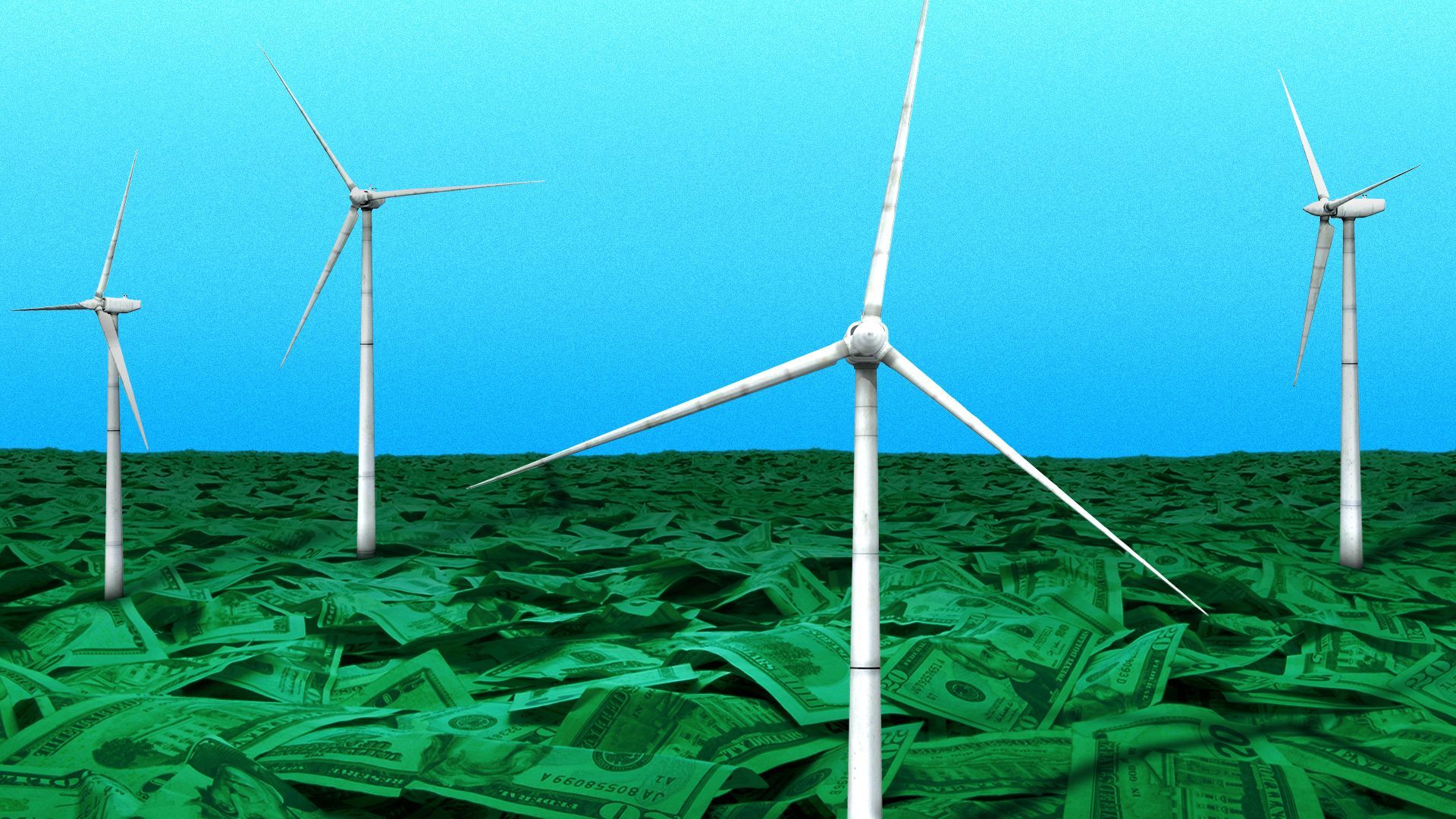
Illustration: Gabriella Turrisi/Axios
BP and TotalEnergies are planning major wind projects off Germany's coast, slated to come online in 2030, after securing development rights in a government auction, Ben writes.
Why it matters: It's lots of power, if the projects come to fruition. BP said its two North Sea sites have a combined potential generating capacity of 4 gigawatts.
- TotalEnergies said its two planned projects have 3GW of combined capacity, which it called enough to power over 3 million homes.
- For reference, the White House target is 30GW of total U.S. offshore wind power in 2030.
Driving the news: The money involved shows that the oil giants see big potential in the power market of Europe's biggest economy.
- BP is making initial payments of $755 million, 10% of its bid amount, with the remainder paid over 20 years when the projects are operational — a total of around $6.8 billion.
- BP's offshore wind pipeline now exceeds 9GW globally, it said.
Quick take: It's a "Forgot About Dre" moment for BP's renewables efforts.
- BP took heat in February for slowing its plans to cut oil and gas production.
- However, that strategic change came alongside plans to boost low-carbon investments. Reuters has more.
📬 Did a friend send you this newsletter? Welcome, please sign up.
🙏 Thanks to Chris Speckhard and Javier David for edits to today's edition, along with the talented Axios Visuals team.
Sign up for Axios Generate

Untangle the energy industry’s biggest news stories


