Axios Generate

June 13, 2024

🐣 Good morning! We've got a newsy 1,223 words, 4.5 minutes.
👀 Situational awareness: Tesla CEO Elon Musk claimed via X that shareholders are supporting his $56 billion pay package by a "wide" margin.
- The results of the closely watched vote will arrive later today at Tesla's annual meeting.
🎶 At this moment in 1995, Monica was No. 1 on Billboard's R&B chart with this week's final intro tune...
1 big thing: Goodbye El Niño, hello La Niña


So long, El Niño, we hardly knew you.
According to NOAA, ocean temperatures have cooled enough in the equatorial tropical Pacific Ocean to declare the once-strong event over.
Why it matters: What comes next has forecasters and coastal residents particularly worried, since a La Niña event is projected to develop this fall. It could potentially juice the Atlantic hurricane season.
Zoom in: According to Michelle L'Heureux, head of the El Niño forecasting unit at the Climate Prediction Center, neither El Niño nor La Niña conditions are likely to be present through August, when the odds of a La Niña increase.
- "El Nino is over! Finished," L'Heureux tells Axios via email.
- Forecasters are now more confident that La Niña, which features cooler-than-average ocean temperatures in the equatorial tropical Pacific, will form slightly later than previous projections showed — setting in during the July-through-September timeframe, she adds.
Between the lines: A slightly later emergence of the Pacific climate cycle may help prevent the Atlantic hurricane season from being as hyperactive as predicted. It could offset its peak effects until after the season's typical busiest period, which is from mid-August through September.
- La Niña tends to reduce the strength and prevalence of wind shear across the North Atlantic Ocean Basin. This makes for a friendlier environment for tropical storms and hurricanes to form.
Yes, but: There are still plenty of other signs pointing to a very active Atlantic hurricane season even without a La Niña.
The intrigue: The demise of El Niño means the planet's 14-month-long string of record-warm months is likely to come to an end. El Niño events tend to add more heat to the oceans and atmosphere, coming on top of the influence of human-caused climate change.
- During the most recent El Niño, global average temperatures set new milestones, alarming many scientists and raising questions about whether climate change is accelerating.

2. EV trade fight tests climate priorities
New trade restrictions on China are a test of whether the U.S. and Europe can pursue strong industrial policy and fight climate change simultaneously.
Why it matters: These huge carbon emitters are looking to speed deployment of renewables and electric vehicles, and China is a huge producer of low-cost equipment.
- But officials on both sides of the Atlantic want to boost domestic climate tech industries.
Catch up quick: European Union officials yesterday announced higher tariffs, up to 38%, on Chinese-made EVs.
- It comes just weeks after the White House announced 100% tariffs on China's battery-powered models.
- Chinese EVs have yet to gain a beachhead in the U.S., while in contrast China's exports to Europe have surged in recent years.
- They reached one-fifth of European EV sales last year, by one estimate.
The big picture: The new penalties are part of wider efforts to diversify EV supply chains away from China, including critical minerals and batteries.
What we're watching: Analysts are tracking whether trade friction affects EV sales growth, which has recently weakened in key markets.
- "Tariffs and further protectionist measures could slow down global EV adoption in the near term," research firm BloombergNEF said in a new report.
The intrigue: The European Commission said China's major EV subsidies "unduly hurt the EU industry and ultimately undermine" the energy transition.
- U.S. officials say diversified supply chains make it easier to meet climate goals.
What they're saying: The Atlantic Council's Joseph Webster said the EU's tariffs "appear aimed at incentivizing Chinese inward investment within the EU, not cutting out China from supply chains."
- "[I]f Chinese automakers site production facilities within the EU, the disruption to emission targets could be minimal," he said via email.
3. Ukraine enters deal for U.S. LNG, with a twist
U.S. LNG producer Venture Global struck a deal with Ukraine's DTEK for cargoes from Venture's Plaquemines terminal and its proposed Calcasieu Pass 2 (CP2) project.
Why it matters: The non-binding plan to supply that country and other eastern European markets appears to be the first major LNG deal between a U.S. exporter and Ukraine.
- But CP2 hasn't received key federal approvals — including Energy Department export licenses that Biden officials have paused.
State of play: The deal unveiled this morning calls for DTEK's trading arm to start buying Plaquemines cargoes later this year through 2026, followed by up to 2 million metric tons annually from CP2.
What we're watching: Whether the deal brokered while Ukraine battles Russia's invasion affects the politics of the LNG pause.
The companies emphasized energy security when unveiling the pact. The FT has more.
Elsewhere on our petro-radar...
⚖️ Oil and biofuels industry groups including the American Petroleum Institute are filing suit today against EPA's vehicle carbon emissions rules.
Why it matters: It will test EPA's leeway to impose regulations aimed at speeding up EV adoption following a 2022 Supreme Court ruling that curbed executive running room.
4. Congress and lobbyists game out Trump 2.0

Energy companies and lobbying firms are starting to game out scenarios for an election that could upend generational changes to climate and environmental policy.
Why it matters: Another Donald Trump administration would mean regulatory rollbacks and big changes to how IRA funds get doled out.
- House Speaker Mike Johnson's staff is prepping for a possible reconciliation bill next Congress — that is, measures that aren't subject to Senate filibusters.
The big picture: Everyone's eyeing the coming tax debate in 2025, when parts of Trump's 2017 tax cuts will expire.
- The IRA isn't getting fully repealed. But even with divided government, lobbyists see parts of the law in play as pay-fors and negotiating wedges.
- If Republicans get unified control, expect a reconciliation bill that could curtail its subsidies and uncapped tax credits.
What we're watching: Trump is slated to meet with congressional Republicans today.
The bottom line: The EV tax credit is most vulnerable to outright repeal, or a reversion to its pre-IRA caps, lobbyists and industry sources say.
- Meanwhile, there's a long list of federal rules Trump would likely scale back, like auto emissions standards and power plant greenhouse gas rules.
Unlock the whole story — and a steady diet of scoops and smart analyses — by talking to our sales team about Axios Pro: Energy Policy.
5. Florida's ominous deluge
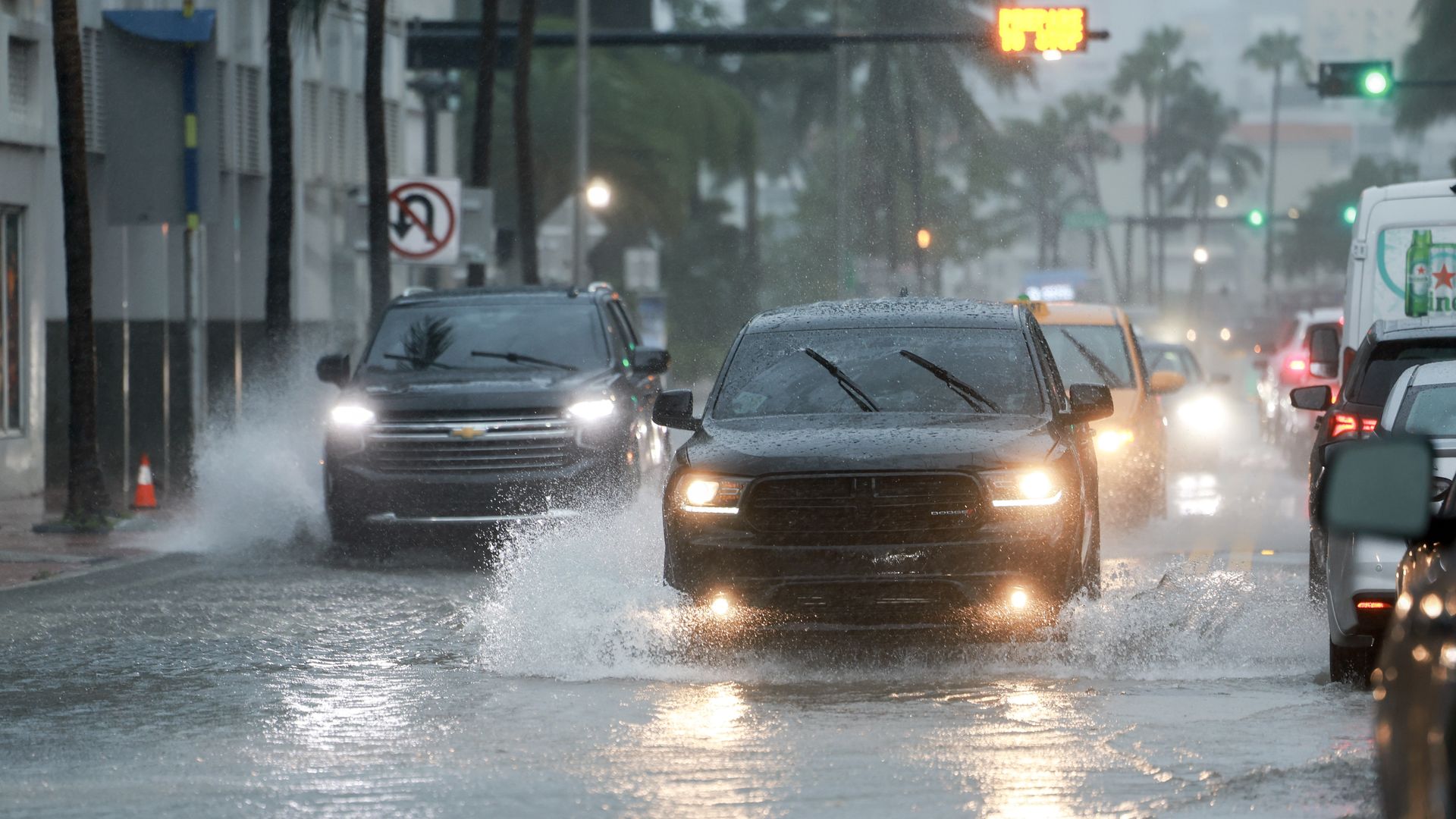
A rare deluge struck the Fort Lauderdale-to-Miami corridor yesterday into early this morning, and more rain is expected to fall today.
The big picture: More than a foot of rain fell across parts of South Florida yesterday, causing widespread, life-threatening flash flooding.
- Two-day rainfall totals across the region have hit nearly 20 inches.
Threat level: The NWS reports that 10 to 15 inches of rain fell yesterday in the heavily populated region, and warned this morning that more heavy rain is expected today.
- It would only take light to moderate showers to worsen flooding, the agency stated, and several more inches of rain are in store for some areas.
Context: The rains are the result of a firehose of tropical moisture flowing from the unusually hot waters of the Gulf of Mexico.
- As the climate warms, extreme precipitation events such as this one are becoming more frequent and intense, studies show.
- This is because warmer air can hold more moisture that storms can wring out as heavy precipitation.
The bottom line: South Florida is not out of the woods yet.
6. ☀️ Number of the day: $1,987
That represents the median annual energy bill savings for adopters of rooftop solar, per a new peer-reviewed analysis from Lawrence Berkeley National Lab researchers.
- But "off-bill" costs like loan repayments reduce that figure to $691. Full paper.
📨 Did a friend, colleague or even a frenemy send you this newsletter? Welcome, please sign up.
🙏 Thanks to Chris Speckhard and Javier E. David for edits to today's edition, along with the brilliant Axios Visuals team.
Sign up for Axios Generate