Axios Generate

May 14, 2024

✅ Tuesday. We've got a brisk and newsy 1,036 words, 4 minutes.
⚡ ICYMI: FERC, as we previewed yesterday, passed sweeping rules to boost transmission and grid modernization.
- Why it matters: The policies will unlock more low-carbon sources and make the grid more reliable, backers say. Full rules...AP coverage
🎸 The Steve Miller Band dropped the album "Fly Like an Eagle" this week in 1976, and their talent shines all around us with today's intro tune...
1 big thing: Biden's China gamble
By trying to stem the tide of cheap Chinese climate technology without slowing U.S. decarbonization, the White House is betting it can have its cake and eat it too.
Why it matters: It's an environmental gamble as officials unveil higher tariffs on Chinese electric vehicles, steel, batteries, solar cells, critical minerals and more.
- It's an economic gamble, too, as the administration predicts it won't raise consumer costs.
The intrigue: And it's a political bet. President Biden could boost support in states including Michigan, a major auto hub.
- But he's also fighting on terrain presumptive GOP nominee Donald Trump relishes: trade restrictions and being tough on China.
Driving the news: The White House is quadrupling penalties on EVs from China to 100% to prevent low-cost Chinese models from getting a beachhead here.
- Biden, in a Rose Garden speech today, will also announce tariffs on Chinese tech that's already here in abundance.
Zoom in: Duties on EV batteries will rise from 7.5% to 25% this year, while tariffs on batteries used in energy storage will see the same spike in 2026.
- Tariffs on solar cells will rise from 25% to 50% this year. Tariffs on natural graphite and permanent magnets would go from 0% to 25% in 2026.
- Certain other "critical mineral" tariffs would see new 25% penalties this year.
- It comes alongside new or higher penalties on semiconductors, certain cranes and medical products, and more.
The big picture: The move comes as the 2022 climate law and other policies are spurring massive investments in U.S. manufacturing of low-carbon tech, but competition with China is fierce.
- The White House alleges "unfair" Chinese trade practices that flood the market are a threat.
- "The president knows it is vital to invest in American manufacturing and workers and to enforce our trade laws to give our workers and businesses a fair chance to compete," National Economic Council head Lael Brainard told reporters.
What they're saying: The United Auto Workers union said it "applauds today's decisive action from the White House on ensuring that the transition to electric vehicles is a just transition."
What we're watching: The response to the tariffs from China, U.S. industries — and Trump.
2. Zoom in: China's battery export growth
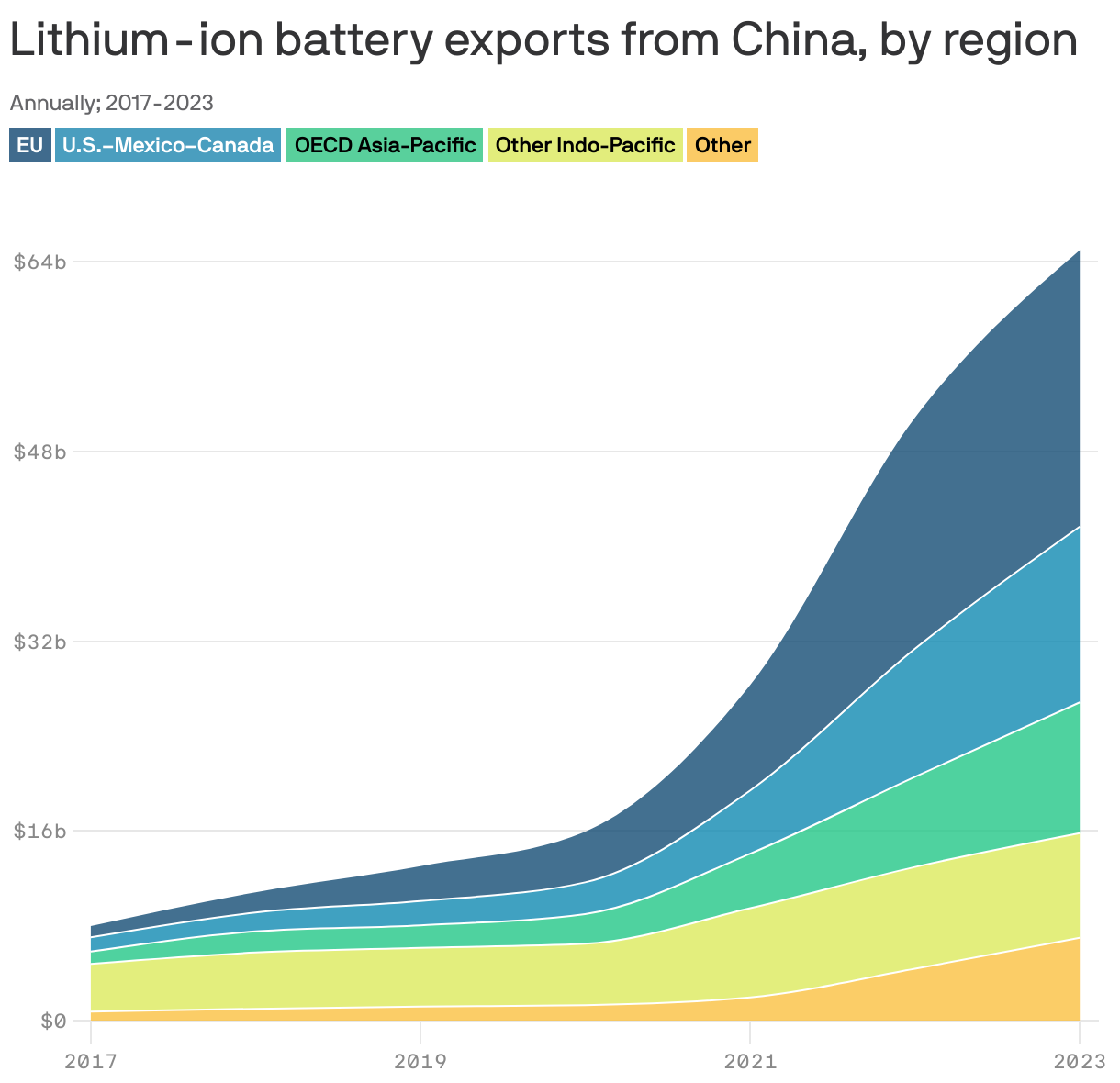
This chart shows the dramatic rise of Chinese battery exports to the U.S. and other nations in recent years.
Why it matters: China's industry creates climate opportunities but also security risks for the U.S. and allies, the Atlantic Council's Joseph Webster writes in a smart new post.
The big picture: He notes the storage and transport applications help the U.S. cut carbon.
- But allowing China to dominate the sector "hollows out US manufacturing capacity and know-how," and simultaneously could allow Beijing the chance "to grow in capacity and provide synergies with its submarine and drone-making capabilities," Webster notes.
- "This rise in industrial capacity could prove significant in military contingencies involving Taiwan," he writes.
Zoom in: The vast majority of North American imports shown above come to the U.S.
What's next: Webster counsels a "balanced" approach.
- He says Washington should act when Chinese batteries present security risks to the U.S. and allies.
- Yet given climate needs, officials should only move against near-term imports when there's a "compelling reason," even while creating a "friend-shored" supply chain.

3. What they're saying: data centers and power
Data center-driven growth in power use is an ongoing story Generate is covering, so here are a couple things on my radar over the past 24 hours.
💬 Brook Porter of the VC firm G2 Venture Partners tells Axios Pro's Katie Fehrenbacher that it's a new landscape.
- The big picture: Data center operators are "saying they'll take whatever power they can get at whatever pricing they can get."
- Why it matters: "This is a first for the energy industry. We've never had the demand, particularly for low carbon energy, unconstrained by price."
- Go deeper: Talk to our sales team about Axios Pro: Climate Deals for a steady diet of smart analysis and scoops.
🗞️ Energy Intelligence has a nice look at natural gas producers feeling optimistic — with some caveats — about serving AI-driven energy thirst.
- What's next: It cites predictions that data center hot spots will emerge in "close proximity to natural gas basins" while also benefiting producers with pipeline access further afield.
- The intrigue: In one sign data centers are changing the equation, research firm East Daley Analytics no longer expects production declines in "tier 2" basins like the Anadarko, West Rockies and Barnett Shale.
4. Catch up quick on business: Mining and EVs
⛏️ Anglo American today unveiled major restructuring plans that include divesting its metallurgical coal business while maintaining strong focus on copper.
- Why it matters: The company, which has rejected recent takeover bids from mining giant BHP, said the moves will position it for the energy transition. Reuters has more.
↪️ Via Bloomberg, "Tesla Inc. has begun hiring back some of the almost 500 members of its Supercharging team that Chief Executive Officer Elon Musk dismissed late last month."
5. More policy news! Hydrogen, permitting, uranium
🚨 Breaking: Green hydrogen developer Plug Power has secured a conditional commitment for up to $1.66 billion in Energy Department loan guarantees, Axios Pro's Katie Fehrenbacher scooped today.
- Why it matters: It's the largest hydrogen deal yet from DOE's loan programs office and is designed to support up to six U.S. projects.
- The big picture: In a world of high interest rates, developers have been holding back because projects are expensive and buyers often hard to find. DOE's guarantees can help companies access low cost financing. Full story.
🛑 Big permitting legislation looks dead this year, Senate Majority Leader Chuck Schumer said.
- State of play: "I'm happy to listen, but I've told Joe Manchin it's going to be virtually impossible to get something done," Schumer told reporters yesterday. Manchin, who leads the chamber's energy committee, has been working with ranking Republican John Barrasso.
- Why it matters: Faster permitting could help speed both low-carbon and fossil fuel projects, but measures that address both sides of that equation face huge political hurdles. Go deeper via Axios' Nick Sobczyk.
⚛️ President Biden signed a bipartisan bill yesterday banning imports of Russian enriched uranium, with waivers for companies to continue until 2028, Axios' Sareen Habeshian reports.
- Why it matters: The law cuts off a revenue source as Vladimir Putin's forces escalate their war on Ukraine. Full story.
📫 Did a friend send you this newsletter? Welcome, please sign up.
🙏 Thanks to Chris Speckhard and Javier E. David for edits to today's edition, along with the talented Axios Visuals team.
Sign up for Axios Generate