Axios Future of Energy

April 10, 2026

πΊ Friday. We're closing the week with...
- A double dose of Iran war analysis
- EV news, power prices, Chris Wright's climate compliment (sort of) and much more, all in 1,395 words, 5 minutes.
π Thanks to Chuck McCutcheon, David Nather and Chris Speckhard for editing and to our brilliant Axios visuals team.
πΈ This week in 1982, pop craftsmen Squeeze dropped a perfect single that's today's intro tune...
1 big thing: Oil-price disconnect obscures energy shock
As high as those oil prices flashing on TV are, underlying market conditions are even worse β and so is the unfolding global economic pain.
Why it matters: Headline-grabbing futures prices β bets on where oil prices are headed β are far below the cost of increasingly scarce physical shipments.
- This disconnect can obscure how dire things are in the unprecedented energy shock that will take a long time to unwind.
Zoom out: Futures contracts are often traded among parties that never obtain oil, and also used by companies to hedge price risk.
- But lots of today's turmoil is rooted in physical, or spot, markets for commodities now in short supply.
Zoom in: An example of dissonance is that "Dated Brent," one physical grade refiners buy, hit a record $144 per barrel this week.
- But Brent futures topped out briefly at roughly $120 last month and are now in the $95 range β even as the Strait of Hormuz remains bottled, and Mideast producers have cut output by roughly 10 million barrels per day.
- Futures haven't approached 2008's $147 record, or even hit the roughly $122 peak after Russia attacked Ukraine β a crisis that took comparatively tiny amounts of oil off the market.
Friction point: Analyst Vandana Hari sees market failure.
- "In the long run β¦ the broken futures market risks becoming the exclusive playground of speculators, a hive of insider trading, but useless for hedging physical barrels," she posted on X.
Between the lines: There's no single reason why futures β both the front month trade and the longer forward curve β are so chill compared to physical prices.
- Nobody knows what to make of such a historic disruption.
- A portion of the market believes the whole thing is "too big to fail," Neil Crosby, an analyst with market data and intelligence firm Sparta Commodities, told Axios.
- On the other side, some traders see looming "demand destruction" that brings prices down the painful way.
And don't sleep on the Trump factor. Traders are hesitant to bet on higher prices when a single social media post can bring big downward market swings, Columbia University's Daniel Sternoff said.
What we're watching: U.S. oil producers.
- "As it becomes clear that the forward curve does not reflect the magnitude of the supply disruption and prices may be 'higher for longer,' some producers have begun to discuss rig additions," Rystad Energy's Jai Singh said in a note.
2. π The new oil world order
The energy shock from the Iran war may drive long-lasting change in how the global multitrillion-dollar oil market operates β turning a relatively open and smoothly functioning system into something weaponized and fractured.
Why it matters: Such a reordering would mean, at a minimum, higher energy prices and inflation, and in the long term could even shake the foundations of the dollar-based global economy and with it, U.S. power.
The latest: Iran still has the critical Strait of Hormuz effectively locked down, and oil prices have resumed climbing.
- The price of oil is now about 50% higher than before the war began.
- And prices in the physical market for oil are at record highs as countries and companies compete for increasingly scarce barrels.
The big picture: This is "the mother of all supply chain disruptions," Dan Yergin, author of "The Prize: The Epic Quest for Oil, Money and Power" and vice chairman of S&P Global, tells Axios.
Flashback: Such shocks in the past have led to permanent changes in the global economy, and there's little reason to think this one would be different.
- The pandemic drove a push among countries to reshore manufacturing.
- The Ukraine war forced European countries to reduce dependence on Russian natural gas.
- The 1970s oil crisis got Americans to actually drive small cars.
3. π Catch up quick: EVs, Ukraine, batteries, mining, methane, Arizona
π VW will stop producing the electric ID.4 at its plant in Chattanooga, Tennessee, which will focus on the gasoline-powered Atlas SUV.
- Why it matters: It's a sign of the times, with the automaker noting the EV market "continues to challenge the industry."
- Yes, but: Existing ID.4 inventory will remain available in the U.S., and a new version is planned, VW said. Go deeper.
πΊπ¦ Ukraine's largest private energy company announced an MOU with Baker Hughes aimed at accelerating natural gas production in Ukraine.
- Why it matters: DTEK said the deal was signed at last month's CERAWeek conference, which CEO Maxim Timchenko attended to try to drum up business as his company copes with the massive Russian-inflicted damage.
πͺ« Ascend Elements, a battery recycling startup, is filing for Chapter 11 bankruptcy reorganization, Bloomberg reports.
βοΈ Venezuela's National Assembly gave final approval to a mining law aimed at luring outside investment, the NYT and other outlets report.
πͺπΊ The EU will relax methane emissions rules on gas imports as governments "scramble" for additional supplies amid the Iran war, the FT reports.
π³οΈ Axios' Jeremy Duda has a nice look at the intense political fight that gave the "clean energy team" a majority on the board of an Arizona utility giant.
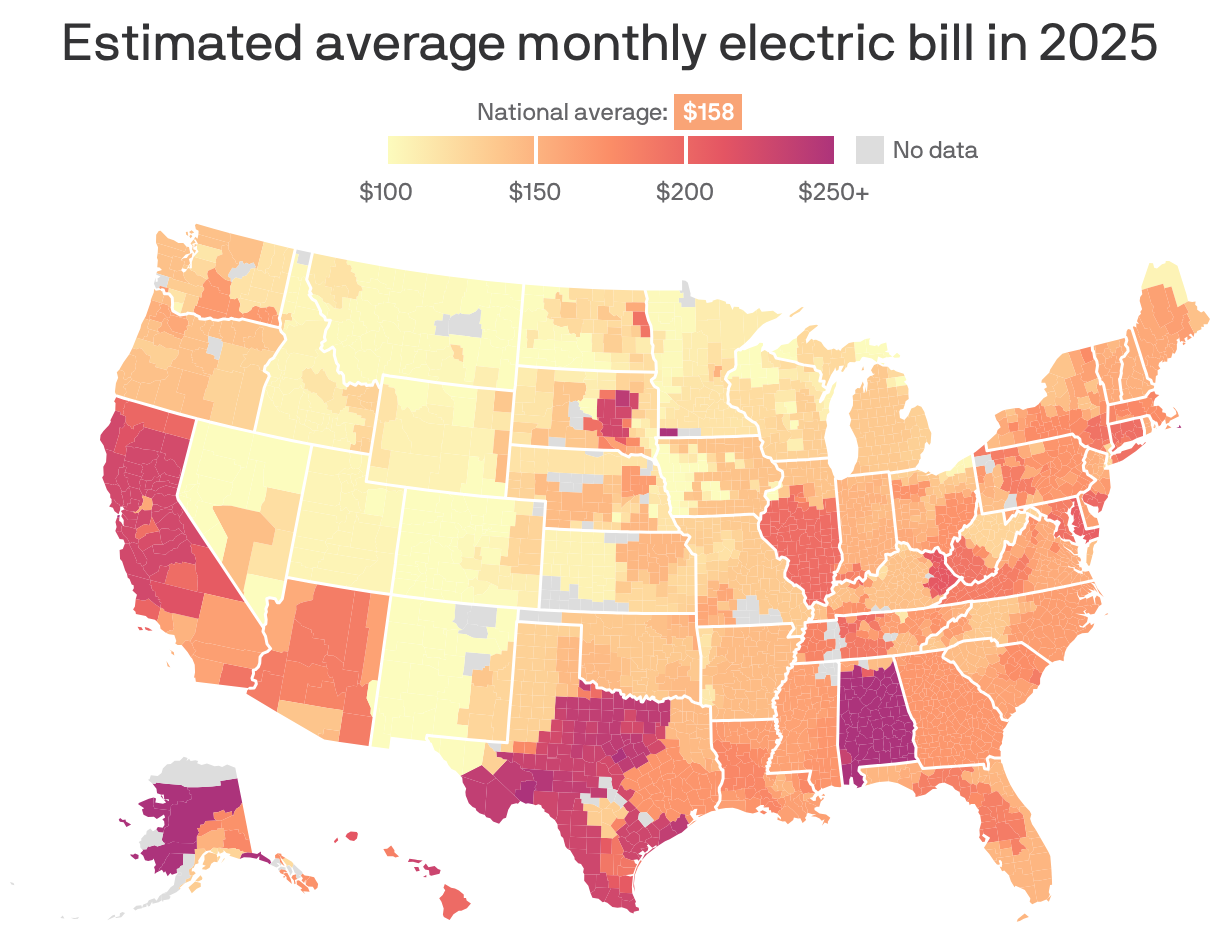
4. πΊπΈ Mapped: America's highest electric bills

Americans are spending an average estimated $158/month on their home electric bills, per a new Axios analysis of data collected and shared by climate newsroom Heatmap News.
Why it matters: Tensions over rising energy bills and power-hungry AI data centers are emerging as a key political issue.
Zoom in: Nantucket County, Massachusetts ($296); San Francisco County, California ($282) and Nobles County, Minnesota ($273) had the highest estimated average monthly electric bills in the continental U.S. across 2025.
Zoom out: Counties in Alabama and Texas dominate the top of the most-expensive list, broadly speaking.
- Costs are also higher than average in many parts of Alaska, whose isolation and geography often drives up prices across the board relative to the lower 48.
5. π Toyota shows up fashionably late to the EV party

Toyota spent years drawing criticism for its hybrid-centric strategy while rivals went all-in on EVs.
- Now, the party is winding down, but here is Toyota, showing up with four new EVs for 2026.
Why it matters: Toyota is playing catch-up, but it hasn't really changed its strategy to offer a mix of hybrid, electric and gas vehicles.
- Until recently, however, it had only one mediocre EV in its lineup.
- By the end of this year, it will offer four much more competitive models.
Driving the news: Toyota recently launched three electric SUVs: the 2026 bZ, the compact C-HR, and the off-roading bZ Woodland.
- Later this year, the family-friendly, three-row Highlander EV will join Toyota's lineup.
Between the lines: Toyota's first EV, the bZ4X, was a rare screwup for the Japanese carmaker known for reliability and quality.
- The 2026 bZ is a significant improvement over its predecessor, with a 25% increase in driving range (now up to 314 miles).
6. π Hot reads: Permitting, states, nuclear

Outcomes and timelines for state-based energy facility permitting in the United States (Frontiers in Sustainable Energy Policy)
Chuck says: As federal permitting delays for wind and solar projects stir debate, a group of researchers finds that state-permitted projects are green-lit much more swiftly β in roughly a year β and that nine in 10 are approved.
State Climate Laws Targeted Around US as Iran War Spikes Gas Prices (Bloomberg)
Amy says: This trend of blue states retreating on climate policies in the name of the war turns upside down one theory that prolonged conflict could boost clean energy. The (at least) perceived nature that climate policies are unaffordable is trumping that.
The Economics of Diablo Canyon: Maximizing Pollution Reduction While Protecting California Ratepayers and Taxpayers (UC Santa Barbara 2035 Initiative)
Chuck says: Three academics accuse PG&E of inflating costs when seeking a state loan for California's Diablo Canyon nuclear plant and say the utility should have requested a loan for hundreds of millions of dollars less. (PG&E denies doing so.)
7. π¬ Quote of the day: Silver linings edition
"Sadly, it's the climate change movement and the overhyping of climate change that has brought your generation and younger to be pro-nuclear. So ... I would say that's a positive side effect of a very aggressive climate movement."β Energy Secretary Chris Wright on the Katie Miller podcast this week
π« Did a friend send you this newsletter? Welcome, please sign up.
Sign up for Axios Future of Energy