Axios Future of Energy
April 09, 2026

📡 The weekend is appearing on radar. Let's get closer with quick and newsy reads on...
- Carbon removal money
- Oil flows (or not) and prices
- Lots of state news, the latest on tech finance and more, all in 1,185 words, 4.5 minutes.
🔮 "The Axios Show": Kalshi founders Tarek Mansour and Luana Lopes Lara talk prediction markets vs. gambling, insider trading and Donald Trump Jr. with Dan Primack. Watch on YouTube.
🌶️ This month marks 20 years since the Red Hot Chili Peppers released today's intro tune...
1 big thing: Exclusive — JPMorgan's carbon removal deal that's also wildfire prevention
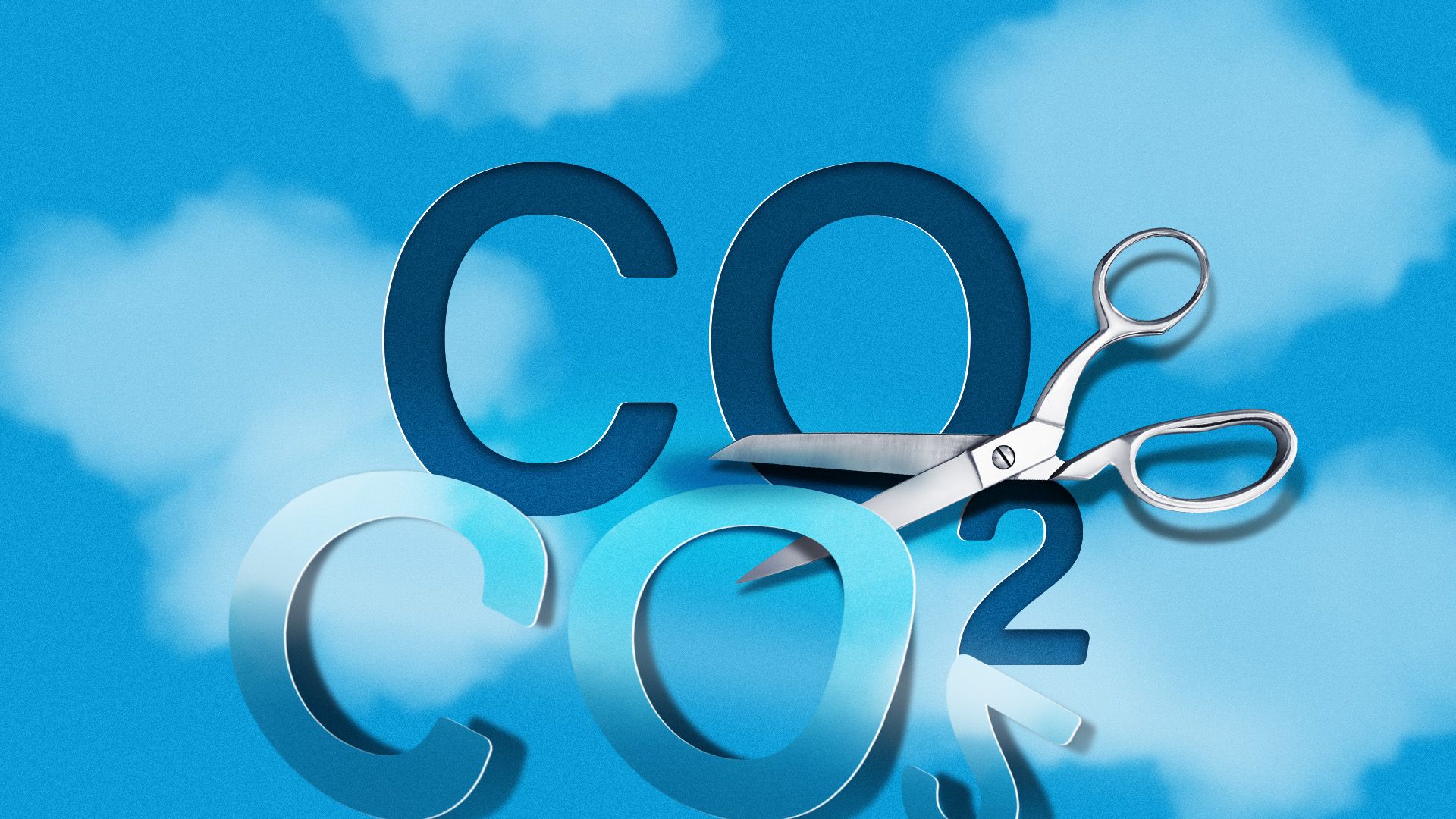
JPMorganChase has inked a deal with a startup to remove carbon from the air — a step that could also prevent wildfires, Axios has learned.
Why it matters: The purchase signals that the carbon removal industry is pushing ahead despite policy setbacks — and highlights how near-term benefits can help drive deals.
Driving the news: Graphyte, a carbon removal company founded in 2023, will supply 60,000 tons of removal credits over 10 years from an existing Arkansas project and a planned facility in Arizona enabled by the deal.
- Financial terms weren't disclosed.
The big picture: Carbon removal — which pulls CO₂ from the atmosphere — is seen as critical to meeting climate goals.
- But the market is still in its early stages and has faced setbacks as President Trump rolls back supportive policies.
How it works: Graphyte's technology compresses agricultural and forestry waste and stores it underground to keep carbon from re-entering the atmosphere.
The intrigue: The Arizona facility would use material from forest thinning projects, which reduce wildfire risk but often lack strong commercial markets.
- Taylor Wright, JPMorgan's head of operational sustainability, cited Graphyte's proven technology as one reason behind the deal.
- But "equally as important for us is looking for projects that go beyond just delivering carbon benefits," Wright said, citing the wildfire prevention and local economic growth potential.
- "We can create a market for that [forest] material by converting it into durable carbon removal," said Barclay Rogers, founder and CEO of Graphyte.
Between the lines: Climate startups are increasingly emphasizing co-benefits like wildfire prevention and jobs as federal support wanes.
- "I say this in DC a fair bit: Say what you will about climate change, but I think we can all get behind the idea that you need to reduce the wildfire risk in the West," Rogers said. "And we can create jobs in rural places in doing so."
By the numbers: The 60,000-ton deal is the largest publicly known purchase for Graphyte and roughly in line with mid-sized carbon removal agreements JPMorgan has struck with other suppliers.
- Graphyte aims to remove up to 5 million tons of carbon dioxide by 2030.
Reality check: Those amounts are still tiny relative to the broader climate challenge: the U.S. emits roughly 5 billion tons of CO2 each year.
- Smaller deals like these are seen as critical early steps in scaling a nascent industry that would need to grow dramatically to make a meaningful dent.
Friction point: The lack of federal policy is making scaling harder, said Rogers, noting that an existing tax credit for capturing carbon doesn't apply to methods like Graphyte's.
What's next: The Arizona facility should begin operating next year.
2. 😮 Charted: A historic oil disruption


This graphic ☝️ via data from Baringa Partners, a consulting firm, gets to the stunning scale of the oil shock from the Iran war.
Why it matters: Baringa economist Caspian Conran said the conflict leaves Iran in a stronger geopolitical position despite U.S. military success.
- That's from "being able to turn on and off flows through the Strait at will, and no doubt demanding a price for safe passage," he posted on LinkedIn.
3. 🛢️ Oil climbs anew as Strait of Hormuz remains stifled


Crude oil prices are heading back toward $100 per barrel after the plunge earlier this week that followed the U.S.-Iran ceasefire.
Why it matters: The partial reversal of the steep selloff shows that shippers lack confidence in safe passage and understanding of conditions Iran will impose.
What they're saying: "[L]et's be clear: the Strait of Hormuz is not open. Access is being restricted, conditioned and controlled," Sultan Ahmed Al Jaber, head of UAE state oil giant ADNOC, said in a statement today.
The latest: Brent crude futures, which fell as low as $91-ish per barrel earlier this week, are trading at $97.77 this morning, with the U.S. benchmark WTI at $98.74.
The bottom line: "[W]e think the mechanics of reopening the Strait will be exceedingly messy, with Iran potentially having a vote on nearly every barrel that exits the waterway until Gulf countries can build more alternative access routes," RBC Capital Markets said in a note.
4. 🏃 Catch up quick on state policy
⚛️ New Jersey Gov. Mikie Sherrill signed legislation "that would alter the permitting process for new nuclear power facilities to remove what the administration called a de facto moratorium on new plants," the New Jersey Monitor reports.
🗳️ In Arizona, candidates running as a "clean energy team" won control of the board of the state's largest public utility, the NYT reports.
💵 Via North Carolina's WUNC, "Gov. Josh Stein is asking a state energy policy task force to recommend overhauling or repealing a data center sales tax exemption that state officials say could cost the state hundreds of millions of dollars in coming years."
5. 🗞️ Tech finance news: Fusion, climate, ocean mining

⚛️ The Energy Department's loan office is conditionally offering fusion company SHINE Technologies up to $263 million to help build a medical isotope production facility in Janesville, Wisconsin.
- Why it matters: It would be the largest such plant in the world, the company said. And medical business lines are a way to help fusion players generate revenue and move toward commercial power.
🌎 Evok Innovations, a Canadian VC firm focused on climate, is targeting US$400 million for its third fund, Axios Pro has learned.
- Why it matters: The fund will seek to fill a persistent funding gap for green startups seeking to scale beyond the lab. A first close is expected in Q3.
- Catch up quick: Recent investments include water-treatment membrane producer ZwitterCo, geologic hydrogen startup Koloma, and geothermal energy developer Rodatherm.
🌊 American Ocean Minerals, a Houston-based deep-sea mining company, agreed to a reverse merger with Odyssey Marine Exploration.
- Why it matters: The U.S. needs to find new sources of critical minerals for batteries and other industrial and national security applications, so that it can't be choked off by geopolitical conflict.
- State of play: AOM, led by ex-Rio Tinto CEO Tom Albanese, is focused on finding polymetallic nodules in waters near the Cook Islands.
6. ⛏️ Number of the day: $60 billion
That's the combined 10-year public and private funding needed to diversify rare earth magnet supply outside of China, per new IEA analysis.
Why it matters: Demand is rising for rare earth magnets needed in energy infrastructure, and China isn't shy about imposing export controls.
7. 💬 Quote du jour: Zeldin zinger edition
"We aren't just following blind obedience to whatever the dire, doom-and-gloom prediction of the day is from John Kerry or Al Gore or AOC."— EPA Administrator Lee Zeldin, speaking yesterday at a conference organized by the Heartland Institute, a group that rejects mainstream climate science. Zeldin is seen as a leading candidate for attorney general.
🙏 Thanks to Chuck McCutcheon, David Nather and Chris Speckhard for editing and to our brilliant Axios visuals team.
📫 Did a friend send you this newsletter? Welcome, please sign up.
Sign up for Axios Future of Energy