Axios Future of Defense
November 17, 2026

Yo! Busy week ahead. Of course, stoked to see y'all Thursday.
- In town ahead of our summit and want to link? Reply to this email.
🧠 Situational awareness: The Defense Department has rebranded the Chief Digital and Artificial Intelligence Office, established in 2022, as the Super Intelligence Office.
Hot 'n' fresh: Valkryn's stealth exit, Merlin's Africa plans and Estonia's border.
Today's newsletter is 1,854 words, a 7-minute read.
1 big thing: Now arriving ...
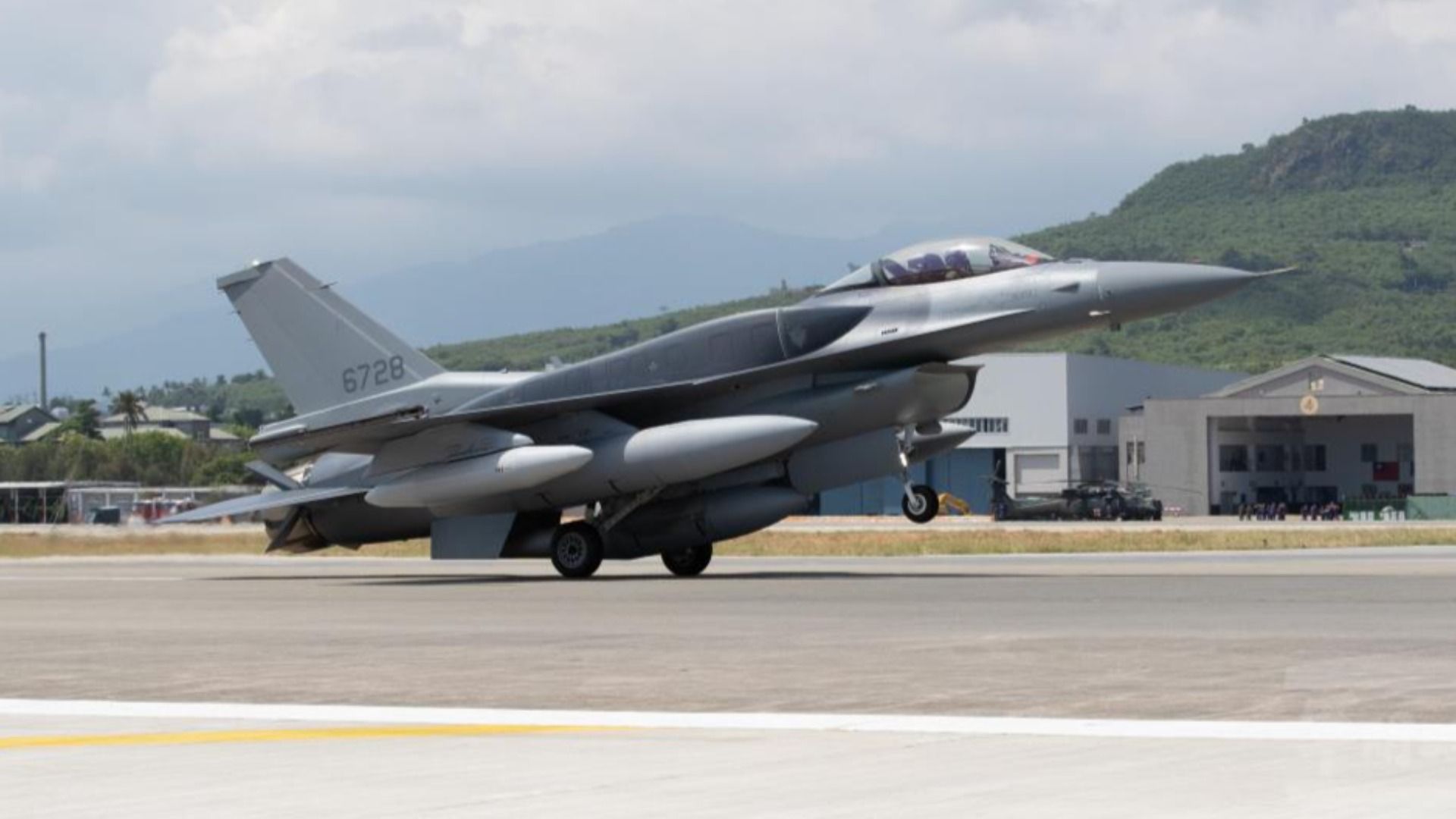
A handful of new F-16 Block 70s have arrived in Taiwan from the U.S. It's been years in the making — and dozens more are outstanding.
Why it matters: The delivery of these Lockheed Martin-made fighter jets comes as the island's political parties scrap over what to spend on which weapons and why, and as Chinese belligerence hardens regional resolve.
- Their arrival also marks progress in relieving a $30 billion backlog of weapons Taipei sought from Washington. But slipping schedules raise broader questions about whether the arms delivered today will be effective tomorrow.
What they're saying: "The defense wonk angle here is 'It took a long time,' with the challenges the defense industrial base is facing" and the demands of conflicts elsewhere, one former Pentagon official told me.
- "Something's getting across the finish line, or at least starting to get across the finish line, and I think that's worth noting," the official added.
- Still, "Five is great, but that's just a fraction of what was promised."
Catch up quick: Two batches of F-16s — three this month and two in October — have landed so far at an air base near Taitung. A total of 66 are on order.
- National Security Council Secretary-General Joseph Wu on Nov. 8 shared footage of the approaching warplanes on X, saying: "Welcome home!"
Follow the money: The U.S. approved a multibillion-dollar sale of F-16s to Taiwan in 2019, with deliveries expected to begin in 2023.
- A Lockheed spokesperson told me the company is "committed to delivering mission-critical deterrence capabilities that support U.S. policy objectives and Taiwan's security goals," but referred questions about schedule and potential usage of the jets to the respective governments.
Threat level: China considers Taiwan a renegade province and seeks to bring it under its control. U.S. military officials have warned China could attempt a takeover as soon as next year.
- A spokesperson at Taiwan's de facto U.S. embassy told me maintaining the "status quo in the Taiwan Strait remains Taiwan's unwavering goal" and the "ability to procure and receive up-to-date equipment" like the F-16 Block 70 is an "essential part of achieving peace through strength."
- "Facing a growing challenge," the spokesperson added, "we will continue to strengthen our national defense accordingly, and deepen cooperation with like-minded partners in our region."
Zoom in: The U.S. has for decades armed Taiwan, angering China. But holdups have been a sore spot in the relationship — and served as red meat for the Beijing-friendly Kuomintang party.
- The political climate in Taipei "is such that the opposition KMT has tried to use these delays to argue about the unreliability of procurement from the United States and to try to poke holes in President [Lai Ching-te's] request for new special budgets," David Sacks at the Council on Foreign Relations told me.
- "Their narrative is, 'If the United States can't deliver what we've already paid for, why should we spend more money on things that we're not sure will ever be delivered?'"
What we're watching: If and when the Trump administration releases to Taiwan a $14 billion weapons package lawmakers greenlit almost a year ago.
Go deeper: Taiwan frets as U.S. withholds weapons
2. Exclusive: Chunmoo trial
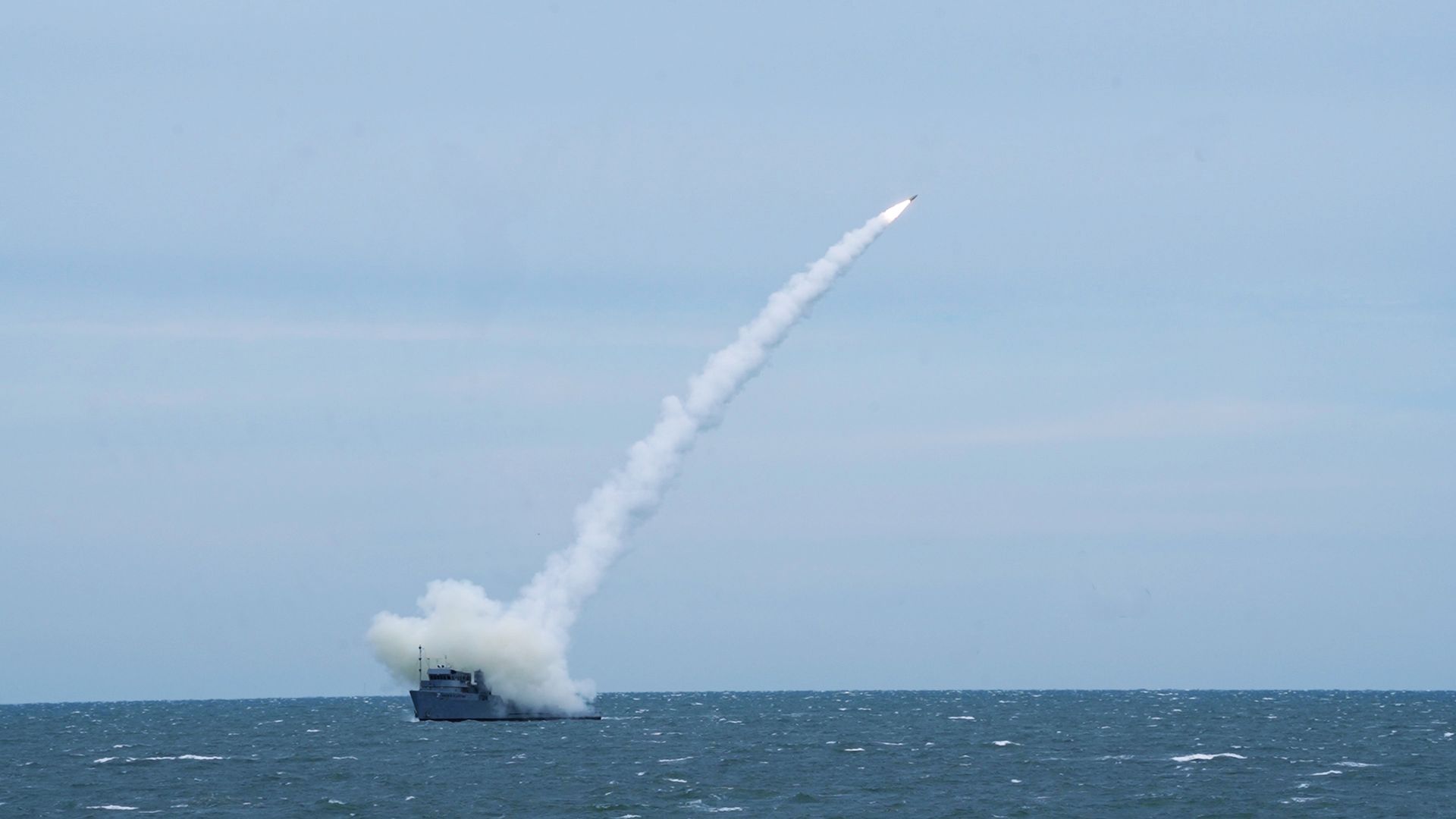
Hanwha Defense USA alongside its parent Hanwha Aerospace on Sunday test-fired a Chunmoo missile from a vessel off the Mississippi coast.
Why it matters: The U.S. Navy is hungry for modular, affordable weapons it can drop onto and pull off warships, manned or unmanned.
- This is the first time a Chunmoo system — typically used on land — has been brought to the U.S.
Driving the news: One photo from the test I reviewed showed a four-missile pod launcher aimed over the water, off the back of The Spaceport Company's Once in a Lifetime ship. Other images showed the munition exiting and arcing over the Gulf of America.
Zoom in: The trial, in the works for 11 months, according to executives, gave Hanwha a close look at:
- The effects of firing a missile from a smaller ship;
- The design demands of containerized or palletized launchers;
- Fire-control needs.
What they're saying: "I'm big believer of crawl, walk, run. I hate doing stunts just to do a stunt. I want to have something that I'm learning from," executive vice president for missiles Kevin Schoonover told me.
- "I can tell you firsthand, shooting missiles off a vessel of that size in sea state two is not easy."
The intrigue: A Magnet Defense research craft helped track and evaluate the launch. The company is working with Hanwha to build medium unmanned surface vessels.
- The first prototype is being manufactured now.
Go deeper: Navy unveils "ShipOS" with Palantir to speed up shipbuilding
3. Defense-tech testers

Valkryn exited stealth with $17 million raised and a workforce with ties to some of America's buzziest businesses — including Applied Intuition, Palantir Technologies and SpaceX.
Why it matters: The Washington-based startup wants to help call the balls and strikes of defense tech by serving as a neutral auditor of the robotic and autonomous systems troops are increasingly wielding (and being threatened by).
- "Test is scarce. It's really hard to do. It's really rare to do," co-founder Hugh Zabriskie told me.
- "Companies wait months for an opportunity to demonstrate themselves," he said. "There's a lot of talk about being more adaptable and moving faster. Ultimately, that is on the back of test capacity, proving capacity."
State of play: Valkryn today is advertising:
- "Battle Lab" technology, which instruments real-world tests of autonomous systems under realistic combat conditions and measures how they perform.
- Quickly available test records and scoring measured against government criteria to help officials figure out which UAV, UGV or USV is the best fit.
"The reason there is often such a large gap between claimed performance — I'm sure you've seen this — and real performance is that there is such a lack of ability to understand that performance in the first place," Zabriskie said.
- "We primarily operate on the fact that the government already has a massive outlay of land and airspace, and this is a resource that is fundamentally underutilized."
Between the lines: This all hinges on an unbiased track record — plus test, evaluation and training dollars.
- "Neutral means we don't build the systems that are under test," Zabriskie said.
The intrigue: Valkryn recently worked with a task force in the Middle East. Additional details are scarce.
Follow the money: The startup's $15 million seed was led by Andreessen Horowitz. Ambition Capital, Caffeinated Capital and Cantos Ventures participated.
- It previously raised a $2 million pre-seed.
The bottom line: "With this growing ocean of robotic and autonomous systems, we're reaching a breaking point," Zabriskie said.
- "Traditional testing is very event-based and waterfall-based," he added. "The future is very clearly continuous."
Go deeper: Musk returns to Trump world for Pentagon war study
4. AFRICOM evac
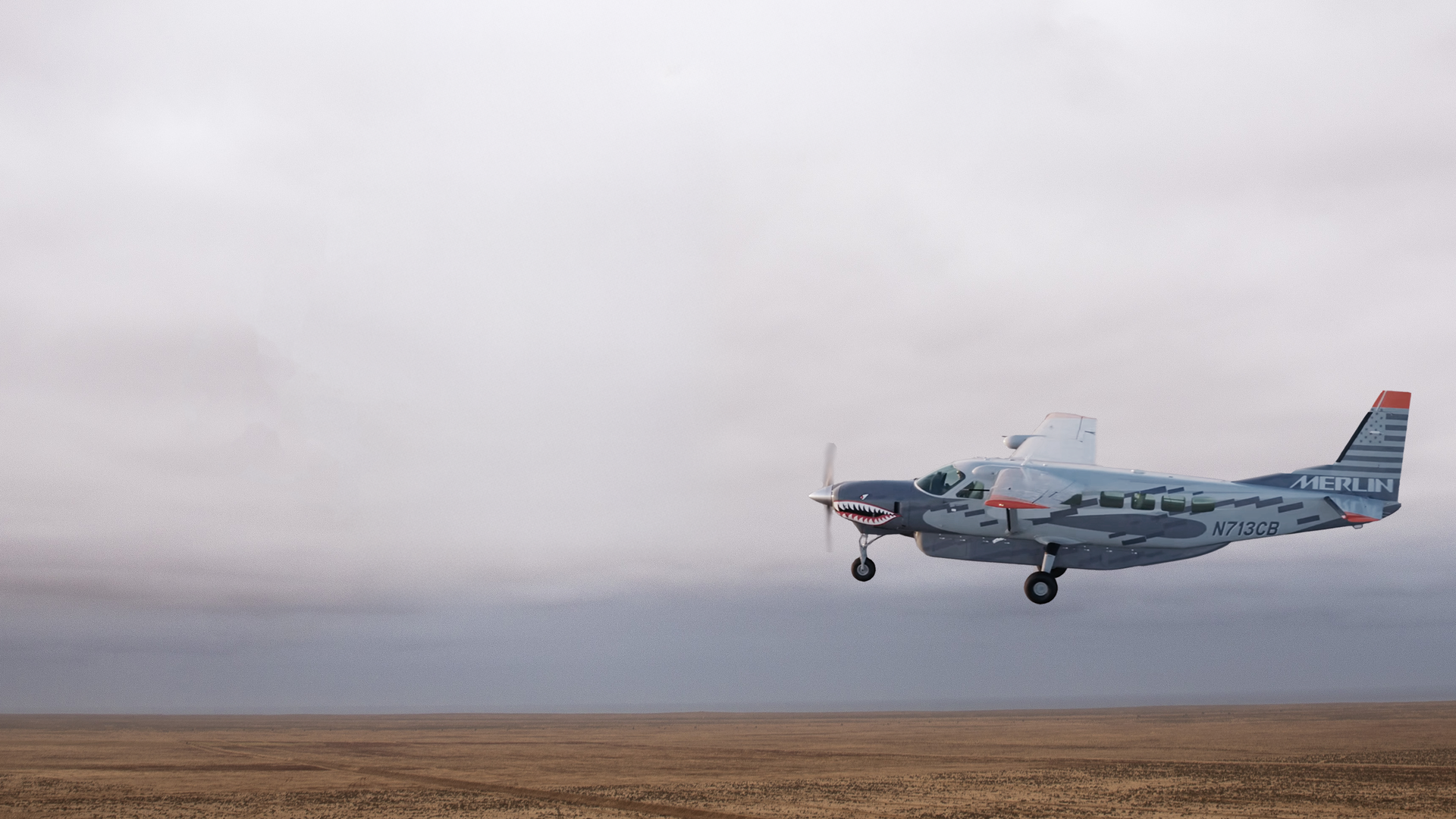
Merlin will soon participate in an autonomous casualty evacuation demonstration in Morocco, under a $500,000 contract with U.S. Africa Command.
Why it matters: American military resources on the continent are sparse, especially compared with Europe or the Asia-Pacific.
Driving the news: Merlin last week announced the run of show, which includes:
- Initial tasking and flight planning
- Autonomous departure and flight to an "austere casualty collection site"
- Simulated patient loading
- An autonomous return flight and landing
What they're saying: "The military has a real problem — it needs to move people and supplies over longer distances, often where communications are unreliable, without putting more crews at risk. Autonomy can help solve that," chief executive Matt George told me.
- "This isn't a someday capability. We believe it's ready to prove out now."
Zoom in: Merlin will use a Cessna 208B Grand Caravan for the demonstration.
- It features a large cargo door and a flat-floored cabin, and will be configured with an air ambulance module providing oxygen and power.
Friction point: China and Russia have expanded their influence across Africa.
- Chinese, Russian and Iranian warships gathered off South Africa early this year for the Will For Peace naval drills.
- Meanwhile, the most recent U.S. National Defense Strategy mentioned "Africa" only twice.
More from Axios:
The American war too few talk about
5. Quick hits

🔒 Estonia will close its border crossings with Russia on Dec. 1, according to its foreign affairs ministry. "Russia's attempts to intimidate, destabilize or undermine our security," it said on X, "will come with a price."
- Why it matters: The decision follows a failed arson attack on Estonian defense contractor Threod Systems. It was allegedly orchestrated by Russia's GRU intelligence service.
- 💭 My thought bubble: Estonia's former ambassador to the U.S., Kristjan Prikk, once told me the Russia-Ukraine war is "not only about territory."
🏗️ Hadrian acquired Kutztown Foundry & Machine in Pennsylvania and plans to invest some $300 million to "massively upgrade" the site, to be known as Factory 6, chief executive Chris Power told reporters.
- Why it matters: "We'll be feeding the submarine program, both steel and critical castings made from that steel, from day one," he said. "This is massive, massive, massive heavy industry."
- 💭 My thought bubble: Hadrian was valued just shy of $8 billion this summer, after a $1.37 billion raise. More on that here.
👀 Northrop Grumman and Hermeus have partnered, with plans to develop and deliver "a new class of autonomous, high‑Mach aircraft." The former's announcement mentions "months, not years."
- Why it matters: The two companies have plenty of airframe, autonomy, electronic warfare, sensing and networking expertise.
- 💭 My thought bubble: Remember Ramjet-X? And remember how Hermeus got the green light to manufacture Pratt & Whitney's F100 engine?
🤖 Path Robotics raised $300 million and is now valued just shy of $2.5 billion. The Series E was led by Georgian. Other backers include Drive Capital and IronArc Ventures.
- Why it matters: Path said it's experienced "significant" growth as defense and energy builders, among others, "turn to physical AI to overcome production constraints and expand capacity."
- 💭 My thought bubble: You can't reindustrialize for tomorrow with yesterday's tools!
6. Check this out
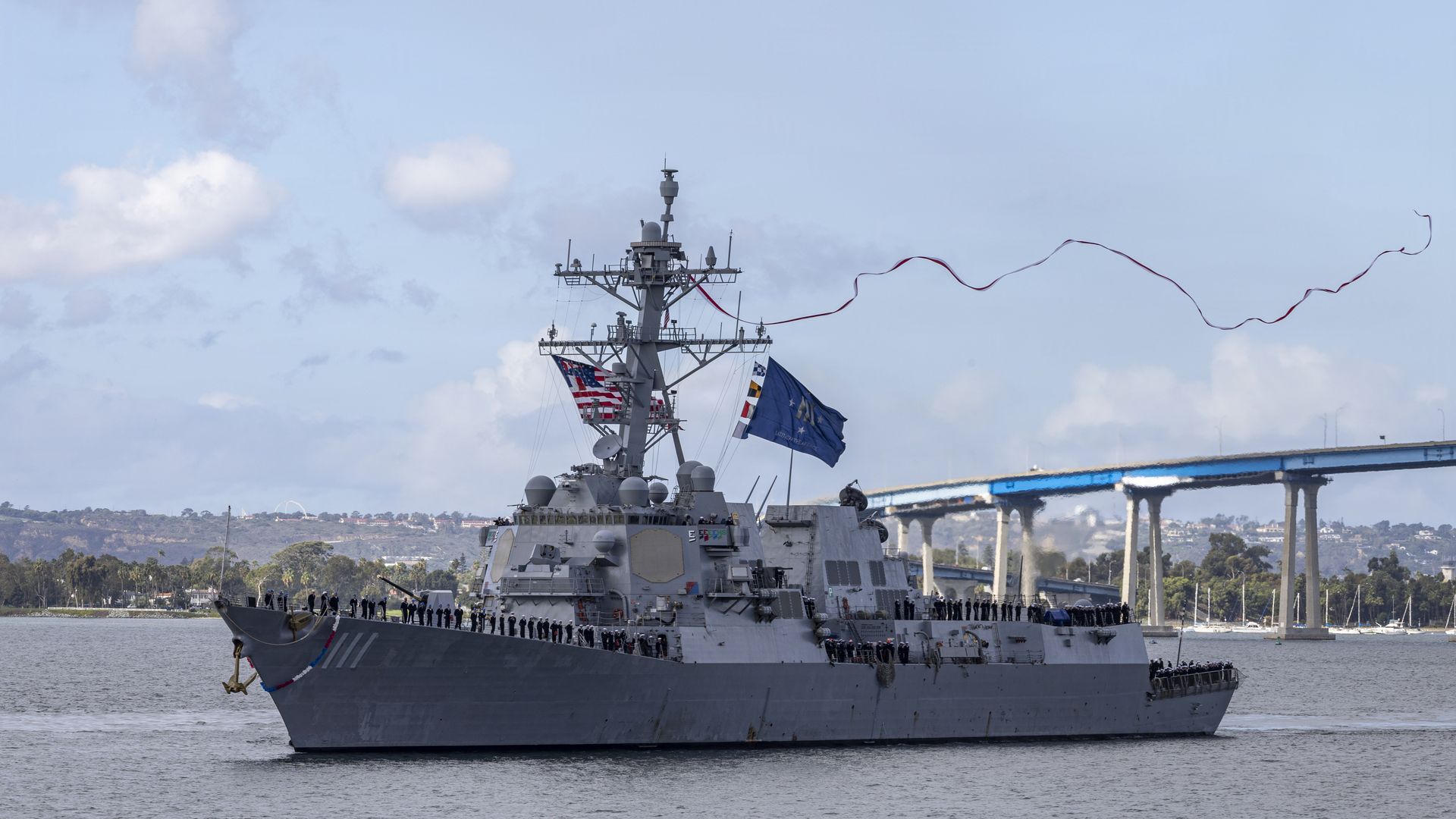
The USS Spruance returned to San Diego just a few days ago, capping a yearlong, worldwide deployment.
Why it matters: The Arleigh Burke-class guided-missile destroyer played a "pivotal role" in combat during Operation Epic Fury, the U.S. Navy said, and operated "under persistent threat from anti-ship cruise missiles and one-way attack drones."
What they're saying: "Leading the ship and crew has been the honor of a lifetime," Cmdr. Leigh R. Tate said in a statement shared by the service.
- "Spruance sailors made a difference."
More from Axios:
Iran war, said to be over "very soon," nears 6 months
Shoutout to Mike Zapler for editing and Matt Piper for copy editing.
👋🏼 Thanks, as always, for reading and sharing. Tell your friends to subscribe here.
Sign up for Axios Future of Defense