Axios Future of Defense
January 08, 2025

Hello from a thawing Washington.
- I'm chatting with Anduril Industries Chief Revenue Officer Matthew Steckman at the How We Win summit today. See me? Say hi!
🇸🇴 Situational awareness: The U.S. killed 10 al-Shabab militants in an airstrike and helped evacuate Somali forces under attack, Africa Command announced Tuesday.
- My thought bubble: The global war on terror rages far beyond the Middle East. Neglect Africa at your own peril.
Just keep scrolling: Black Sea engagements, shipbuilding with Donald Trump and Augustine's law.
Today's newsletter is 1,387 words, a 5-minute read.
1 big thing: Chinese toys for Christmas

The debut of Chinese military hardware on the heels of Christmas — or, more poignantly, Mao Zedong's birthday — shows Beijing can pump out futuristic-looking tech and still catch outsiders off guard.
Why it matters: It takes only a few grainy photos, a batch of aggressively zoomed-in cellphone videos and some state-media pomp to ignite Cold War fever.
- Sixth-generation this, seventh-generation that. You can hear the questions in Congress now: "Do they have what we don't?"
- That other noise? It's the Next Generation Air Dominance money machine spinning up.
Driving the news: Spotted at the end of 2024 were three novel aircraft and a massive amphibious assault ship. They were:
- A potential bomber from Chengdu, with a cockpit, weapons bays, paired wheels and a trio of engines.
- What looks like a fighter from Shenyang, sporting a smaller lambda-wing figure and a pointy noise.
- An airborne early-warning and control plane with hallmark radome, based on the Y-20 airlifter. It's been referred to as KJ-3000.
- The Sichuan, a Type 076 warship, outfitted with an electromagnetic catapult and arresting gear. It can also launch troops toward shore.
State of play: The U.S.-China rivalry is very real, as are these advances.
- The emergent aircraft underline Beijing's commitment to "developing successors to its current combat fleet," The War Zone reported. Key considerations include range, payload and stealth.
- The KJ-3000, specifically, will boost the People's Liberation Army's sensing and tracking of threats. It also ditches propellors for punchier jet power.
- Experts at the Center for Strategic and International Studies in August wrote the Type 076 will be a "substantial step forward" in the PLA's ability "to project power farther from China's shores."
- "The Chinese defense industrial base continues to churn out ever larger and more capable warships at a stunning pace," they added.
My thought bubble: Don't read too much into these events and their proximity to Trump's inauguration. There are better ways to send a message.
Threat level: The Pentagon in its annual report on Chinese firepower and policy warned the PLA was beefing up "with the delivery of domestically built aircraft and a wide range" of unmanned aerial systems.
- It is also "signaling its efforts in next-generation capabilities."
Yes, but: The media that survived China's firewall shows only exteriors. It's the electronic guts that so often make the difference — and are trickier to copy.
The bottom line: The developments are a reminder that manned aircraft are still a hit, and that big ships are anything but obsolete.
- Even China agrees wars will not be won solely with $500 drones.
2. Splash two
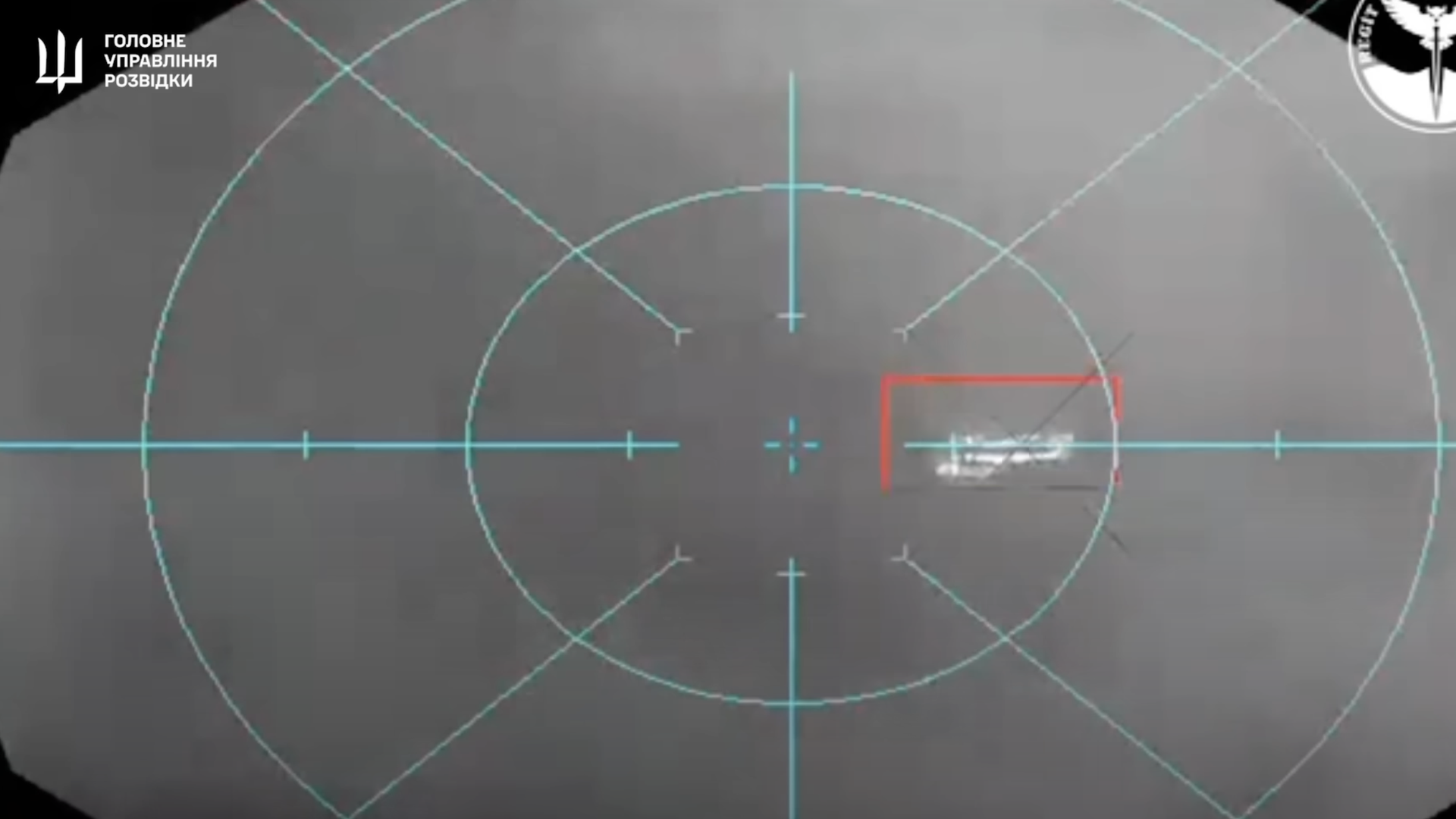
Missile-toting drone boats blew up two Russian helicopters and damaged a third in a Black Sea skirmish.
Why it matters: Ukrainian outlets said the shoot-downs were world firsts.
- Engagements like this — especially with video evidence — leave little room for drone warfare naysayers.
Zoom in: Footage shared by Kyiv shows a Magura V5 unmanned surface vessel slipping through a spray of bullets and firing off a missile. One helicopter responds with flares.
- Intelligence officials said R-73 air-to-air missiles were used. They dubbed the new application "SeeDragon."
My thought bubble: Home-brewed weaponry continues to shine in Eastern Europe. FrankenSAMs are here to stay.
Zoom out: Unmanned surface vessels are proving their worth across the globe.
- Houthi rebels in Yemen are challenging world powers with a combination of ship-killing missiles and explosives-strapped jet skis.
- Closer to home, the Marine Corps is tinkering with the Autonomous Low-Profile Vessel, a narco-boat capable of ferrying a pair of Naval Strike Missiles.
What's next: There will certainly be copycats. Trial and error on the battlefield will elevate the best.
3. Quick hits
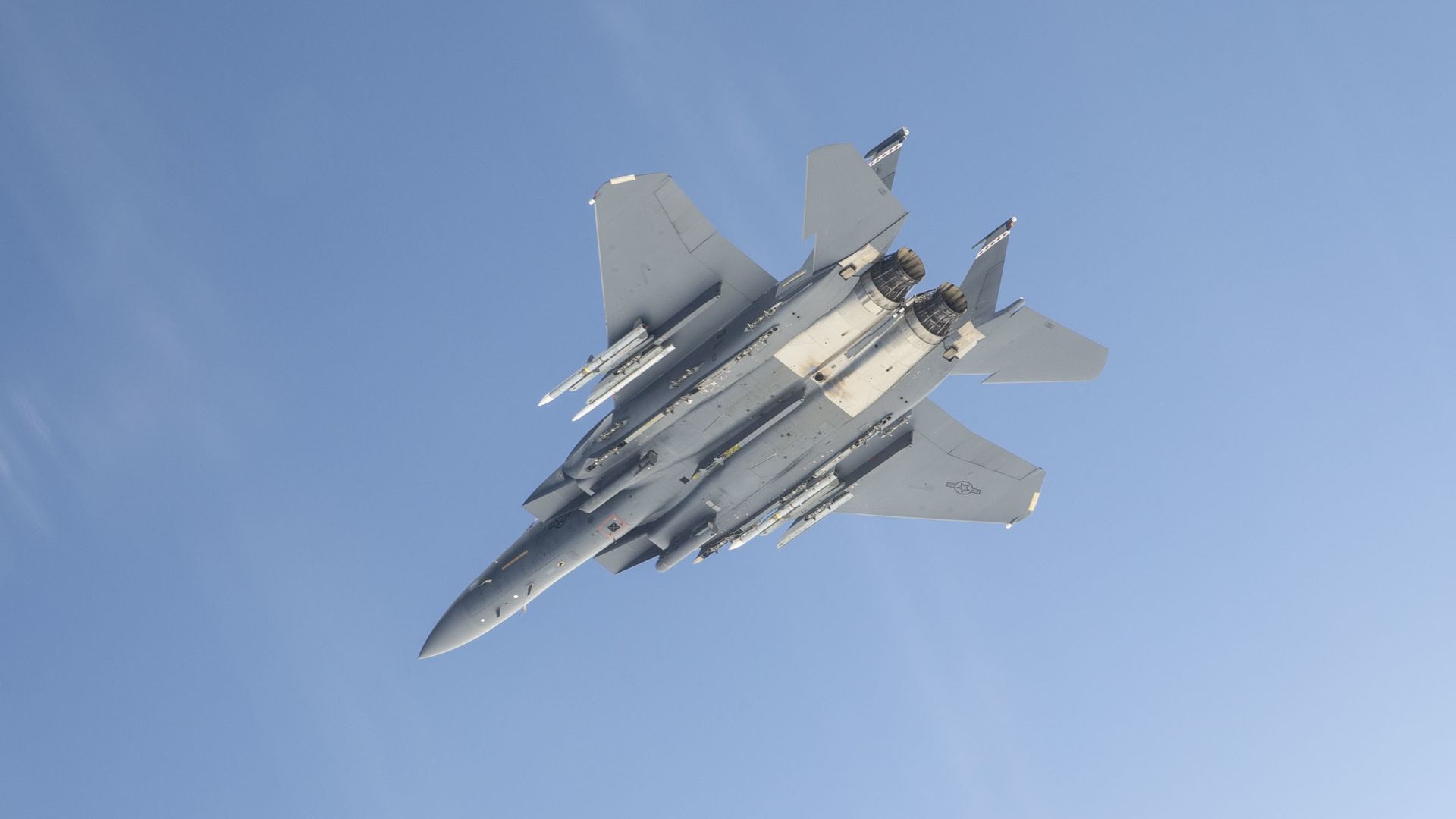
🚀 The U.S. State Department approved a potential $3.64 billion sale of RTX-made Advanced Medium-Range Air-to-Air Missiles to Japan.
- Why it matters: The green light was given just a day before President Biden blocked the sale of U.S. Steel to a Japanese company, citing national security concerns.
- 💭 My thought bubble: Selling missiles isn't a worry, but selling steel is? Huh.
🛠️ Rebuilding the U.S. Navy may require going "a different route than you would normally go," President-elect Trump said in an interview with radio host Hugh Hewitt.
- Why it matters: Shipbuilding is and always will be a hot topic. More, more, more is the current refrain.
- 💭 My thought bubble: Trump himself was intensely interested in select projects during his first term. Expect that to continue.
🔫 The U.S. Army is tapping BAE Systems for Multi-Domain Artillery Cannon and Hypervelocity Projectile prototypes, meant to defend against drones, missiles and other aerial threats.
- Why it matters: The service is going the sole-source way — meaning it thinks only BAE can deliver under schedule constraints. Hundreds of millions of dollars are expected to be spent.
- 💭 My thought bubble: Hitting speedy targets with speedier bullets (to oversimplify) will be fascinating to watch.
🇮🇱 Israel cut the ribbon on a new AI and autonomy office, which will concentrate experts from the country's military, academia and defense industry.
- Why it matters: Everyone wants the smart-machinery edge. A Robotic Combat Task Force already operated in Gaza, according to footage shared by Israel Aerospace Industries.
- 💭 My thought bubble: The AI and Autonomy Administration sounds a lot like the Pentagon's Chief Digital and AI Office, no?
4. Axios interview: Alan Pellegrini

This week's conversation is with Alan Pellegrini, the CEO of Thales North America.
Why he matters: Headquartered in Paris and growing on our side of the pond, Thales plays a key role in transatlantic defense.
- Pellegrini has decades of experience in tech, including connectivity and in-flight entertainment.
Q: When you hear "future of defense," what comes to mind?
A: Four important topics, or trends, come to mind when I consider the future of defense.
- The first is the modernization of naval power, in undersea warfare and lower-value, higher-volume platforms, driven by the China-versus-West tensions that are likely to persist for the mid- to long-term.
- The second area is collaborative combat, which will include AI-enabled communications and networks, along with smart mission systems.
- The third is the rise of attritable, autonomous systems whose validity has been demonstrated in the Ukraine war.
- And finally — and perhaps most significantly — the imperative to create force multipliers through strong, committed alliances and sharing between the U.S. and its Western allies, of which AUKUS is a good example.
Q: When will wars be waged solely by robots?
A: Hopefully never! We feel strongly about maintaining the human in the loop.
Q: What's a national security trend we aren't paying enough attention to?
A: I like the AUKUS model for allied cooperation, bringing down barriers to share technologies and co-develop between Australia, the U.S. and U.K. I think this model can be expanded to be effective among other allied partners.
Q: How many emails do you get a day, and how do you deal with them?
A: About 150, of which about half are significant in importance.
- I need to feel current with my inbox, so I monitor and respond throughout the day and evening, even if on personal time. Otherwise I feel I'm falling behind, and it's stressful.
Q: What time do you wake up? What's the morning routine look like?
A: I admit I'm more of a night than a morning person. I wake up around 7 am and prepare to go to the office, an offsite meeting or trip.
- I prefer to work at the office versus at home, although occasionally I will do early morning meetings from home office. I save my exercise time for the evenings.
Q: What advice would you give your younger self?
A: I find my two adult, professional sons concern themselves with work-life balance matters far more than I did at their age. I think finding that balance would be the advice I would give my younger self.
5. Check this out
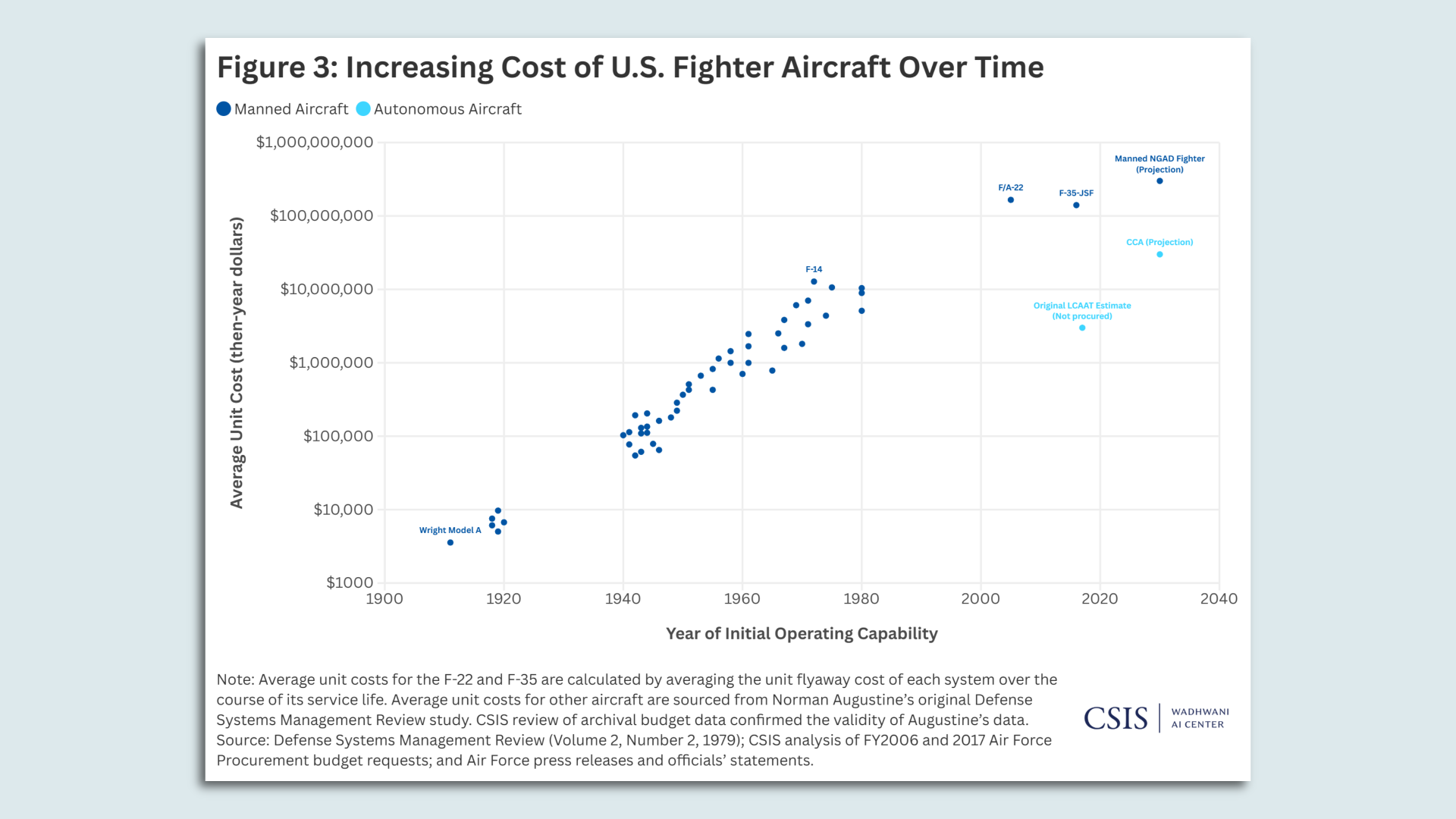
Recent analysis from the Center for Strategic and International Studies shows just how prescient Norman Augustine was.
Why it matters: "AI-enabled and autonomous systems are the [Defense Department's] best chance to break Augustine's law and are almost certainly the future of airpower," the authors, Gregory Allen and Isaac Goldston, argue.
- "But the United States is not alone in heading there."
Zoom in: Check out the full-size graph, plus some other insights, here.
- Peep the manned Next Generation Air Dominance fighter in the top right corner.
Shoutout to Nicholas Johnston for editing and Matt Piper for copy editing.
👋🏼 Thanks, as always, for reading and sharing. Tell your friends to subscribe, here.
Sign up for Axios Future of Defense