China may face succession crisis

Add Axios as your preferred source to
see more of our stories on Google.
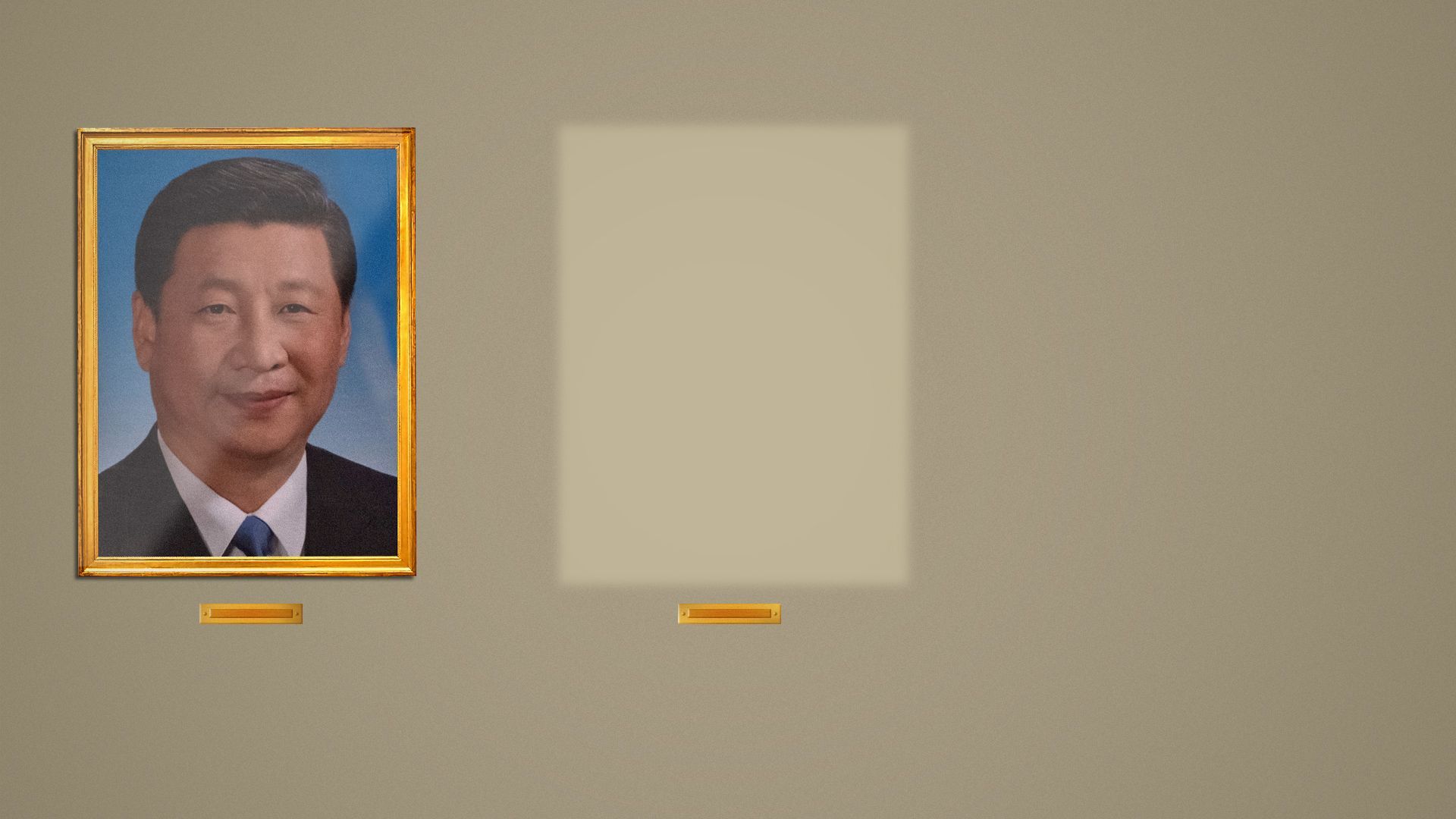
Photo illustration: Aïda Amer/Axios. Photo: Lam Yik Fei/Getty Images
Chinese President Xi Jinping dominates the Chinese Communist Party leadership as no one else has since Mao. But Xi's total consolidation of power could create a succession crisis in the future.
Why it matters: Xi's erosion of established guidelines for succession creates uncertainty and puts China at risk for high-level power struggles in the future.
Details: In his book "Party of One," Wall Street Journal reporter Chun Han Wong documents Xi's rise to power, his purging of party officials to sideline rivals, and his remaking of the party with himself at the center.
- After the death of Chinese dictator Mao Zedong in 1976, which resulted in years of instability at the party's highest levels, party leaders eventually developed a relatively stable model of succession in which each top leader served for two five-year terms, with a clear successor already waiting in the wings when the leader formally stepped aside.
- But Xi dismantled that system by abolishing term limits, not designating a successor and assuming a third term.
What he's saying: "The central drama in Chinese politics since 1949 is leadership succession," Wong told Axios in an interview.
- With Xi's iron grip on power, that drama looms once again.
- "Xi confronts a timeless conundrum that scholars call the 'successor’s dilemma,'" Wong writes. Dictators prefer to choose their own successors, but once they do, those "leaders-in-waiting must start building their own power base ahead of time, if they are to avoid being deposed or rendered ineffectual after taking office."
- Then, as the designated successor tries to build power, "the political elite will naturally start realigning their loyalties — a process that can undermine the incumbent leader, who may come to fear that the heir apparent is plotting to usurp power."
Between the lines: One of the most visible signs of Xi's monopoly over the levers of power in China's one-party state is the constant and positive coverage that Chinese state media gives him.
- "No leader since Mao Zedong has enjoyed the level of exposure in the party-state media that we’ve seen for Xi Jinping in recent years, particularly since around 2017. ... Even the party’s view of history has been reshaped to support the cult of Xi and affirm his centrality in all areas and endeavors," David Bandurski, director of the China Media Project, told Axios.
- "There is a huge gap in coverage between Xi and the other members of the Politburo Standing Committee," Bandurski said. This is another indication that "the era of collective leadership at the top of the CCP is a thing of the past. Xi’s rise in propaganda corresponds to the cratering of Chinese leadership."
Zoom out: Xi's consolidation of power and his emphasis on security have also deeply impacted China's foreign policy, Sarah Kirchberger, an expert on China's military development at the Center for Asia-Pacific Strategy and Security at Kiel University in Germany, told Axios.
- Xi put China's "already ongoing military buildup on steroids," Kirchberger said, and has asserted "his dominance in foreign affairs by relying on military prowess."
- "Partly this is probably done to impress the Chinese public, but Xi ultimately needs the military also domestically to guarantee his rule and, by extension, his own personal safety."
The big picture: "By remaking the party around himself, Xi may have become the weakest link in his quest to build a Chinese superpower," Wong argues.
What to watch: Wong lays out several succession crisis scenarios, including government paralysis, factional struggles, intervention by the military and security services, and prolonged instability.
