Thales North America CEO wants more international collabs like AUKUS

Add Axios as your preferred source to
see more of our stories on Google.
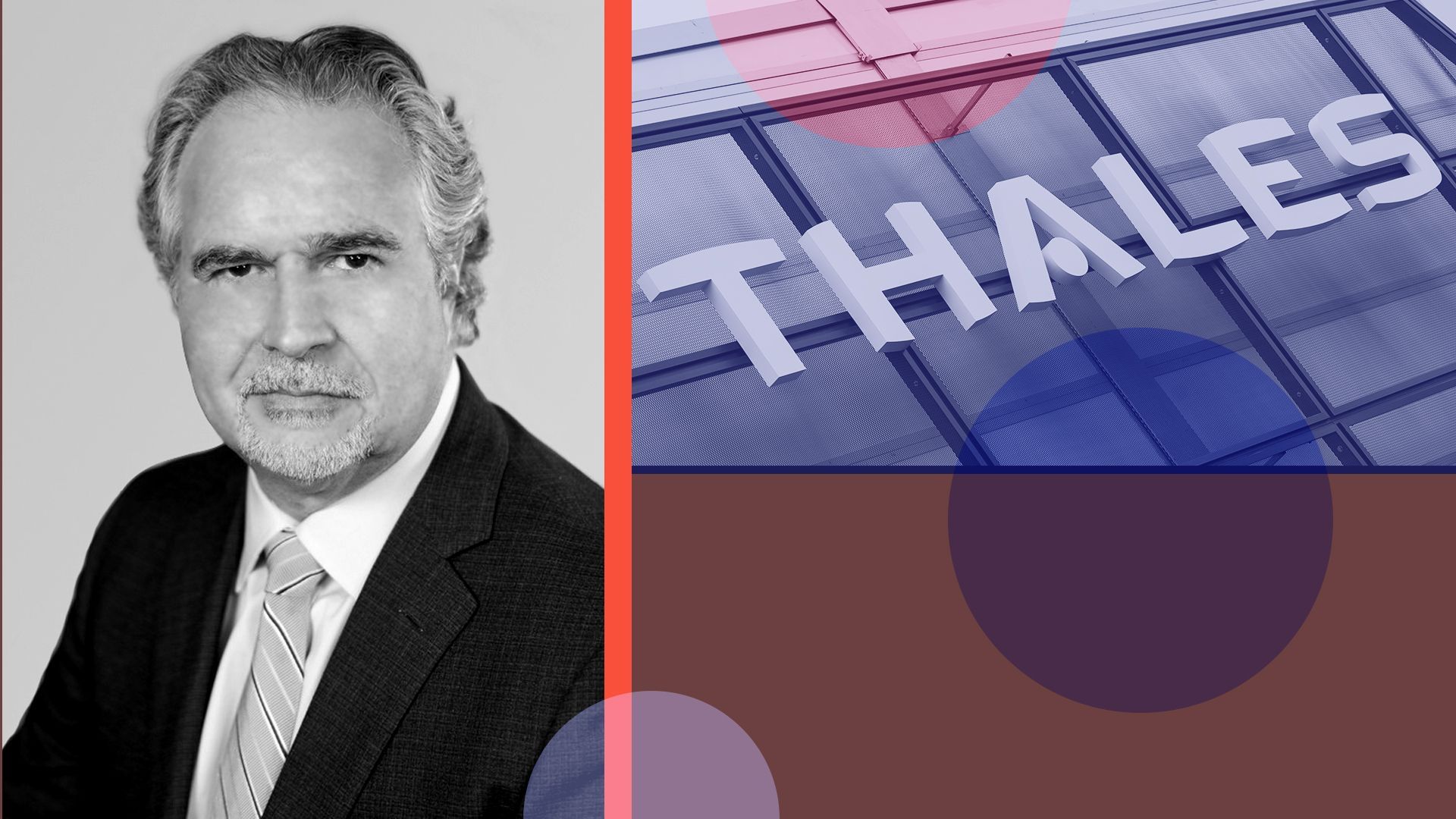
Photo illustration: Axios Visuals. Photo: Bloomberg via Getty images and Thales
Expanding the AUKUS model of cooperation would benefit other likeminded countries and militaries, according to Thales North America CEO Alan Pellegrini.
- "I would say the biggest challenge is how to scale up capacity to meet the challenges we face," he told Axios in an interview.
- "This requires technical innovation but also increases in industrial capacity," he added. "Sharing and relying upon capabilities with our allies can also help optimize the significant investment required."
Why he matters: Headquartered in Paris and growing in North America, Thales plays a key role in transatlantic defense.
- Pellegrini has decades of experience in tech, including connectivity and in-flight entertainment.
Q: When you hear "future of defense," what comes to mind?
A: Four important topics, or trends, come to mind when I consider the future of defense.
- The first is the modernization of naval power, in undersea warfare and lower-value, higher-volume platforms, driven by the China-versus-West tensions that are likely to persist for the mid- to long-term.
- The second area is collaborative combat, which will include AI-enabled communications and networks, along with smart mission systems.
- The third is the rise of attritable, autonomous systems whose validity has been demonstrated in the Ukraine war.
- And finally — and perhaps most significantly — the imperative to create force multipliers through strong, committed alliances and sharing between the U.S. and its Western allies, of which AUKUS is a good example.
Q: When will wars be waged solely by robots?
A: Hopefully never! We feel strongly about maintaining the human in the loop.
Q: How many emails do you get a day, and how do you deal with them?
A: About 150, of which about half are significant in importance.
- I need to feel current with my inbox, so I monitor and respond throughout the day and evening, even if on personal time. Otherwise I feel I'm falling behind, and it's stressful.
Q: What time do you wake up? What's the morning routine look like?
A: I admit I'm more of a night than a morning person. I wake up around 7 am and prepare to go to the office, an offsite meeting or trip.
- I prefer to work at the office versus at home, although occasionally I will do early morning meetings from home office. I save my exercise time for the evenings.
Q: What advice would you give your younger self?
A: I find my two adult, professional sons concern themselves with work-life balance matters far more than I did at their age. I think finding that balance would be the advice I would give my younger self.
