Axios Future of Defense
April 01, 2026

Hello, again! Two big events for your calendars:
- Huntsville, April 23. We're talking aerospace, energy and workforce.
- Washington, Nov. 19. The third annual Future of Defense Summit.
⌨️ Situational awareness: Iranian hackers are taking aim at U.S. government officials and employees at major companies, my colleague Sam Sabin reports. "Even unproven threats," she writes, can sow fear.
What's happening: Iran war costs, Precision Strike Missile promises and a whole bunch of funding rounds.
Today's newsletter is 1,613 words, a 6-minute read.
1 big thing: Data held hostage
Data centers are juicy targets. Nowhere is that becoming more clear than in the Gulf.
Why it matters: These centers — fragile and exposed, protected against intruders but not drones and missiles — underpin financial systems, communications and artificial intelligence projects.
- They represent billions of dollars of investment both foreign and domestic, today and tomorrow.
- And they can be held hostage.
Driving the news: Iran struck a handful of data centers in the United Arab Emirates and Bahrain following Epic Fury bombardment from the U.S. and Israel.
- State media later shared a list of "enemy" infrastructure tied to American companies — Amazon, Nvidia and Palantir Technologies among them.
- Multiple outlets described this kind of retaliation as a first. It won't be the last.
What they're saying: "The biggest takeaway is that physical resilience was taken for granted for the longest time, even in the Gulf states," Michael Deng, a geoeconomics technology analyst at Bloomberg, told me.
- "This huge bet on the Gulf, itself, as this big AI hub outside the U.S. and China is looking, in hindsight, like not a really great decision."
Between the lines: These exchanges aggravate business and digital workload concerns already stirred up by a geopolitically messy conflict.
- "Before now, the thought was, if America gets constipated in its ability to build data centers, we'll build them with our allies in the Middle East," Constellation CEO Joe Dominguez told Axios' Mike Allen at our AI+DC summit.
- "But who's going to insure a $20 billion facility in the Middle East that can be taken out by a $5,000 drone? That's the reality we face."
Follow the money: Tehran's menacing is "highly symbolic and strategic," as it gets at "the heart of the U.S.-Gulf relationship" and where it's been headed, according to Elisa Ewers, a senior fellow at the Council on Foreign Relations.
- "The 1979 paradigm is clashing against this Vision 2030 paradigm. They're in direct tension," she told me.
- "The targeting of critical and civilian infrastructure is saying: The cost of direct conflict with us is high, there are any number of ways we can raise the costs."
Threat level: Data centers in the U.S. could be vulnerable to physical strikes or cyberattacks, and the Pentagon and other national security agencies don't have much slack in the system to replace lost capacity, particularly in wartime, other experts told Axios.
- Previous drone scares exposed just how lacking the suburban game plan and countermeasures are.
- Data centers are also attractive targets for sophisticated hackers backed by Iran, China and Russia.
- Nearly 3,000 new centers were under construction or planned across the U.S. as of late 2025.
What we're watching: How all of the above informs the sci-fi-tinged but very real discussions about data centers in space.
- "You have to have this protect-and-defend conversation now, as this idea is starting, because if we wait until Elon Musk has 10,000 data centers on orbit, we've probably waited too long," Portal Space Systems CEO Jeff Thornburg told me.
More from Axios:
Trump inherits a Middle East in flux
U.S. lacks the "will" for Iran ground war, Anduril's Luckey says
Defense industry must collaborate more in Middle East, says Dunford
2. Tally it up


The U.S. is dedicating significant amounts of firepower to the Middle East as it wrestles with Iran. Some of it — billions of dollars' worth, in fact — will not be returning.
Why it matters: The costs of Operation Epic Fury are mounting.
- Hundreds of American troops have been injured and 13 killed.
- Some exquisite weaponry, everything from stealth jets to radars, has been knocked out.
By the numbers: The incremental cost of the Iran war sat at $16.2-23.4 billion as of March 19, according to research published by the American Enterprise Institute.
- The high end includes costs associated with radar replacement at Al Udeid Air Base in Qatar and some fixes to the Gerald R. Ford aircraft carrier, which last month suffered an hourslong laundry fire.
Among the other materiel either damaged or destroyed are:
- One Lockheed Martin F-35A
- One Boeing E-3 Sentry
- One RTX AN/TPY-2 radar
- Three Boeing F-15E Strike Eagles
- Multiple Boeing KC-135 Stratotankers
- Multiple General Atomics MQ-9 Reapers
What they're saying: Regarding "air wings and airframes, there's some things adversaries are doing to provide info and intel they shouldn't. We're aware of it," Defense Secretary Pete Hegseth said during a Tuesday briefing.
- "Ultimately, we move things around. One of the biggest principles you learn in the military is to not set predictable patterns," he added.
- "Commanders are working hard to adjust, in real time, with those systems and make sure they're in the right places and not easily targetable."
The other side: The U.S. has also expended more than 850 Tomahawk missiles, launched by surface ships and submarines.
- "We've shot a lot of munitions," Chief of Naval Operations Adm. Daryl Caudle said at a separate CSIS event. "The munitions have taken a hit."
- Maker RTX in February said it would surge production to 1,000-plus annually.
The big picture: Six in 10 Americans disapprove of President Trump's handling of the conflict, according to a Pew survey.
- A little more than half believe the fight will continue for another six months.
Go deeper: The U.S. military can't quit the Middle East
3. Navy's trainer request

The U.S. Navy published its request for proposals for the Undergraduate Jet Training System, slated to replace the aging T-45 Goshawk.
Why it matters: This is years in the making.
- Plus, the winner will long influence how Navy and Marine Corps aviators are educated.
State of play: Several competitors have emerged, including Boeing, Lockheed Martin and Sierra Nevada Corporation.
Zoom in: Responses are due in June. A contract is expected early next year, Aviation Week reported.
- Ultimately, the Navy expects to buy more than 200 of the trainers.
Flashback: The service previously said the Goshawk fleet was facing "significant aircraft, engine and component obsolescence issues."
Go deeper: Navy nominee wants futuristic fighter despite White House doubts
4. PrSM production
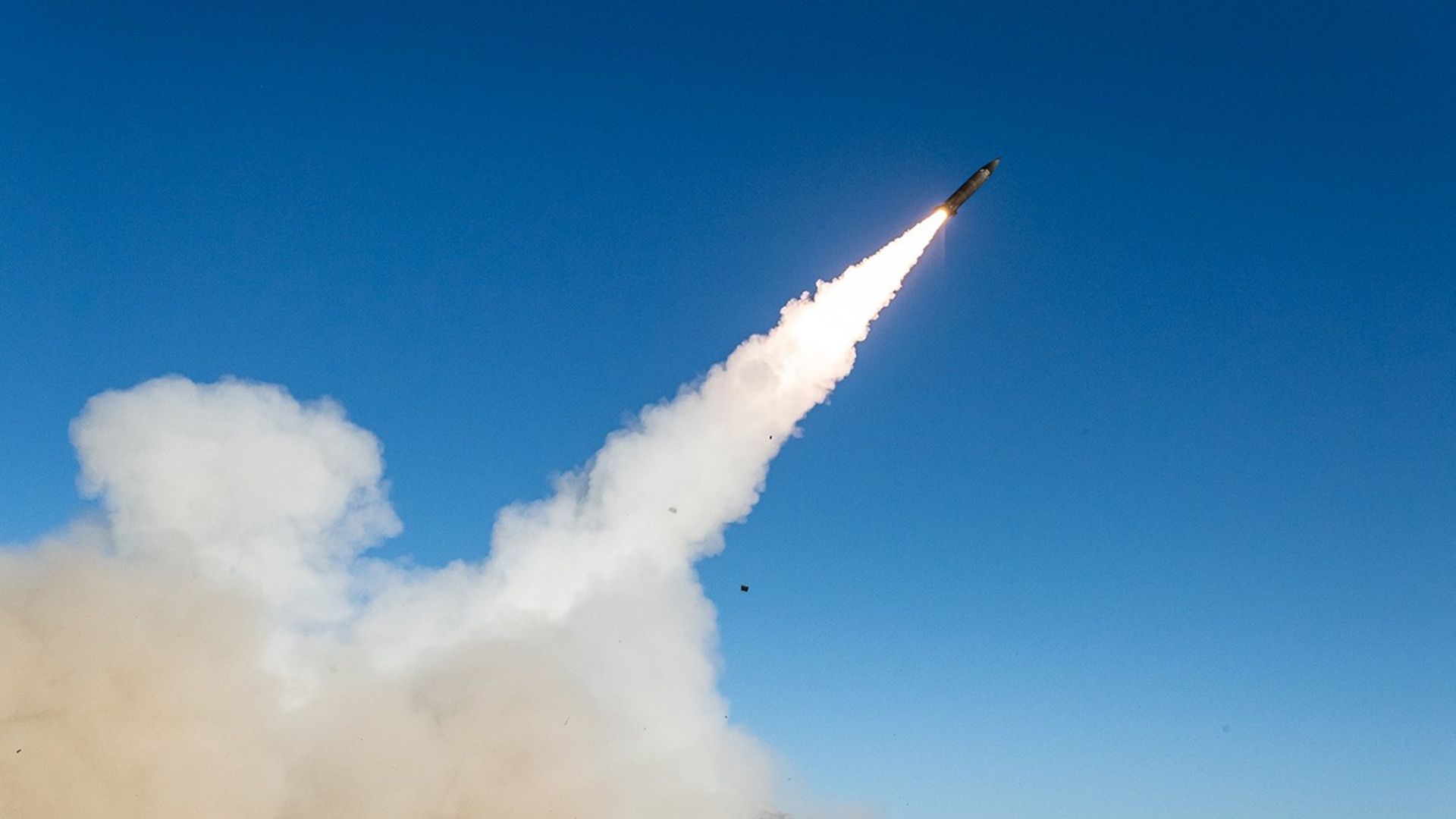
Lockheed Martin plans to quadruple its output of Precision Strike Missiles, used for the first time in the Iran war.
Why it matters: Questions about production capacity and stockpile health haunt the U.S. military, especially as its offensive alongside Israel breaks the one-month mark. And PrSM's first-ever employment has already drawn scrutiny.
- CENTCOM last night denied reports from outlets including the New York Times and BBC that the missile was used in an attack that hit a sports hall and elementary school near an Islamic Revolutionary Guards Corps complex in southern Iran, killing around 21 people.
Driving the news: Lockheed and the Defense Department announced the production ramp-up last week.
- The company is planning "targeted investments" in advanced tooling, facility upgrades and testing equipment "to slash production lead times," according to the department. No dollar figure was provided.
- There is also potential to negotiate a multiyear contract, should Congress authorize it.
State of play: PrSM, pronounced "prism," is a short-range ballistic missile. It's compatible with the popular High Mobility Artillery Rocket System, and it's meant to replace the Army Tactical Missile System.
- The baseline version of PrSM can hit targets hundreds of miles away.
- An anti-ship option, dubbed Increment 2, is also in the works. A successful flight test was announced March 12. Additional tests are expected this year.
Go deeper: Lockheed plans to triple output of coveted Patriot interceptors
5. Quick hits
💸 A bunch of companies scored a bunch of money. Xona Space Systems raised $170 million, Saronic raised $1.75 billion and Shield AI raised $2 billion
- Why it matters: These are massive bets on space and autonomy. Telling.
- 💭 My thought bubble: Want more news? Read about Xona, here. Read about Saronic, here. And read about Shield, here.
🍁 Canada hit its 2% NATO spending target in fiscal 2025-26. Ottawa has pledged to satisfy the new 5% metric by 2035.
- Why it matters: "Canada's new government made a promise to rebuild, rearm and reinvest in the Canadian Armed Forces — and we're getting it done," Prime Minister Mark Carney said in a statement.
- 💭 My thought bubble: Speaking of, read this.
🌌 U.S. Space Command anticipates moving approximately 200 people to Redstone Arsenal by year's end, as it slowly relocates from Colorado to Alabama.
- Why it matters: Where SPACECOM calls home has been a hot political topic, with the Trump and Biden administrations disagreeing which location is best.
- 💭 My thought bubble: Subscribe to Axios Huntsville! And give my colleague Derek Lacey a shout!
🗾 The State Department approved a possible $340 million deal with Japan to advance its Hyper Velocity Gliding Projectiles effort.
- Why it matters: It follows a $200 million arrangement for HVGP announced last March.
- 💭 My thought bubble: Japan's remilitarization is a slow burn.
6. Check this out
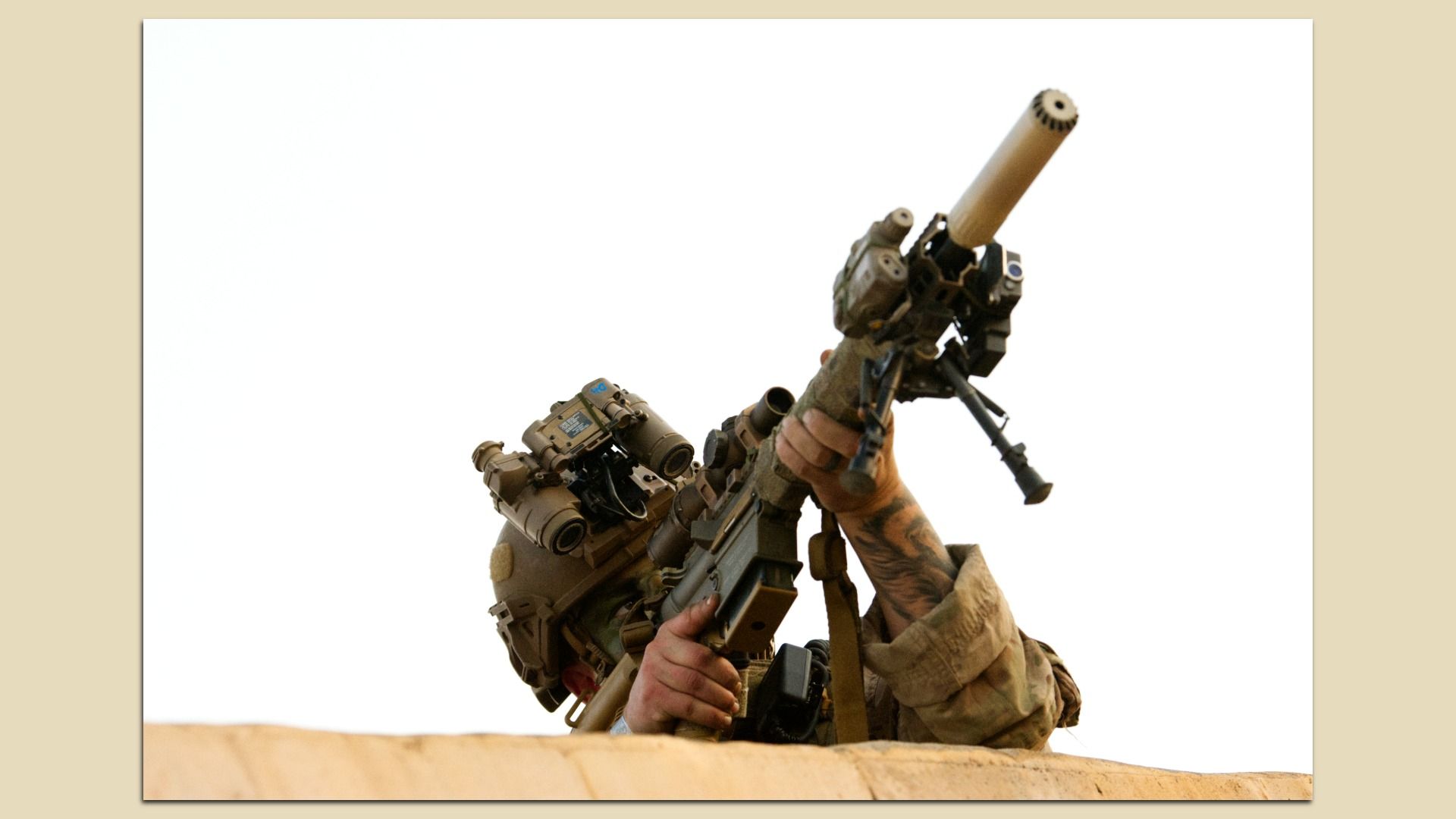
Here's one final photo from my two-day visit with the 82nd Airborne Division.
Why it matters: It didn't fit the theme of last week's reporting from Louisiana.
- But I didn't want to leave it on the cutting room floor.
Zoom in: Yep, that's what he's doing.
My thought bubble: Many thanks to the Multi-Functional Reconnaissance Company for letting me hang out.
Go deeper: What the 82nd Airborne does and why it could play a key role in Iran
Shoutout to Dave Lawler for editing and Matt Piper for copy editing.
👋🏼 Thanks, as always, for reading and sharing. Tell your friends to subscribe here.
Sign up for Axios Future of Defense