Why House Dems didn't force an Iran war powers vote

Add Axios as your preferred source to
see more of our stories on Google.
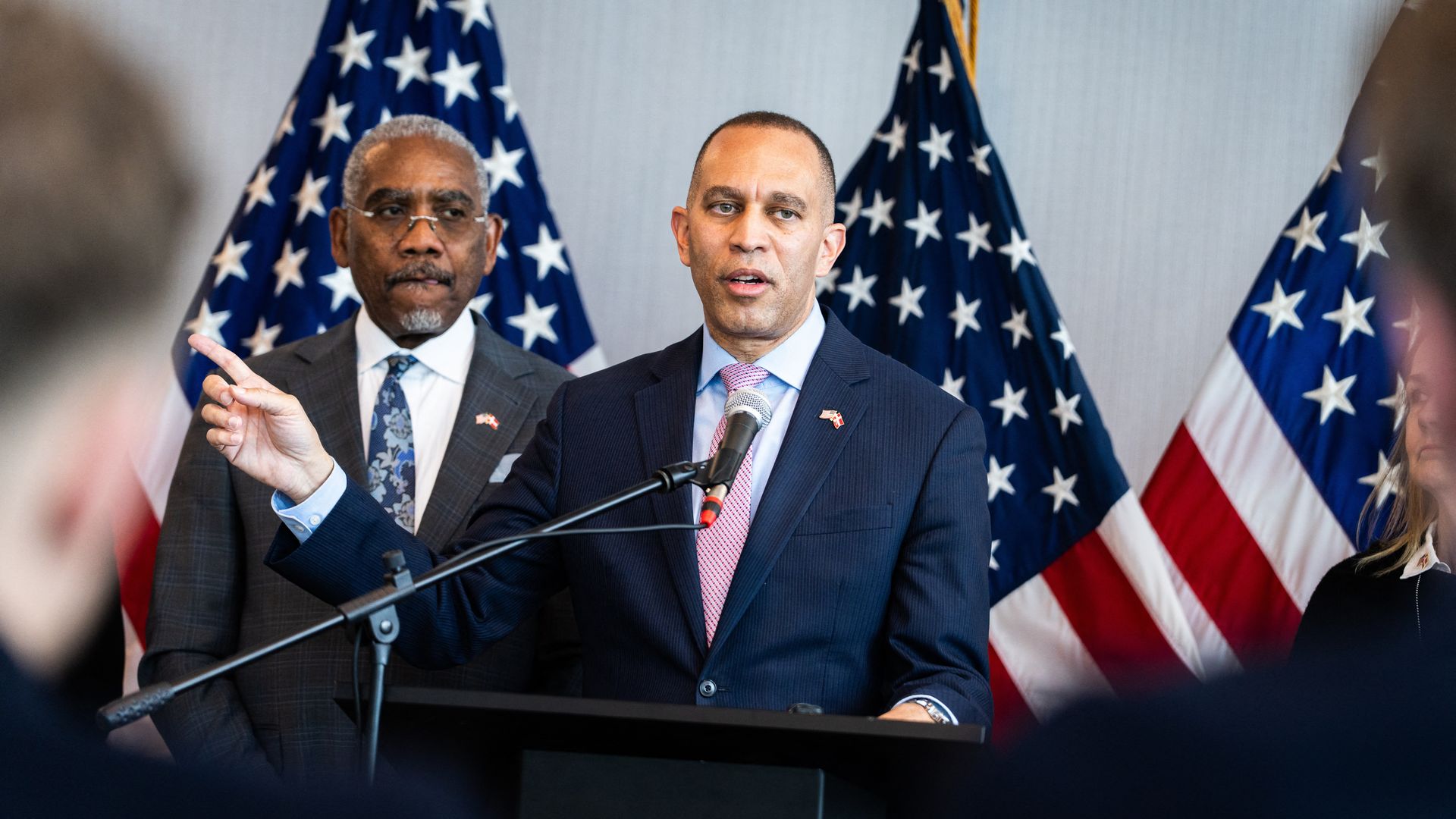
House Minority Leader Hakeem Jeffries and House Foreign Affairs Committee ranking member Greg Meeks speak at a press conference in Copenhagen, Denmark on April 25, 2025. Photo: EMIL NICOLAI HELMS/Ritzau Scanpix/AFP via Getty Images
House Democrats chose not to force a vote this week to block President Trump from unilaterally waging war with Iran in part out of fear that they still lacked the votes to pass the measure, Axios has learned.
Why it matters: The move is frustrating the Democratic grassroots, with some progressive groups and lawmakers fuming over the fact that another vote won't be possible until mid-April.
- Rep. Delia Ramirez (D-Ill.) told Axios there is "absolutely" frustration among lawmakers on the left that an Iran war powers resolution didn't get a vote this week.
- "Democrats should absolutely be forcing Republicans to vote on stopping this war as urgently as possible," Andrew O'Neill, national advocacy director at the progressive group Indivisible, said in a statement to Axios.
What happened: Democrats had signaled they were prepared to force a vote as soon as this week after failing to pass an Iran war powers resolution earlier this month.
- While Reps. Thomas Massie (R-Ky.) and Warren Davidson (R-Ohio) broke ranks to vote for the measure, four Democrats voted against it. The measure failed in a 212-219 vote.
- The intervening weeks have seen an intense Democratic whip operation to get those four Democrats on side — and, sources say, most have.
- Rep. Nancy Mace (R-S.C.) also told Axios on Thursday that she will "most likely" vote with Democrats the next time they force a war powers vote.
Yes, but: One more potential Democratic holdout and several absences are still giving party leadership pause, according to multiple House Democrats who spoke on the condition of anonymity to speak candidly about private deliberations.
- Rep. Jared Golden (D-Maine) told Axios on Wednesday he doesn't "have an answer" on how he plans to vote, saying this is "just not the type of thing I feel like you rush into decisions about."
- "We have some absences. Ted Lieu's not here this week," said one House Democrat familiar with the matter, referring to the House Democratic caucus vice chair who was out due to the recent death of his father.
- Said a senior House Democrat: "Everyone's freaked out, but we didn't have the people here to pass it. … No point in bringing up a resolution that's going to fail because we have an attendance problem."
What they're saying: Several of the Democrats spearheading the war powers effort signaled they still want a decent cushion of GOP votes to create as little room for error as possible.
- Rep. Ro Khanna (D-Calif.) told Axios he is working with Massie to "identify certain Republicans" who could flip, divulging that there are "five or six" GOP lawmakers who are "on the fence."
- House Minority Whip Katherine Clark (D-Mass.) told Axios: "We can't win this, procedurally, every day. So we are holding that option until we can pass it or events turn and we can get more Republicans to join us."
House Minority Leader Hakeem Jeffries (D-N.Y.), asked Tuesday about a possible war powers vote, told reporters he was in "ongoing conversations" with House Foreign Affairs Committee ranking member Greg Meeks (D-N.Y.) and other top lawmakers leading the effort.
- Jeffries said he is committed to "moving forward with the war powers resolution sooner rather than later."
Zoom out: While war powers resolutions are largely toothless — Trump could veto one even if it passes the House and Senate — a successful House vote can serve as a powerful rebuke of operations in the Middle East.
- A failed war powers vote, however, is looked on by many as effectively a green light for the administration to stay the course.
- That is a central reason why Democrats are so reluctant to force another war powers vote without the guaranteed support for it to pass.
The bottom line: To the anti-war left, the punted vote is simply more evidence of Democratic leadership's weakness.
- "If Dems say they oppose the war but won't force a vote, it reinforces the sense they're not willing to use their power when it counts," said Paco Fabian, the director of campaigns at Our Revolution.
