Axios Future of Defense
March 12, 2025

Welcome back. Happy Wednesday.
- Sidenote: I can't stop listening to "Babylon" by David Gray.
🎇 Situational awareness: President Trump's withdrawal of support for Ukraine has longstanding allies debating development of their own nuclear arsenals, my colleague Dave Lawler reports.
- My thought bubble: These are no-joke stakes. As Lawler writes, a "force of personality alone won't be enough to keep the world's 'greatest threat' in check."
Ahead: Arlington Capital Partners unveils GRVTY, an early look at a U.S.-Israel study and a one-on-one with Ursa Major's Dan Jablonsky.
Today's newsletter is 1,761 words, a 6.5-minute read.
1 big thing: AI's battlefield moment
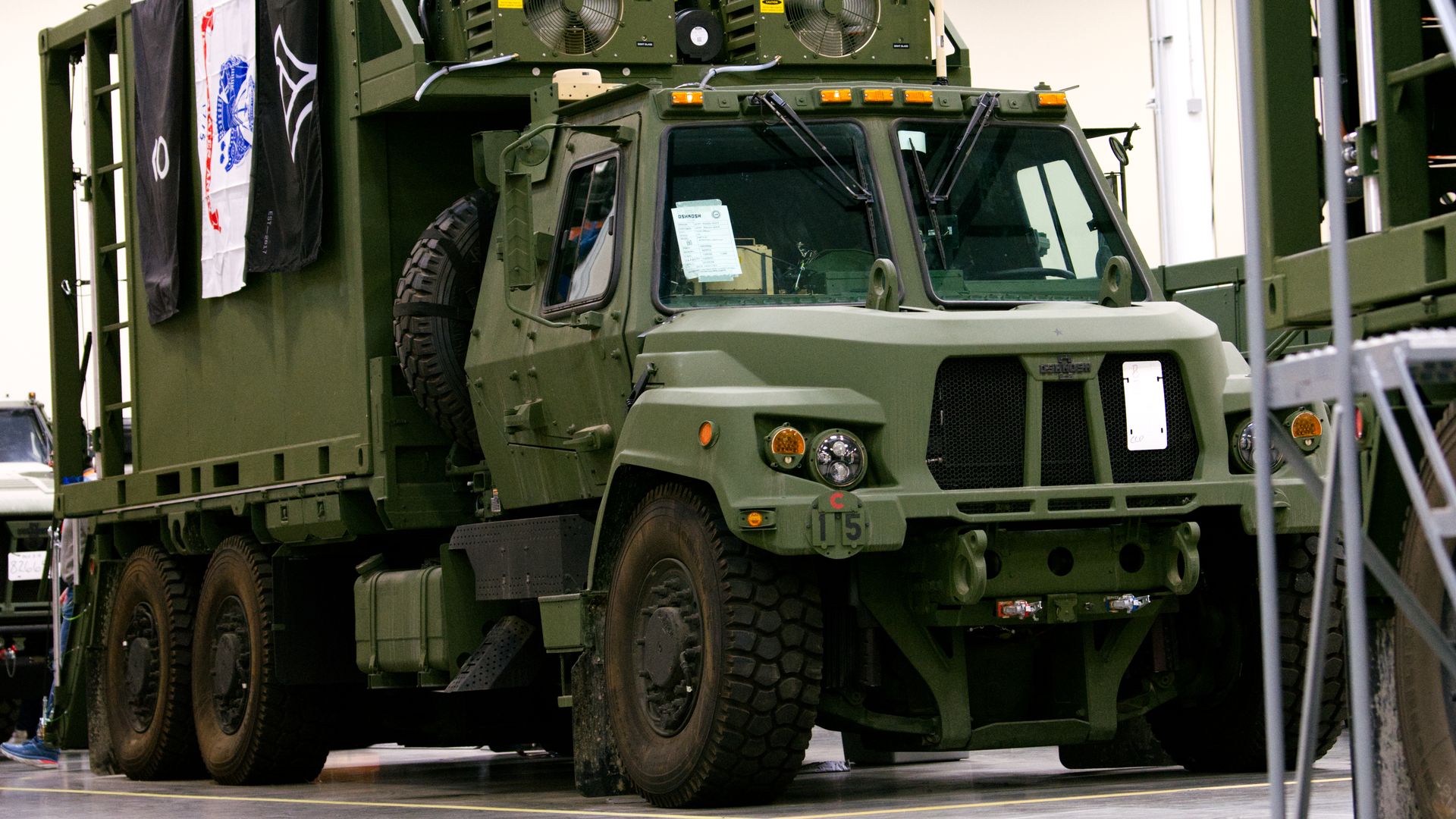
The U.S. Army now has in hand a few Tactical Intelligence Targeting Access Nodes, state-of-the-art trucks that promise to streamline the battlefield process of spotting, tracking and blasting.
Why it matters: The program — years in the making, but also on time and budget — is critical to the Defense Department's connect-everything-everywhere dream of Combined Joint All-Domain Command and Control.
- It also supports two of the Army's biggest ambitions: deep sensing and long-range precision fires, or the ability to find, shoot and kill more accurately from farther away.
Driving the news: I flew to Southern California to what's known as "Tower House" to see firsthand a pair of TITANs that Palantir Technologies and its partners (including Anduril Industries, Northrop Grumman and L3Harris Technologies) are delivering.
- The package included one basic variant and one advanced variant, which hoovers up space data. The former is built on a Joint Light Tactical Vehicle. The latter, on the Family of Medium Tactical Vehicles.
The latest: Palantir has now handed over three systems, with the first going to the 1st Multi-Domain Task Force at Joint Base Lewis-McChord last year.
- Another delivery is slated for early summer. The company declined to confirm the location or purpose, citing Army guidance.
TITAN has so far avoided typical Pentagon pitfalls like laggard timelines and drip-feed budgeting, according to Akash Jain, Palantir's president of U.S. government business. He spoke with reporters at the California factory.
- "This is, really, a live system that is going to continue to get better, and that is different for the Army and for this type of technology," he said. "It is very much a software-centric acquisition, where hardware has been built around the software."
- "At the end of the day," he added, "Palantir does not bend metal."
Zoom out: The defense and intelligence communities are betting big on AI. More than 685 AI projects were underway at the Pentagon as of early 2021, according to a watchdog. (The Army led the pack with 232.)
- Before that, in 2018, an official strategy warned the tech would "transform every industry" and influence all facets of national security.
- The havoc caused by DeepSeek's arrival underlines how seriously Washington takes its rivalry with China.
Catch up quick: Palantir this time last year beat RTX for the $178 million TITAN production contract. The Army pick followed a yearslong design and prototyping face-off.
- Palantir's win was seen as a major shakeup. There were certainly doubters: Could a software specialist really pump out hardened battlefield vehicles?
- RTX is the third-largest contractor in the world when ranked by defense-related revenue, according to Defense News.
- "As we came together, there's been a bit of learning from each other," said Aaron Dann, Northrop's vice president for payload and ground systems. "We can pull from where we do welding of space tanks and take a look at welds on TITAN and say, 'Hey, are we doing this, right?'"
What's next: TITAN production will continue in California for the foreseeable future. Its place at Arsenal-1, Anduril's planned Ohio megafactory, is unclear.
- Should the Army go full steam ahead, it is expected to buy 100-150 units.
2. Lockheed's calculus

Lockheed Martin is eyeing everything from its command-and-control networks to its F-35 stealth fighter to its Sentinel A4 radar for Golden Dome, the rebranded missile shield sought by President Trump.
Why it matters: "In terms of importance for the defense of the nation, it's similar to the Manhattan Project," Frank St. John, the company's chief operating officer, said in an interview.
- A key difference between past and future, though, is the "wide array" of existing, deployed equipment that will "form the basis," he said.
The latest: Lockheed is responding to government government requests, including from the Space Development Agency and the Missile Defense Agency.
- The MDA wants solutions on a rolling basis, dubbed "epochs": no later than the ends of 2026, 2028, 2030 and "beyond."
The American industrial base — not just defense specialists — will be needed to realize Golden Dome, according to St. John.
- "This is a project that is going to require the best of every technology company, whether it's primes that already have existing systems that are proven and capable, whether it's commercial companies that would provide networking and artificial intelligence capability and cloud computing, or even new entrants that would come in with innovative ideas," he told me.
Zoom in: Lockheed's TPY-6 radar was used in a successful test intercept of a ballistic missile from Guam late last year. Its PAC-3 Missile Segment Enhancement has also succeeded in Ukraine.
Zoom out: RTX, L3Harris Technologies and General Atomics are also bullish about their chances.
Yes, but: Golden Dome will be pricey.
- Money will need to stretch across budget cycles, election swings and commanders in chief.
What's next: "We are in full planning mode," Vice Chief of Space Operations Gen. Michael Guetlein said at an event last week when asked about Trump's Golden Dome executive order.
- "It's going to take concerted effort from the very top of our government," he added. "It's going to take national will to bring all this together."
Go deeper: What Trump's Iron Dome demands
3. Exclusive: Meet GRVTY

There's a new defense contractor in town, supported by the same investment firm that's selling BlueHalo to AeroVironment.
The big picture: Arlington Capital Partners this week unveiled GRVTY, which specializes in signals and geospatial intelligence as well as cyber.
- The company is led by Katie Selbe. She worked at Northrop Grumman for more than 15 years.
- It has more than 325 employees across 11 states. Its footprints include Arlington, Virginia, a defense-tech hot spot, and St. Louis, home to the National Geospatial-Intelligence Agency.
- It's logged more than $100 million in revenue.
What they're saying: "A lot of the insights that we're getting at the combatant commands, we're able to filter those back into some of the larger [requests for proposal] that, maybe, back in D.C. they're not tracking," Selbe said in an interview.
Follow the money: Arlington Capital has since 1999 invested in more than 150 companies. It's currently working through a $3.8 billion fund.
- "The geopolitical risks out there are more complicated and more pressing than ever," managing partner David Wodlinger told me.
- "We want to do our part and steward hundreds of millions of dollars into a company that's designed to address the highest priority areas of our customers' needs."
What we're watching: If and how GRVTY differentiates itself from hordes of competition.
4. Quick hits

↔️ The U.S. should transition its "military financing of arms procurements to direct military sales to Israel, ending in 2048 to coincide with the 100th anniversary of Israel's independence," argue the authors of a Heritage Foundation report first shared with me.
- Why it matters: The war in Gaza and a turbulent Middle East are stress testing the U.S.-Israel relationship.
- 💭 My thought bubble: Another interesting suggestion? Washington and Jerusalem should "establish an information warfare working group."
🪖 Two weeks into his new gig, Army Secretary Dan Driscoll is working the West Coast, visiting Joint Base Lewis-McChord, discussing hypersonics and the Mid-Range Capability, and spending time in Los Angeles and Silicon Valley.
- Why it matters: It's an early showing of Driscoll's priorities. "We must move faster," he told me, "and clear any hurdles that hinder us from getting the best technology and capabilities into the hands of our soldiers."
- 💭 My thought bubble: Washington's relationship with Silicon Valley has never been more important. A region once leery of defense work is now champing at the bit.
💥 The Ukrainian military attacked Moscow with a drone barrage, reportedly the largest of its kind. At least two people were killed; more than a dozen were injured.
- Why it matters: This is not the first time the Russian capital has been hit. But such attacks remain rare, my colleague Ivana Saric wrote.
- 💭 My thought bubble: This news broke before Ukraine backed the idea of a 30-day ceasefire. Another colleague, Barak Ravid, has the details.
💽 Scale AI will outfit U.S. Indo-Pacific and European commands with artificial intelligence planning tools as part of a Defense Innovation Unit effort dubbed Thunderforge.
- Why it matters: "The first nation to fully incorporate artificial intelligence into military decision-making will shape the history of the 21st century," the company said in its contract announcement.
- 💭 My thought bubble: More of this means fewer resources — manpower, work hours, energy drinks — spent on rote tasks.
5. Axios interview: Dan Jablonsky

This week's conversation is with Dan Jablonsky, the chief executive at Ursa Major.
- We did this interview in a coat closet at the Hay-Adams hotel in Washington as Sen. Roger Wicker (R-Miss.) addressed attendees of a Ronald Reagan Institute defense conference.
- I'm not joking.
Why he matters: Ursa is racking up defense contracts and test flights. It's also playing alongside some of the biggest names, like RTX.
Q: When you hear "future of defense," what comes to mind?
A: The technical revolution taking place right now, across the defense industry. I think it's a really exciting time for companies to be involved in this.
- In an area like this, when you have this much disruption, it actually allows the disruptors to break through, which I'm really excited about.
Q: What's a national security trend we aren't paying enough attention to?
A: The mass industrialization of China's capabilities.
Q: Where are you investing internally, and how could it shake up the status quo?
A: Hypersonics, hypersonics and hypersonics.
- We've got category-leading technologies that are flying right now that nobody else in the world has been able to use.
Q: How many emails do you get a day, and how do you deal with them?
A: About 250.
- I delegate as many of them as I can. I pay attention to the half-dozen that really matter.
Q: What's your secret to a successful overnight flight?
A: I grew up in the Navy. You sleep when you can. You eat food when it's offered to you. And you have lots of coffee when you need it.
Q: What advice would you give your younger self?
A: Relax a little bit more.
6. Check this out
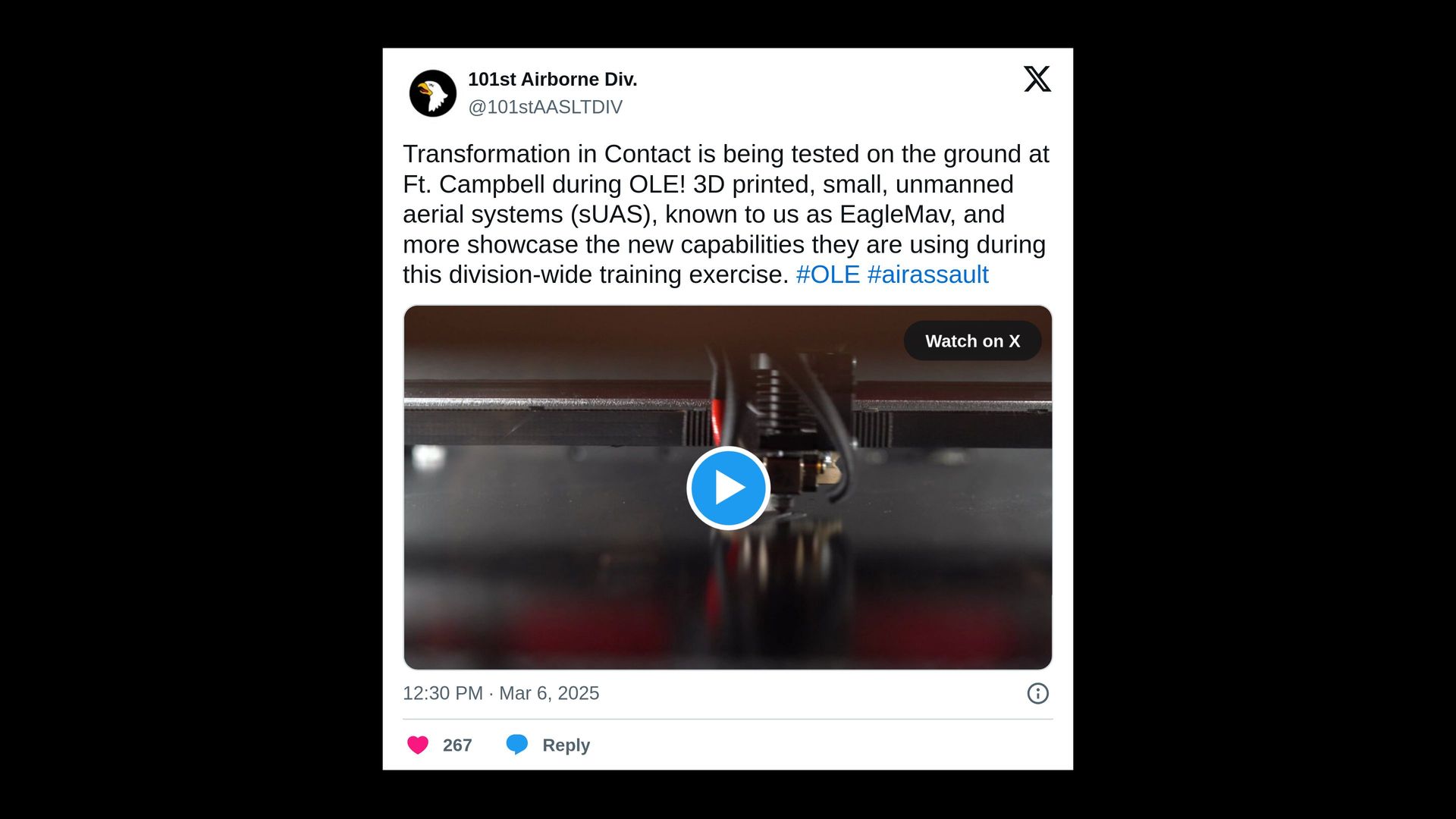
The U.S. Army's 101st Airborne Division (Air Assault) is printing its own drones.
Zoom in: In a video shared on X, soldiers are seen assembling pieces and flying the small unmanned aerial systems.
What they're saying: "Soldiers asked for sUAS that were more versatile, durable and expendable than the standard previously fielded versions," the Army said in an announcement.
My thought bubble: Mark Pomerleau at DefenseScoop has more details, here.
- I also wrote about additive manufacturing and its defense applications in February. Give that a read, here.
Shoutout to Nicholas Johnston for editing and Matt Piper for copy editing.
👋🏼 Thanks, as always, for reading and sharing. Tell your friends to subscribe, here.
Sign up for Axios Future of Defense