What Trump's Iron Dome demands

Add Axios as your preferred source to
see more of our stories on Google.
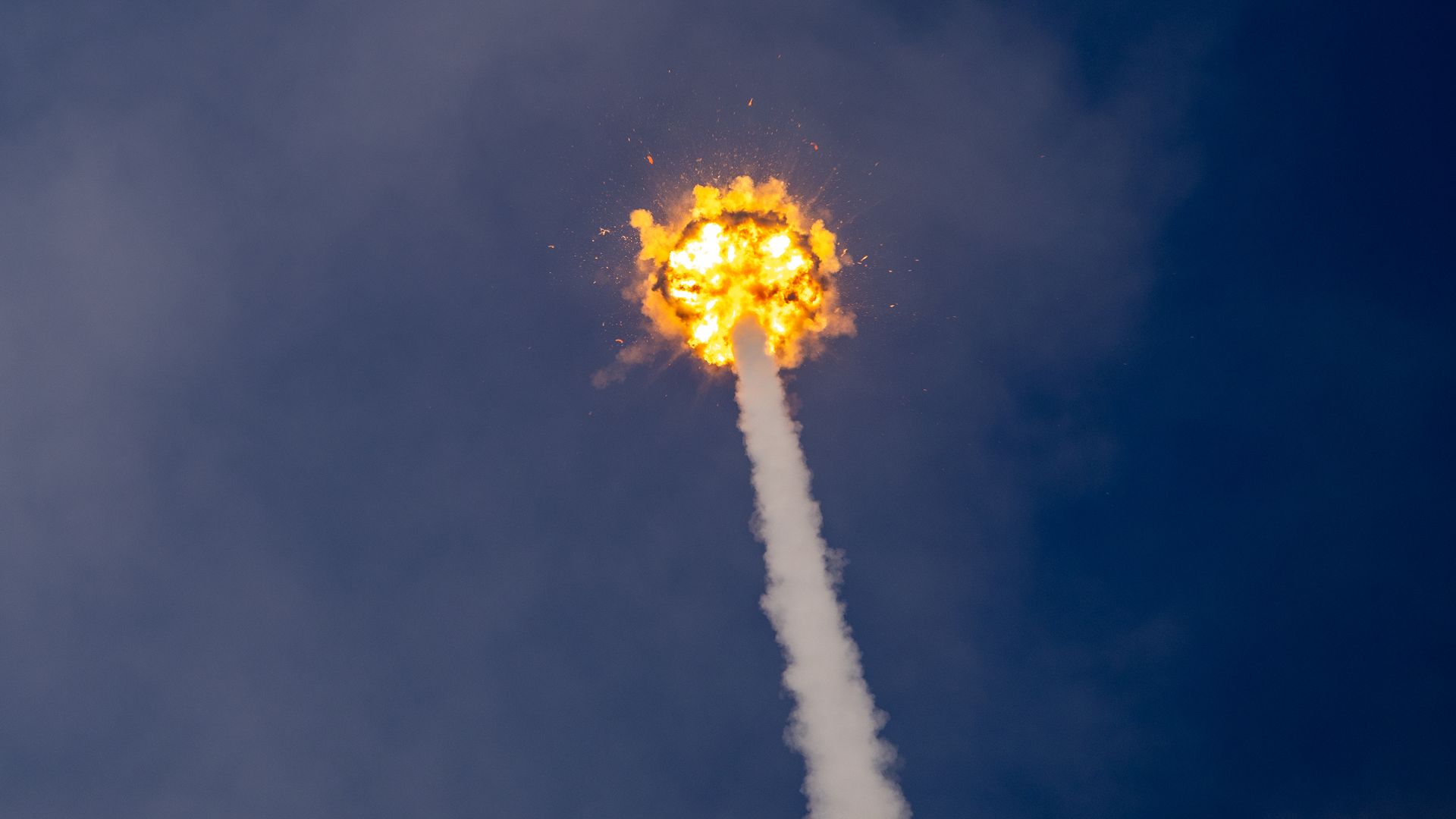
A successful intercept during Operation Shining Star at McGregor Range, New Mexico. Photo: JaDarius Duncan/DVIDS
So you want to build an Iron Dome. But much bigger, more complex and pricier than the one protecting Israel, right?
Why it matters: President Trump's fiat for a hemispheric shield raised more questions than it initially answered, spurring debate among lawmakers, military officials, defense contractors, analysts and hobbyists.
- Much like Trump riffed on Ronald Reagan with MAGA, here, too, does he invoke the former president and his Star Wars ideals.
- This is a campaign promise made manifest and also a return to 2019, when Trump pledged to "detect and destroy any missile launched against the United States, anytime, anywhere and any place."
To figure out what's needed to make the vision a reality, Axios consulted defense experts, tuned into timely congressional testimony and did the reading. Here's some of the consensus:
Sensors galore. U.S. Northern Command and North American Aerospace Defense Command have for years yearned for additional monitoring capabilities.
- Their jobs are getting no easier, with a steady drumbeat of foreign activity off the coast of Alaska.
- Gen. Gregory Guillot told lawmakers last week: "You can't defeat what you can't see, and the adversaries have an increasing capability of reaching us and threatening us from ranges beyond what some of our current systems can detect and track."
- The possibilities stretch from seabed to space, including the E-7 Wedgetail and the Hypersonic and Ballistic Tracking Space Sensor layer.
Networks and handoffs. One of the biggest hurdles here — exemplified by Northeast drone mania — is information sharing and interdiction responsibilities.
- The Global Information Dominance Experiments are chipping away at this. The exercises were resuscitated by the Chief Digital and Artificial Intelligence Office and feed the beast that is Joint All-Domain Command and Control.
- "We have a network of ground-based sensors that is very exquisite and very effective, but we need to be thinking about out-of-the-box solutions to get that coverage of hypersonic threats, to get that coverage of drone threats," Masao Dahlgren, a fellow at the Center for Strategic and International Studies, said in an interview.
- "The sensing piece and the software needed to stitch it all together, I think, is going to be the No. 1 priority for any Iron Dome, before we even get into the conversation of what we're going to defend."
A stomach for debate. Missile defense can be cast as provocative. It's partly chicken-and-egg thinking: If country A has better defense, country B wants better offense.
- "The United States has been restrained in its development and deployment of strategic defenses with the hope that Russia and China would follow suit," Rebeccah Heinrichs, a senior fellow at the Hudson Institute, told Axios. "But that restraint really hasn't bought us anything."
- "Both adversaries," she said, "are developing and deploying serious air and missile defenses of their homelands."
- Space-based weapons are polarizing. There are widely expressed concerns about the exploitation of space and potential arms races there.
Money, money, money. The executive order included no price tag or plainly stated funding source. But if the past is any indication of the future, Iron Dome for America will compete for and chew through cash.
- "This will cost tens of billions of dollars and require a sustained commitment over at least a decade," Todd Harrison, a senior fellow at the American Enterprise Institute, told Axios. (His spending breakdown can be found here.)
- "It will be interesting to see how the administration proposes paying for this," he added, "and whether they can advance the program enough in the next four years to make it stick when a future administration takes over."
- Sens. Dan Sullivan (R-Alaska) and Kevin Cramer (R-N.D.) filed legislation, the Iron Dome Act, that would inject billions into missile defense. During a congressional hearing, Sullivan shared a poster highlighting Long Range Discrimination Radar, Aegis Ashore and Terminal High Altitude Area Defense.
Humility. Perfect, impenetrable defense isn't realistic. Certain sites demand priority, and something will eventually get through.
- There were 350 drone detections across 100 installations last year.
- Both Israel and Ukraine — smaller than the U.S. and frequently tested by neighbors — miss. Saturation is deadly.
- There's also defense-tech graveyards littered with such grand plans.
My thought bubble: Defense of Guam will be a good barometer.
- The Missile Defense Agency for the first time in testing intercepted a ballistic missile target from Guam. It happened last year.
Catch up quick: The Space Development Agency and MDA pinged industry to see what's possible.
- RTX, L3Harris Technologies and General Atomics have all said they're well-positioned to win work.
What's next: Government officials have less than 60 days to complete homework assigned to them by the executive order.
