Axios Future of Defense

January 15, 2025

I was wrong when I said Washington was thawing. It's not. Send wool socks.
- The Surface Navy Association conference is underway. I'm here today and tomorrow. Got news to share or decent coffee at your booth? Hit reply.
🏛️ Situational awareness: Pete Hegseth's confirmation hearing lacked talk of future weaponry and defense-contractor innovation. It instead focused on women's role in combat, alleged misconduct and the "warrior ethos."
- My thought bubble: The acquisition reform question from Sen. Gary Peters (D-Mich.) was a highlight. So was Hegseth's apparent support for digital twins.
Ready or not: Blasting satellites, self-driving ship-killers and a new line of drone boats from Textron Systems.
Today's newsletter is 1,142 words, a 4.5-minute read.
1 big thing: Race for the Arctic

President-elect Trump's talk of Canada as a "51st state" and annexing Greenland registered among national-security crowds as an "Oh, boy!" moment. Obnoxious, enticing, familiar.
Why it matters: The darlings of Trump's current foreign policy fixation boast Arctic utility at a time when the icy region is heating up.
- Both Russia and China see the northern reaches as a resource-rich crossroads, and melting ice grants new travel and trade routes as well as opportunities for military basing.
It can be argued Trump is on to something, as his onetime national security adviser H.R. McMaster did at the Council on Foreign Relations.
- "What's behind the Greenland comment, I think, is a recognition that not enough has been done ... to secure Greenland and its very important claims to the Arctic."
It can also be argued what underpins all of this is a massive case of FOMO.
- "Once you get involved in high-stakes geopolitical competition, you're very susceptible to these sort of arguments that something ... is about to become much more important, and you've got to get there before the other guy," Jeremy Shapiro at the European Council on Foreign Relations told me.
Here are some things to chew on:
- The Defense Department foresees an ice-free summer by 2030. While Trump has declared climate change a hoax, it is not, and it colors the thinking of designers, planners and engineers.
- The department's latest Arctic strategy argues each military service should be cold-weather ready. Think skiing and snowshoeing, medical care and survival skills. Antarctica is no Afghanistan.
- Pete Hegseth committed to building up Arctic power at his confirmation hearing Tuesday. The answer came at the behest of Sen. Dan Sullivan (R-Alaska).
- In August, the Army put its Alaska-based aviation units under a local command reporting to the 11th Airborne Division. The "Arctic Angel" division is headquartered near Anchorage.
- Chinese and Russian warships operated together near Alaska in 2022 and 2023. In 2024, U.S. and Canadian forces intercepted H-6 and Tu-95 bombers that took off from the same base.
- Beijing for years discussed a Polar Silk Road, part of its mega-influential Belt and Road Initiative.
- A RAND study in 2023 found Moscow "has the capacity to sustain a strong day-to-day presence in the maritime Arctic in a way that the United States does not."
- The U.S., Canada and Finland inked an agreement in November to begin developing icebreakers. It follows the ICE Pact announcement, which coincided with the NATO summit in Washington.
Behind the scenes: Denmark sent private messages to the Trump team expressing a willingness to discuss boosted security in Greenland or increasing U.S. military presence on the island, my colleagues Barak Ravid and Dave Lawler reported.
- This puts the silliness aside in favor of realistic, near-term metrics.
- Greenland's prime minister, Múte Egede, at a briefing said they do "not want to be Danes, and we do not want to be Americans," local outlets reported. But that's not a no to closer ties.
My thought bubble: Refusing to rule out military force and jokes about forcing another state into the union is more shock and awe than it is hard-nosed negotiating.
- But there's signal in the noise.
- As the Congressional Research Service puts it, there's "heightened interest in, and concerns about, the region's future."
2. Counter-space conversations

The U.S. needs more options to disrupt or destroy space tech deployed by other countries, namely China and Russia, according to Air Force Secretary Frank Kendall.
Why it matters: Counter-space weaponry is seemingly taboo to talk about. Rarely will an official discuss hunting spacecraft.
The latest: The outgoing secretary on Monday called for a "much bigger, much more capable, much more powerful Space Force" — going from "a Merchant Marine to a Navy, an armed force."
- "We need a cost-effective mix of terrestrial and orbital weapons," he said at the Center for Strategic and International Studies event.
Zoom out: Militaries rely on space and satellites for navigation, long-haul communications, spying, targeting, missile tracking and more.
Threat level: Experts warn Washington's advantage in space is eroding. Meanwhile, Moscow and Beijing jockey for position and arsenal advancements.
- The former hit a satellite of its own in 2021, creating more than 1,500 shreds of space debris. The latter blew up a defunct weather satellite in 2007, drawing international criticism.
The bottom line: "Space is going to be the decisive domain," Kendall said.
- "The ability of the entire joint force to project power depends upon our success in space."
3. Quick hits

💉 The U.S. is not taking seriously enough Chinese biotechnology advances, which yield benefits for the People's Liberation Army and could subvert the economic status quo, according to a report first shared with me.
- Why it matters: "PLA scholars literally cannot shut up about how they want to integrate biotechnology into warfare and to fight modern wars," Craig Singleton, the author and senior fellow at Foundation for Defense of Democracies, told me.
- 💭 My thought bubble: A point Singleton made that I can't shake off? "I think biotechnology is the next semiconductors."
🚛 Defense firm Forterra is outfitting Oshkosh Defense's Remotely Operated Ground Unit for Expeditionary Fires with self-driving tech, providing the Marine Corps a smart, ship-sinking machine.
- Why it matters: The news follows two low-rate initial production orders for ROGUE-Fires in fiscal 2025.
- 💭 My thought bubble: Can't get enough ground autonomy? Check out my exclusive on Overland AI's Series A.
📊 The U.S. Navy's bundled purchase of four amphibious warships will have immediate benefits for the defense industrial base, 65% of respondents said in a recent poll. A little less than half said it will improve the hiring, training and retention of a skilled workforce.
- Why it matters: The Amphibious Warship Industrial Base Coalition's survey of 219 suppliers shows just how well received block buys can be. (They also save taxpayer dollars.)
- 💭 My thought bubble: Breaking Defense has a solid rundown on the service's multibillion-dollar amphib deal with HII.
➕ Heven Drones and Smartshooter, both with Israeli ties, are collaborating on a drone-killing drone using the former's H100 and Urban unmanned aerial vehicles and the latter's Smash Dragon robotic gun.
- Why it matters: Counter-drone is hot — just look at Replicator 2. Companies of all sizes and provenance want in on the game.
- 💭 My thought bubble: The more the merrier. Competition begets innovation.
4. Check this out
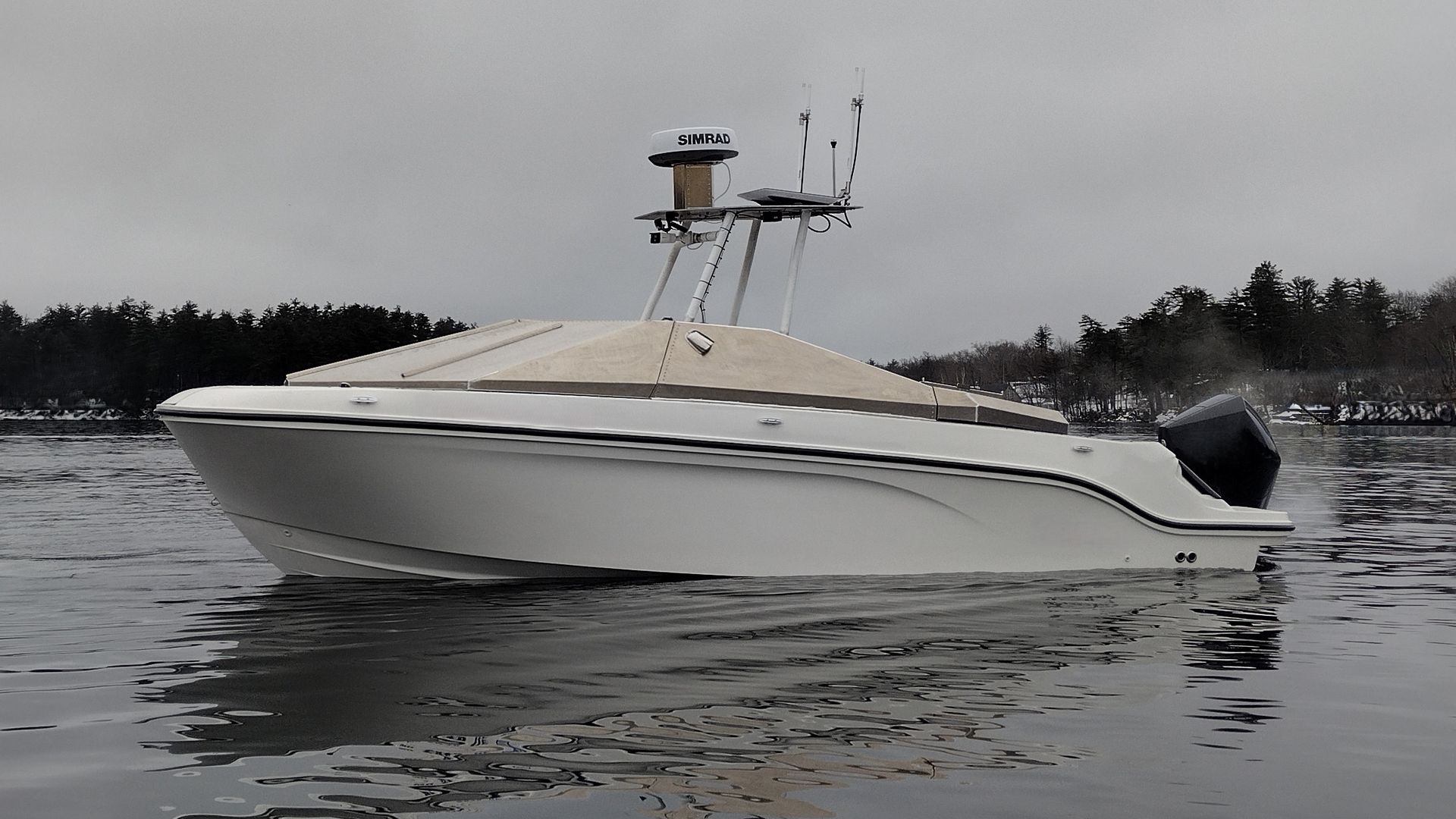
Textron Systems unveiled a line of autonomous surface vessels dubbed Tsunami, built in collaboration with Brunswick Corporation, which owns major boating brands Boston Whaler and Mercury Marine.
Why it matters: "We recognize the need for a ready-now solution that harnesses the capability and capacity of the U.S. industrial base," David Phillips, Textron's senior vice president for air, land and sea systems, told reporters.
- "We don't have to build from scratch."
Zoom in: There are 24-, 25- and 28-foot variants. Ranges can surpass 1,000 nautical miles.
- Payloads are customizable, too. What do you want? Guns? Jammers? Sensors?
Shoutout to Nicholas Johnston for editing and Matt Piper for copy editing.
👋🏼 Thanks, as always, for reading and sharing. Tell your friends to subscribe, here.
Sign up for Axios Future of Defense