Axios Future of Defense
January 21, 2026

Welcome back! Taking any and all arctic survival tips (hello, 11th Airborne Division) as the temperature in Washington plunges.
- Also, I'm hooked on Arc Raiders. If I catch you in Stella Montis, it's on sight.
🇫🇷 Situational awareness: Carmaker Renault is teaming up with defense-and-aerospace company Turgis Gaillard to build drones. They will be similar to the Iranian Shahed, L'Usine Nouvelle reported.
Enjoy: AIM's Air Force contracts, a pricey Pentagon nickname and Dominion Dynamics' seed round.
Today's newsletter is 1,957 words, a 7.5-minute read.
1 big thing: Space's "global challenge"
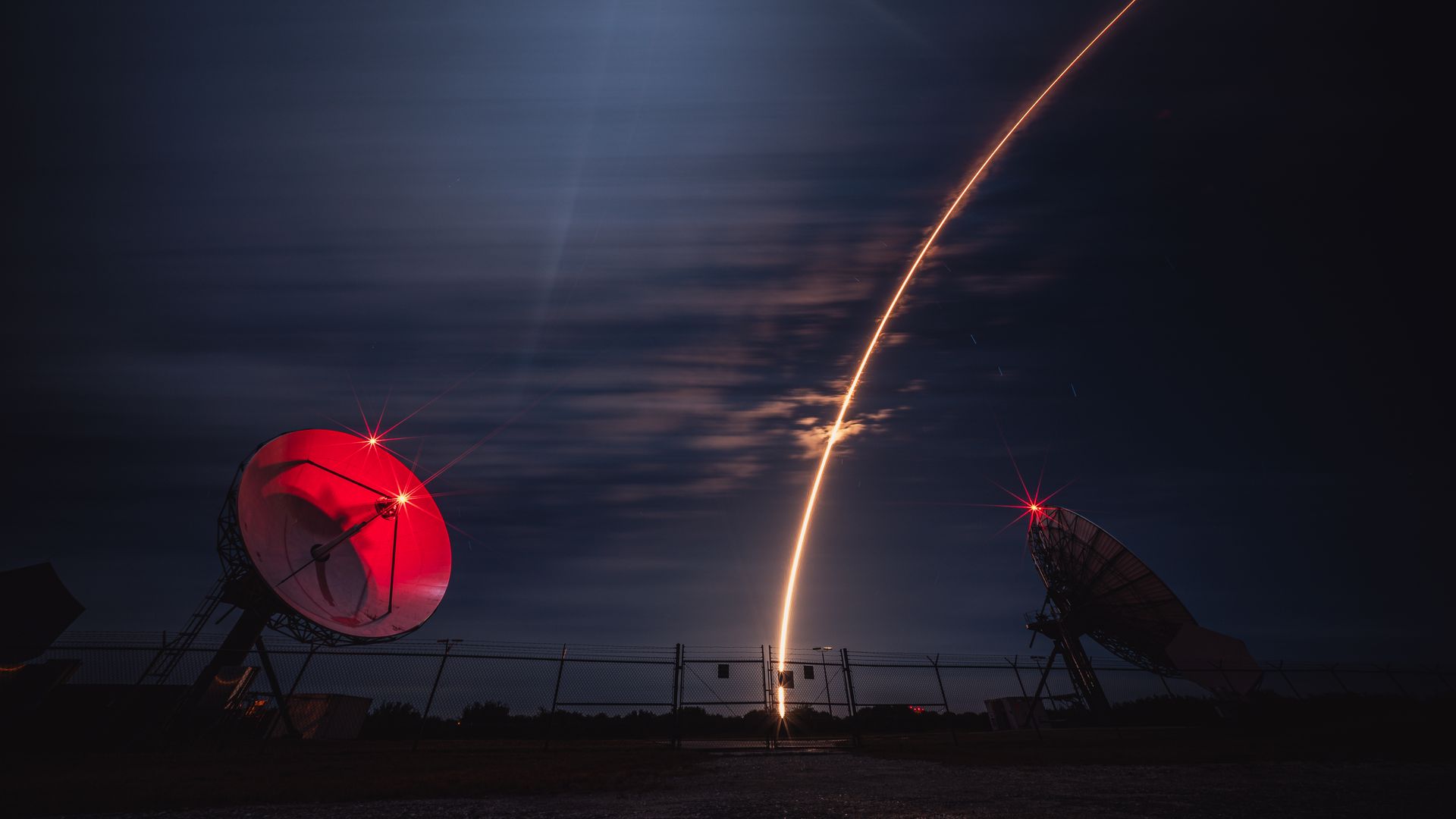
World powers see space as a future battlefield. The consequences are enormous.
The big picture: Tomorrow's war will be fought in the stars above as well as on the ground below. Preparations are happening today.
- The signs are everywhere: in launch cadence competitiveness, insatiable appetites for overhead imagery, Chinese satellite close-approaches, reported Russian development of nukes for space and the Pentagon's pursuit of a revived and rebranded Star Wars.
- "There really is a high-stakes competition unfolding in space, and we're seeing China and Russia really deploying significantly more capabilities," Susanne Hake, a Vantor executive vice president, told me.
- "What's notable here is the line between routine activity and nefarious behavior is getting thinner," she said. "Space has no national boundaries, right? So it's inherently a global challenge."
Driving the news: The military value of space was made clear in the briefing that followed America's capture of Venezuelan strongman Nicolás Maduro; Space Command, it was revealed, helped carve a path for troops headed into a blacked-out Caracas.
- "I think Operation Absolute Resolve is a perfect example of what modern, integrated U.S. warfare looks like," Kari Bingen at the Center for Strategic and International Studies told me.
- "Just like we've seen — whether it's Israel-Gaza, Israel-Iran, Ukraine-Russia — you want to be able to take out the other guy's eyes and ears and ability to communicate."
The intrigue: The Trump administration has expressed interest in both the exploration and weaponization of space, which is governed by a cocktail of agreements, conventions, resolutions and treaties.
- In less than six years, President Trump has energized and complicated this international dynamic.
- In his first term, he springboarded the Space Force, which recently began talking plainly about weapons in space.
- In his second term, he courted Elon Musk, introduced to the world the $175 billion Golden Dome, warned of progress lost to Beijing and Moscow, relocated SPACECOM headquarters to Alabama to "help America defend and dominate the high frontier," and directed the deployment of nuclear reactors on the Moon.
Zoom in: The urgency and opportunity are felt among America's industrial players.
- More than 2,400 applicants have been named, so far, to the Missile Defense Agency's Scalable Homeland Innovative Enterprise Layered Defense contract. It's worth as much as $151 billion.
- "Gen. [Chance] Saltzman has made it clear: Space is a warfighting domain," Gokul Subramanian, senior vice president of engineering at Anduril Industries, told me, referencing the Space Force's operations chief.
- "As our adversaries rapidly develop and field offensive space capabilities, the assumption that space is a peaceful domain no longer holds."
Threat level: Daily life counts on space. Your morning forecast. The quickest route to work. Financial transactions during lunch or dinner.
- "I don't know, on average, if people understand how dangerous their lives would be if satellite systems just blacked out," Jonathan Horowitz, a legal adviser at the International Committee of the Red Cross, told me.
- "As there is increased attention to space, that attention needs to account for humanitarian consequences," he said. "That can't be forgotten."
More from Axios:
Inside Apex as it readies a Golden Dome demo
2. Exclusive: AIM lands Air Force work

AIM, a company automating heavy-duty machinery and earthworks, secured nearly $5 million in U.S. Air Force contracts for remote air base construction and runway repair.
Why it matters: American power projection — its ability to be anywhere at any time — relies on far-flung outposts and depots. Building and maintaining them is manual-labor intensive, putting people in the potential line of fire.
- "There might be craters. There might be debris. Infrastructure might get severed," AIM CEO Adam Sadilek told me. "Our machines are really good at fixing those types of problems, and doing it in a way where there are no humans involved."
Zoom in: AIM retrofits vehicles, like excavators, dozers and loaders, to make them fully autonomous. It's proven the process in the mining and construction industries, and is now plunging into the defense market.
- "If you look at a classic mine site, it's almost as hostile as a lot of the military settings," Sadilek said.
- "Essentially all mine sites are remote, in areas where it's way too hot or way too cold. There's minimal to no connectivity, unless you somehow bring it there. It's areas that are not very desirable for humans to be."
How it works: Airfield repair would, in this case, involve machinery mapping a location, clearing debris and ordnance from it and patching up problems.
The intrigue: The company, based in the Seattle region, previously worked with the Army on de-mining efforts. The service wants to robotize that kind of high-stakes work.
The bottom line: "You can have the best fighter jets and drones and vehicles of war, but if they don't have a place to take off from, or get charged and refueled, or to do maintenance on, or come back home to, they are very inefficient or ineffectual, or they might as well not exist in some sense," Sadilek said.
3. "Now's the time" for lasers

The chief of U.S. naval operations, Adm. Daryl Caudle, is advocating for powerful lasers aboard the newfangled Trump-class battleship, which is also expected to wield nuclear and hypersonic weapons.
Why it matters: Caudle has for years lamented a dearth of directed energy across the Navy. A new armed-to-the-teeth warship — pitched as the apex predator of the futuristic Golden Fleet — could offer a reversal of fortunes.
- "Now's the time," he told reporters at a breakfast on the sidelines of the Surface Navy Association conference, down the road from the Pentagon.
- "We're going to put a clear signal out there," he said. "This is my goal: If it's in line of sight of a ship, the first solution that we're using is directed energy."
State of play: Governments and scientists have for decades tinkered with these sci-fi-style armaments; the Pentagon just a few years ago was pouring into them $1 billion annually. But frontline adoption has been sluggish.
- A handful of lower-power Optical Dazzling Interdictor Navy systems were installed aboard Arleigh Burke-class guided-missile destroyers, according to Laser Wars. There's also the 60-kilowatt High Energy Laser with Integrated Optical-dazzler and Surveillance on the USS Preble.
- "We've got to have different class lasers, I think, going forward on the battleship to make them effective," Caudle said.
Friction point: Trump-class battleships will be outfitted with 300- or 600-kilowatt lasers, according to specs published by the Navy. Such weapons are not readily available.
- The first battleship, if purchased today, could cost a little more than $20 billion, according to a Congressional Budget Office analysis. Follow-on ships would cost less.
The bottom line: "I don't think a 1-megawatt laser is beyond what should be on that battleship," Caudle said. But, "I'll take what I can get."
More from Axios:
Electromagnetic weapon zaps drone swarm in seconds
Introducing Trump's puzzling nuclear-armed battleship
Laser specialist Aurelius gets $10 million for counter-drone quest
4. ICYMI: Pentagon price check

Rebranding the Department of Defense as the Department of War will cost between $10 million and $125 million — but could cost hundreds of millions more if lawmakers make it official, according to the Congressional Budget Office.
Why it matters: The name change is part of a larger overhaul of the U.S. military sought by the Trump administration, which has emphasized physical appearances and wartime messaging while seeking a record-setting $1.5 trillion defense budget.
Driving the news: The CBO detailed its findings in a letter to Senate Minority Leader Chuck Schumer (D-N.Y.) and Sen. Jeff Merkley (D-Ore.).
- The office cautioned its estimate is "uncertain," however, because the Pentagon declined to share information about its implementation.
The fine print: Total costs will vary based on how quickly and widely the "War" nomenclature is adopted, including on signs, letterheads and websites. (What was once defense.gov is now war.gov.)
- A report obtained by the CBO lists $1.9 million in renaming costs across five organizations within the Office of the Secretary of Defense for items such as flags, plaques, badges and training materials.
- But that report "may underestimate how much the name change has cost DOD to date," the CBO said.
What they're saying: "Simply put: Trump does not have the authority to rename DOD without an act of Congress," Merkley said in a statement.
- "This move is performative government at its worst and does nothing to advance national security or help service members and their families."
The big picture: Some of the administration's most ambitious projects — like the Golden Dome missile shield and the Golden Fleet naval revitalization — come with ready-for-market names.
Go deeper: Trump's Cabinet of main characters
5. Quick hits

📸 ICEYE signed a fresh agreement with Ukraine to ensure its defense ministry "continues to receive a high volume of high-resolution satellite imagery."
- Why it matters: "Today's operational environment makes one thing clear: Space is no longer only a strategic domain, it is a tactical layer of defense," ICEYE's John Cartwright said in a statement.
- 💭 My thought bubble: Please refer to item No. 1 in this newsletter.
❄️ Dominion Dynamics announced a $15 million seed round led by Georgian. Bessemer Venture Partners and British Columbia Investment Management Corporation also participated.
- Why it matters: The cash will be used to accelerate deployment of Auranet, its web of sensors and autonomous tech. "We are building systems that can scale, talk to each other and be risked in combat," CEO Eliot Pence said in a statement.
- 💭 My thought bubble: Timely.
🏭 Kongsberg broke ground on a missile-production site in Toano, Virginia. A Navy-Marine Expeditionary Ship Interdiction System was hauled in for the event.
- Why it matters: The facility is expected to boost production capacity and sustainment of Naval Strike and Joint Strike missiles. It's also expected to create 180-plus jobs.
- 💭 My thought bubble: This is a good-news story. More factories, more missiles, more services satisfied. (Full-rate production is expected in 2028.)
📚 A Vannevar analysis found an increase in Chinese and Russian influence operations coinciding with expanding U.S. efforts in Latin America. Dominant narratives include calling for restraint and labeling Washington "a hostile actor."
- Why it matters: Public sentiment can very quickly sway. A vast majority of Republicans, once hesitant, now approve of President Trump's capture of Venezuelan leader Nicolás Maduro, according to a YouGov poll.
- 💭 My thought bubble: Those X bots are baiting you for a reason.
6. Check this out
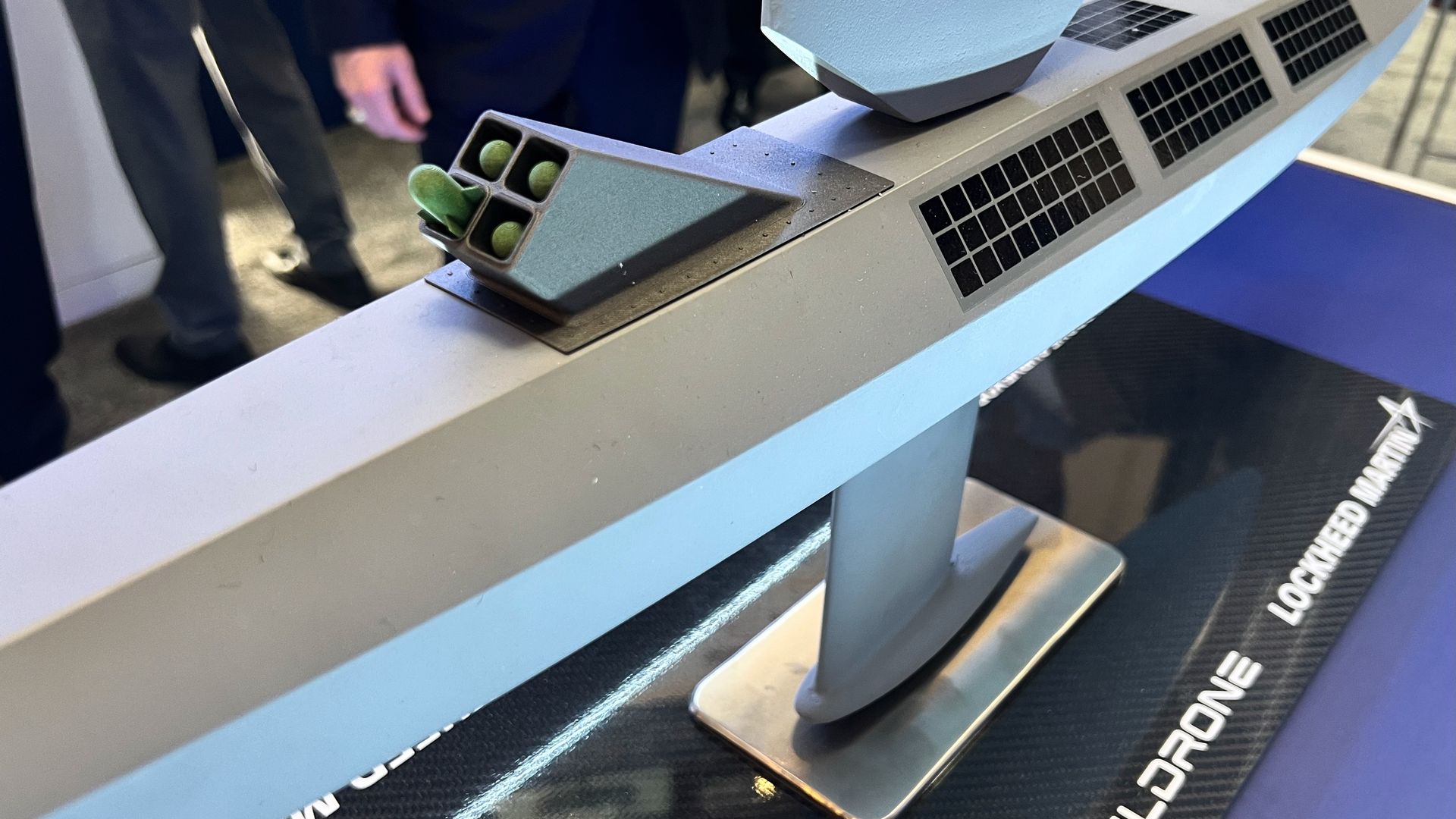
Saildrone and Lockheed Martin teased the look of a missile-toting unmanned surface vessel at the Surface Navy Association conference in Virginia this month.
The big picture: The two companies are outfitting a Surveyor drone-boat with a Joint Air-to-Ground Missile quad-launcher, as seen above.
- Larger Saildrone vessels are also in development, coinciding with potential Mk 70 VLS integration.
What they're saying: "There's a realization within Navy circles that we simply don't have enough manned platforms to cover down on the number and type of missions that are being asked for by our four-star combatant commanders," Saildrone president John Mustin told me.
- "This is an enhancement to existing capability — not a tradeoff."
What we're hearing: Saildrone and Advanced Acoustic Concepts, a Thales company, are also in early talks, regarding variable depth sonar that can be used to hunt submarines.
Go deeper: Ukrainians eye drone collaboration in Portugal trials
Shoutout to Dave Lawler for editing and Matt Piper for copy editing.
👋🏼 Thanks, as always, for reading and sharing. Tell your friends to subscribe here.
Sign up for Axios Future of Defense