Axios Future of Defense
January 14, 2026

Good morning from the annual Surface Navy Association get-together.
- If you're here, too, give me a shout. We can commiserate over conference coffee.
🤖 Situational awareness: The Pentagon on Monday named Cameron Stanley as the next chief digital and artificial intelligence officer and Owen West as the next Defense Innovation Unit director. (DefenseScoop on Jan. 7 described Stanley as the "frontrunner" for the job.)
Keep scrolling: SkyFi's Series A, Onebrief's Battle Road buy and the return of Air Force duty patches.
Today's newsletter is 1,739 words, a 6.5-minute read.
1 big thing: The great 2026 reset
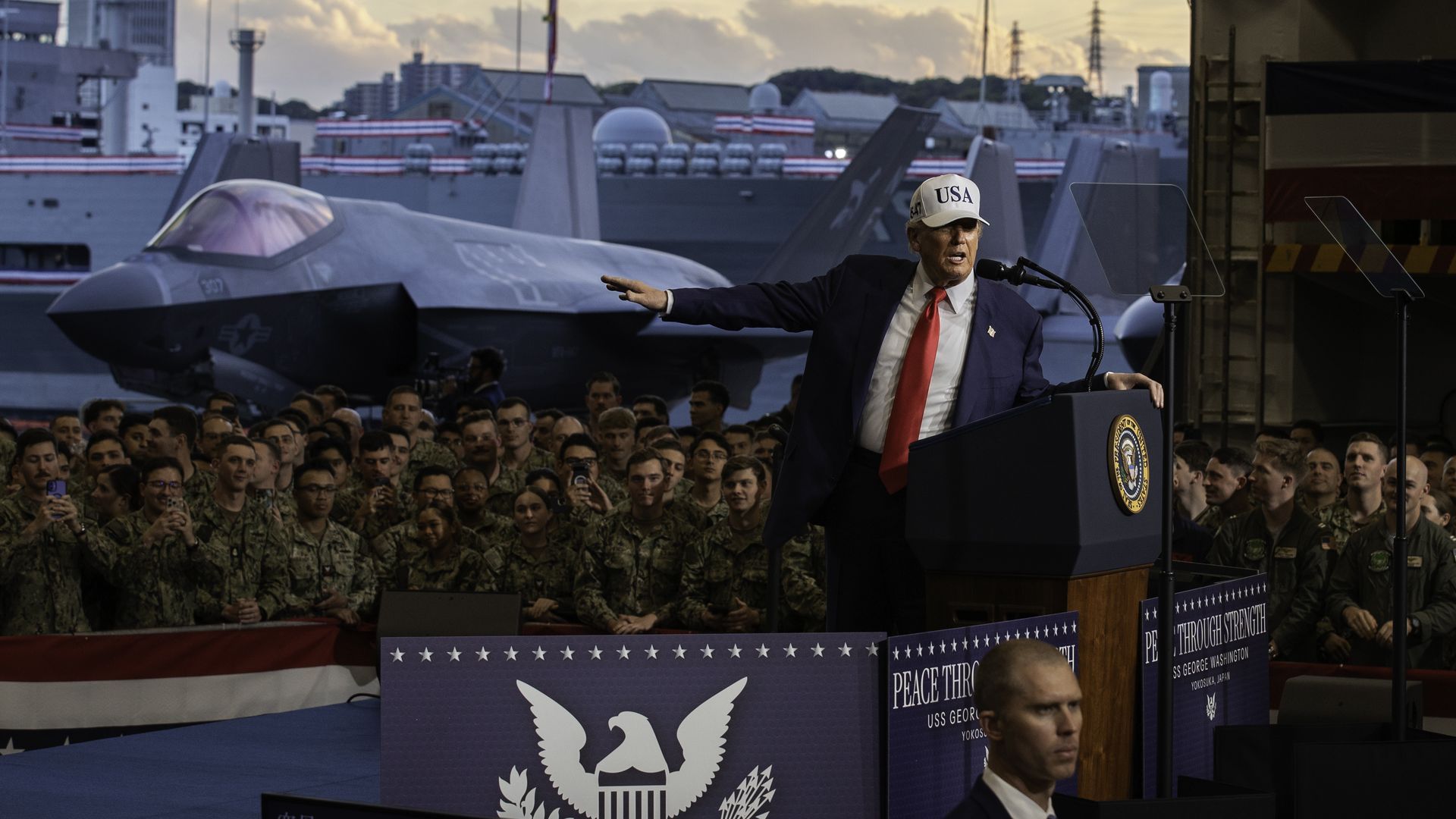
The world's understanding of how President Trump intends to wield the American military and influence the industry that arms it changed dramatically in two weeks flat.
The big picture: In the earliest days of the new year, the commander in chief dispatched troops to capture Venezuelan strongman Nicolás Maduro and warned Colombia, Cuba, Greenland and Mexico they could be next.
- He also hinted at another round of action in Iran, a symptom of his growing affinity for military force. Another sign: Nigeria was the seventh country bombed in less than a year.
- Asked about guardrails to global power, Trump told the New York Times: "My own morality. My own mind. It's the only thing that can stop me."
- "I don't need international law," he added. "I'm not looking to hurt people."
Meanwhile, Trump menaced the contracts of the world's second-largest defense company, sought to suspend dividends and stock buybacks across the sector, and demanded investments in "plants and equipment" and speedier weapons production.
- At the same time, Trump floated a record $1.5 trillion military budget.
- The president wants new warships on the sea and space-based interceptors in the sky on his terms and his expedited timeline.
Driving the news: All of it. All at once. All over the world.
The other side: Critics worry Trump is spreading his attention — and that of the military — in too many scattershot directions.
- "China just conducted its largest military exercise in three decades. Since 2010, their power production, with a huge emphasis on nuclear and solar, has increased by more than the rest of the world combined. Now we're sending them H200s," Rep. Pat Ryan (D-N.Y.) told me, referring to Nvidia's advanced chips.
- "And yet we're stuck in the past, focused yet again on half-baked, regime-change wars for oil fought with conventional weapons, while our grid falls even further behind."
Zoom out: A $1.5 trillion Pentagon budget would push defense spending to its highest levels since the end of the Cold War.
- The proposal easily clears previous allocations, at roughly 5% of GDP.
- It quickly won support from the chairmen of the House and Senate armed services committees.
- The nuance? While Trump wants to flood money into the defense sector, he also wants to shape how it's spent.
Follow the money: Prohibitions on stock buybacks, dividends and compensation "are truly unprecedented, as far as I can tell," Jerry McGinn at the Center for Strategic and International Studies told me.
- "I have no idea how they would be enforced and many have questioned their legality. Seems to be more of a shot across the bow."
- "Bottom line, the president is looking to strengthen the defense industrial base through increased investment and better performance by both companies and the government," McGinn said.
2. SkyFi secures $12.7 million

SkyFi, billed by CEO Luke Fischer as the "geospatial front door for the world," raised $12.7 million.
Why it matters: Demand for and delivery of overhead imagery is booming, flipping a traditionally gatekept intelligence asset on its head.
- These days, everyone from farmers to open-source intelligence geeks on X can glean new information from readily available satellites.
Driving the news: The Series A, announced today, was led by Buoyant Ventures and IronGate Capital Advisors. Other backers include DNV Ventures and J2 Ventures.
- "We started going out and it was $8 million. Then we got more investor demand for $10 million — then up to $12 million," Fischer told me.
- "Then we oversubscribed to $12.7 million."
State of play: SkyFi works with a network of more than 50 companies, including Vantor, Planet, Iceye US, Near Space Labs, Umbra and TurbineOne, to collate and distribute optical, synthetic aperture radar, hyperspectral and aerial imagery as well as related analytics.
- "It's no longer about: 'Can we launch a rocket, can we put metal in space?' It's about, 'How do the customers get the answers?' You needed a company like us to come in and be like, 'This is our sweet spot.'"
- "This is where we're going to focus: on speed to answers, speed to imagery," he said.
What's next: SkyFi is looking to "round out the team" but not "massively increase" its workforce, according to Fischer. The company is based in Austin, a defense-tech hotspot.
Go deeper: Reditus readies for space after raising $7.1 million
3. Frigate factors

HII chief executive Chris Kastner has "high confidence" the U.S. Navy's future frigate will launch in 2028, following word that the warship will be based on the company's National Security Cutter.
The big picture: The NSC is the centerpiece of the Coast Guard's fleet. It's been in service for almost two decades.
- "They know exactly what it can do," Kastner said. "The Navy's been on that ship and fully understands the capabilities of that ship."
- Critics have questioned its wartime fitness, including potential armaments.
The intrigue: A previously pursued frigate, the Constellation class, built by Fincantieri, was nixed days before Thanksgiving after years of trouble.
- Only two of those six ships will now be built.
Driving the news: Kastner briefed reporters at the company's Crystal City offices ahead of the annual Surface Navy Association conference.
- He said the first ship will have "limited design changes" and those alterations "will be topside, which means you're not changing the fundamental structure of the ship, which means you can start now."
- Design work is ongoing. The actual cutting of steel, he added, "is imminent."
Zoom out: The Trump administration has zeroed in on shipbuilding as China, Japan and South Korea dominate the market.
- Trump and Navy Secretary John Phelan late last year revealed the Golden Fleet initiative, which includes the frigate and a heavily armed neo-battleship.
Go deeper: U.S. Navy secretary's "strategic shift" sinks four frigates
4. Exclusive: Onebrief acquires Battle Road
Defense software company Onebrief raised $200 million and snapped up Battle Road Digital, giving its military-planning suite a simulation and wargaming boost.
Why it matters: Onebrief has skyrocketed in just a few short years, riding artificial intelligence and contested logistics waves inside the Pentagon.
- The company, which expects to employ more than 500 people by the end of 2026, is working with most U.S. combatant commands.
- Its valuation nearly doubled from $1.1 billion to $2.1 billion in about half a year.
Follow the money: The Series D was led by Battery Ventures and Sapphire Ventures. Other backers include Salesforce Ventures, General Catalyst and Insight Partners.
- "Everyone involved in the raise is a sophisticated investor who I really respect," chief executive Grant Demaree told me. "We had a competitive round."
State of play: Onebrief's AI-fueled software speeds and simplifies operational planning and other defense workflows. In the past, such assignments relied on sticky notes, emails and disparate documents.
- "Staffs are too slow. They're just too slow for how fast our adversaries move now; they're too slow for how complex the modern battlefield is. We need things to move hundreds of times faster than they do, and that takes automation," said Demaree, a former Army officer.
- "I built this to help who I was before."
The intrigue: Battle Road in July won a three-year, $40 million Army contract to furnish the simulation software engine for the service's Next Generation Constructive program.
Go deeper: Pentagon CTO seeks "five more Andurils and Palantirs and SpaceXs"
5. Quick hits

🇮🇷 Thousands of people — anywhere from 2,000, according to Reuters, to 20,000, according to CBS — have been killed in protests in Iran. Thousands more have been arrested, the Human Rights Activists News Agency reported.
- Why it matters: The protests are the most serious and visible challenge to the country's authoritarian regime in years. The unrest has spread since late December.
- 💭 My thought bubble: Internet restrictions and communication crackdowns make assessments incredibly tricky.
💳 L3Harris Technologies announced two major moves: A $1 billion government investment in its rocket motor business and the sale of a majority stake in its space propulsion and power business to AE Industrial Partners, a private equity firm.
- Why it matters: Together, it's a significant shakeup for the world's ninth-largest defense contractor. (The former appears to be follow-through on Commerce Secretary Howard Lutnick's suggestions last year.)
- 💭 My thought bubble: The "trusted disruptor" is, indeed, disrupting!
➕ Booz Allen Hamilton and Andreessen Horowitz unveiled a new partnership, meant to springboard growth-stage companies. The two already work together on artificial intelligence, autonomy and electronic warfare.
- Why it matters: "Over the years we've witnessed Booz Allen's essential role in bringing commercial tech to the federal government," Ben Horowitz, an a16z cofounder, said in a statement.
- 💭 My thought bubble: My Axios Pro colleague Lucinda Shen has a full rundown, here. Worth reading for her thought bubble!
🗳️ Gen. James Mingus, the U.S. Army vice chief of staff, will retire in the coming months. The Senate confirmed his successor, Lt. Gen. Christopher LaNeve.
- Why it matters: "As he steps into the next chapter, he does so with deep gratitude and complete confidence in the Army's future," Maj. Peter Sulzona, his spokesperson, told me. "The all-volunteer force remains the most lethal and capable military in the world because of the character of the Americans who serve."
- 💭 My thought bubble: Fun fact: Mingus and I sparred over hairstyles once or twice.
6. Check this out
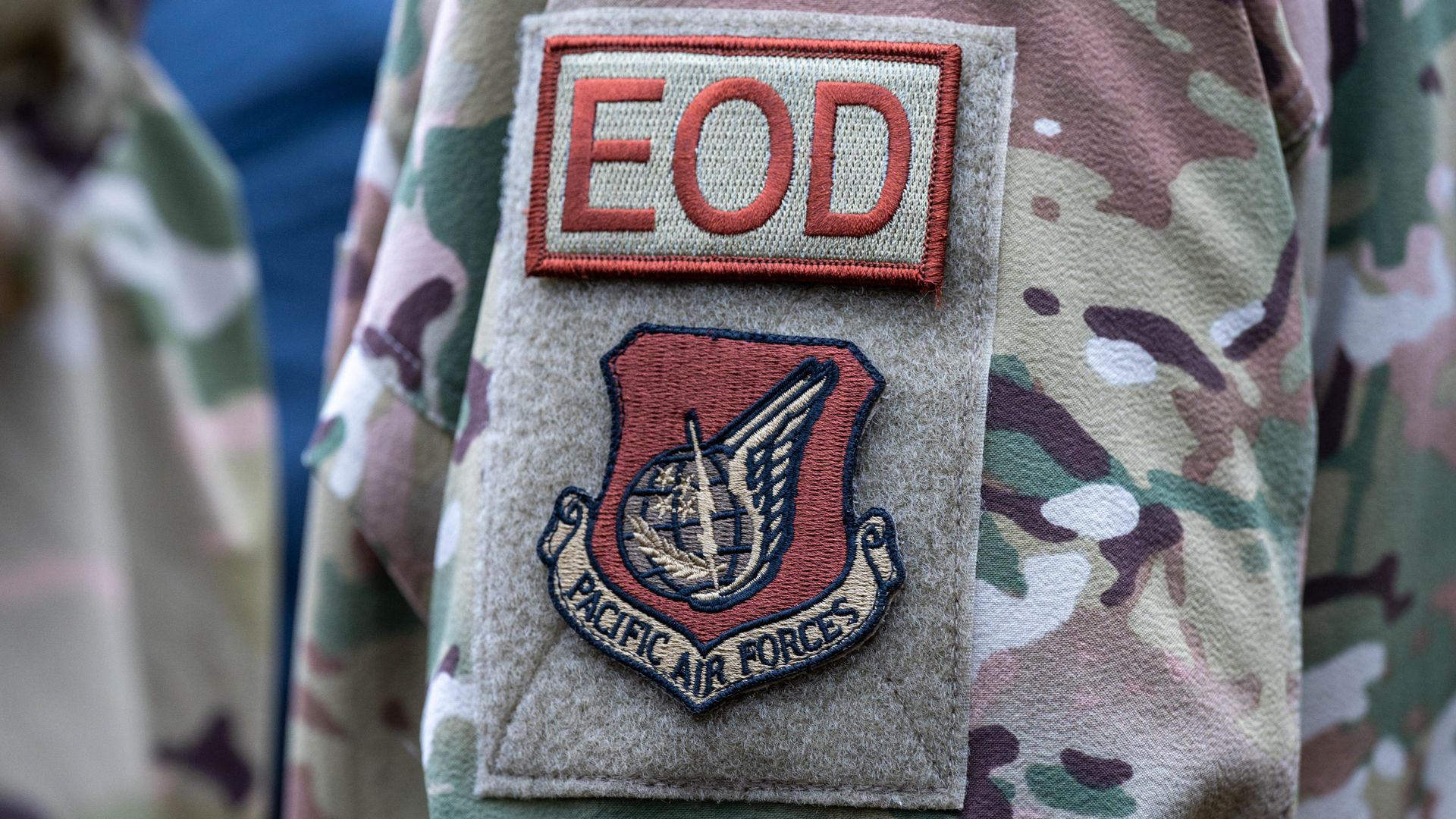
U.S. Air Force duty patches are returning, roughly one year after they were banned.
- The service on Jan. 9 shared a list of dozens of authorized options, including for air traffic control and cyber warfare.
Why it matters: Dropping the patches was controversial in the first place. (Air & Space Forces Magazine offered this Reddit post as an example.)
What they're saying: "I've decided to bring duty identifier patches back because the Air Force is made up of many different specialties, each with a unique role in our mission to generate airpower," Gen. Ken Wilsbach, the service's chief of staff, said in statement.
🎨 My thought bubble: They look sweet. I'm a fan.
Shoutout to Dave Lawler for editing and Matt Piper for copy editing.
👋🏼 Thanks, as always, for reading and sharing. Tell your friends to subscribe here.
Sign up for Axios Future of Defense