Defense contractors sidestep Trump chatter of partial ownership

Add Axios as your preferred source to
see more of our stories on Google.
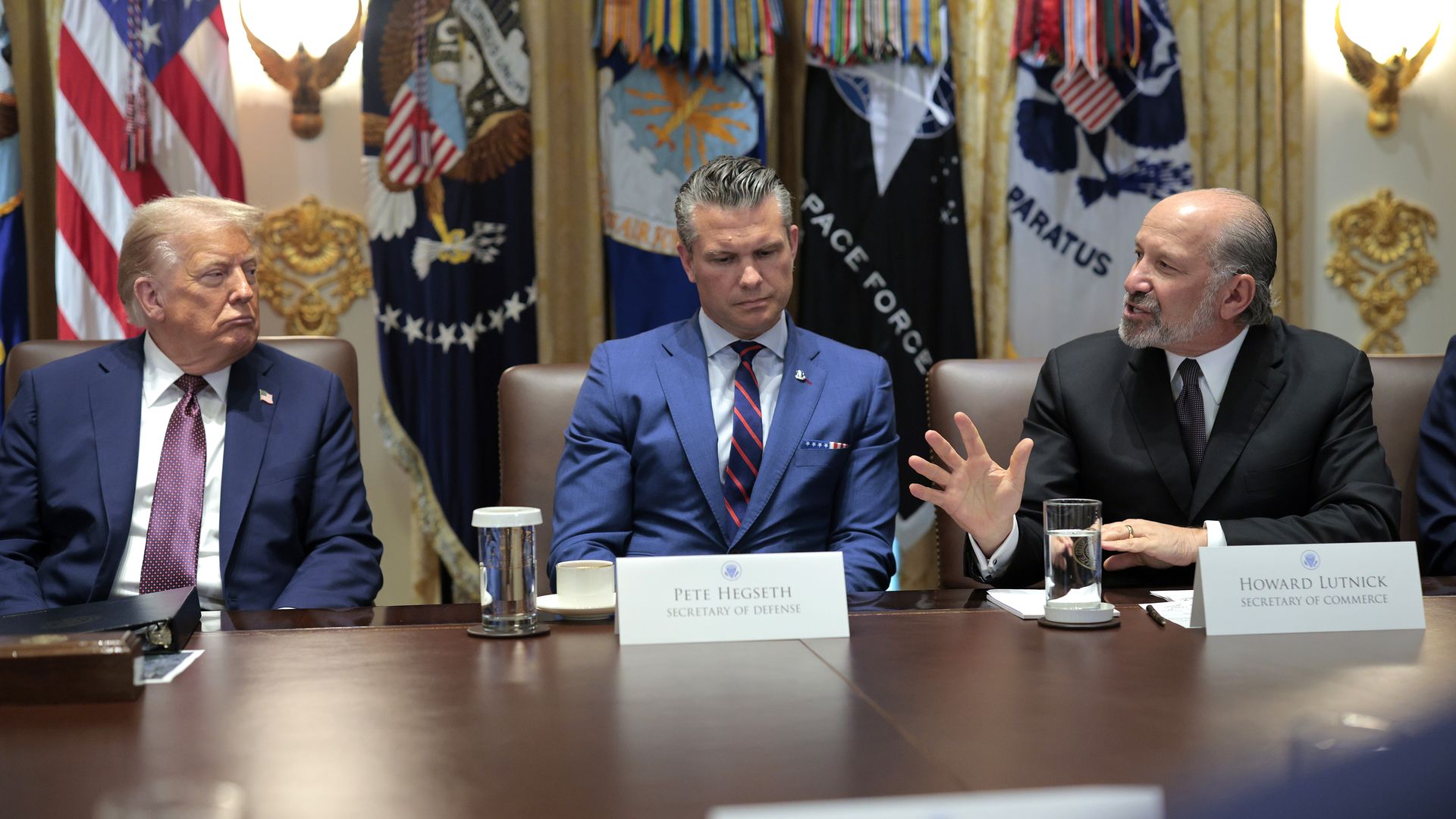
President Trump and his defense and commerce secretaries on Aug. 26. Photo: Chip Somodevilla/Getty Images
As the Trump administration considers taking stakes in big defense contractors, industry insiders are so far offering silence, sidesteps and safe answers.
Why it matters: Commerce Secretary Howard Lutnick's suggestion last month that the government may acquire pieces of weapons makers inspired political jabs from the left and right as well as dramatic comparisons to China's military-civil fusion.
- "There's a monstrous discussion about defense," Lutnick told CNBC, later describing Lockheed Martin, the world's largest defense contractor by revenue, as "basically an arm of the U.S. government."
- The administration is already intervening in the economy in unprecedented ways, particularly when it comes to semiconductors. Arms sales seem like a natural next step.
Friction point: The Cabinet commentary puts companies in a tough spot: Do they publicly break with the White House at a time when loyalty scorecards are a very real thing?
- And imagine this goes ahead. Competitors for multibillion-dollar contracts are now part-owned by the U.S. government.
Driving the news: Axios asked a wide variety of defense firms if they'd had contact with the administration about the partial nationalization idea, and if they would consider selling stakes if asked.
Here's what we heard back:
- L3Harris Technologies said it "supports President Trump as he fulfills his most critical responsibility as commander in chief" and that its "top priority" is "to evaluate new ways to partner with President Trump and the Department of Defense in that regard."
- Lockheed said it is "continuing our strong working relationship with President Trump and his administration to strengthen our national defense."
- Boeing, HII, Leidos and RTX declined to comment.
- Others, including Booz Allen Hamilton and CACI, didn't respond by deadline.
Zoom out: Two government power plays are fueling all this tea-leaf reading:
- Its $11.1 billion investment in Intel, for which it secured a 9.9% stake
- Its 15% fee on some of Nvidia's and AMD's chip sales to China
Yes, but: Defense is a beast unto itself — with timelines, acquisition structures and consequences unseen elsewhere.
The other side: Treasury Secretary Scott Bessent has downplayed Lutnick's speculation.
- "We'll see whether the defense companies are fulfilling their mission in terms of providing adequate and timely deliveries for the U.S. military," he said, "as opposed to maybe an overemphasis on the shareholders."
Go deeper: Trump's pay-me capitalism puts the squeeze on corporate America
