Axios D.C.

April 29, 2025

It's Tuesday!
☀️ Today's weather: Sunny. High near 86.
🌻 Keep local journalism thriving by becoming an Axios Washington D.C. member today.
Today's newsletter is 965 words — a 4-minute read.
1 big thing: 📣 Inside the Commanders' RFK deal
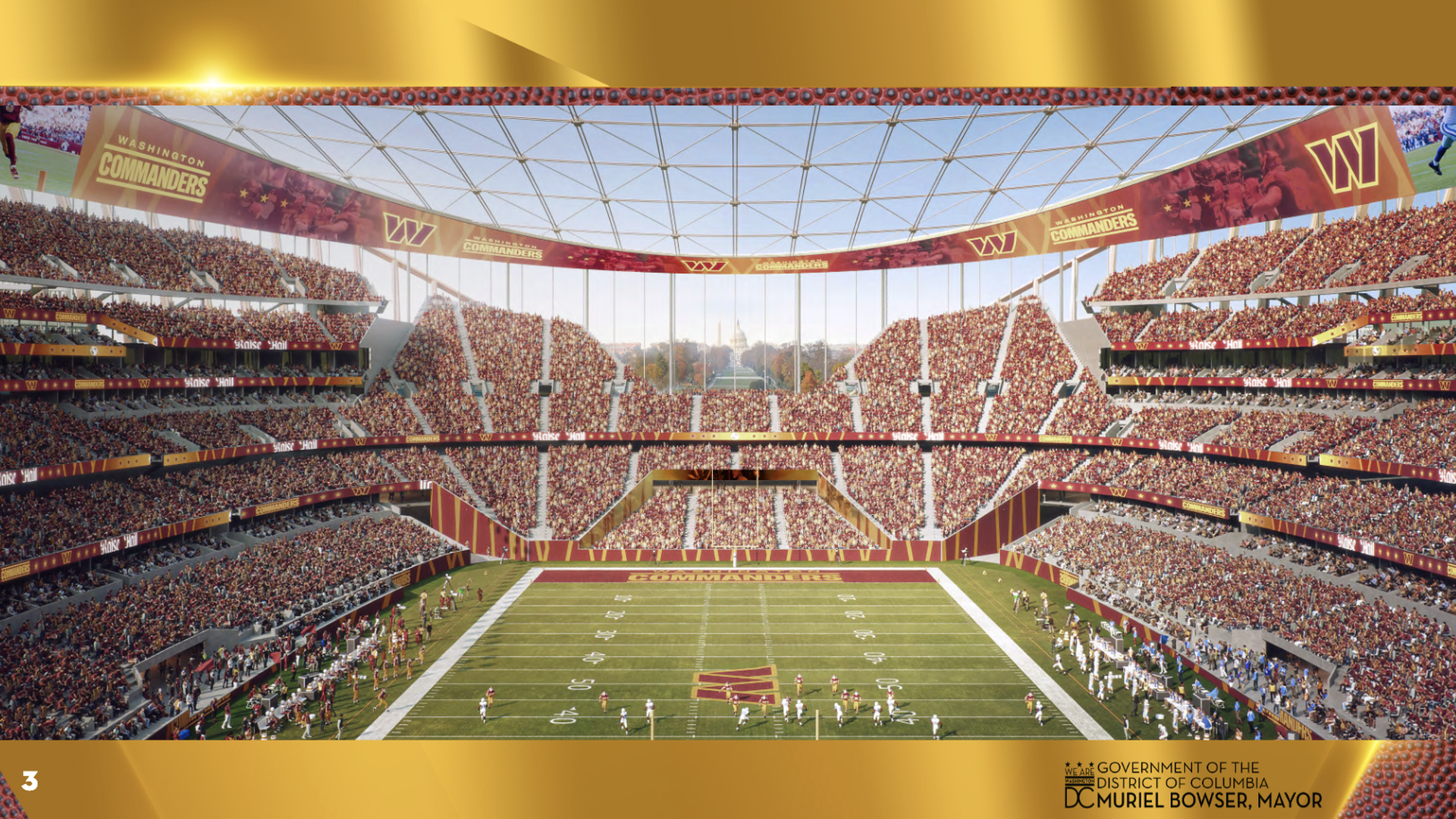
D.C. wants to redevelop the RFK Stadium site into a new entertainment district with a 65,000-seat Commanders stadium, plus 6,000 new homes, Mayor Muriel Bowser and the NFL announced yesterday.
Why it matters: The $3.7 billion project would build a new neighborhood on the Anacostia River, and bring the NFL back to Washington. It's up to the D.C. Council to approve it.
By the numbers: The Commanders will pay $2.7 billion for the Super Bowl-ready, roofed stadium. D.C. officials called it the largest private investment in the District's history.
- The Bowser administration wants D.C. to pitch in around $1 billion.
🏟️ The 170-acre blueprint
The new stadium would replace the current RFK Stadium, awaiting full demolition.
- The franchise wants to hold 20-30 major events every year, like the NCAA Final Four or a Taylor Swift concert, on top of 200 other events like conventions and gatherings, Commanders officials told the press.
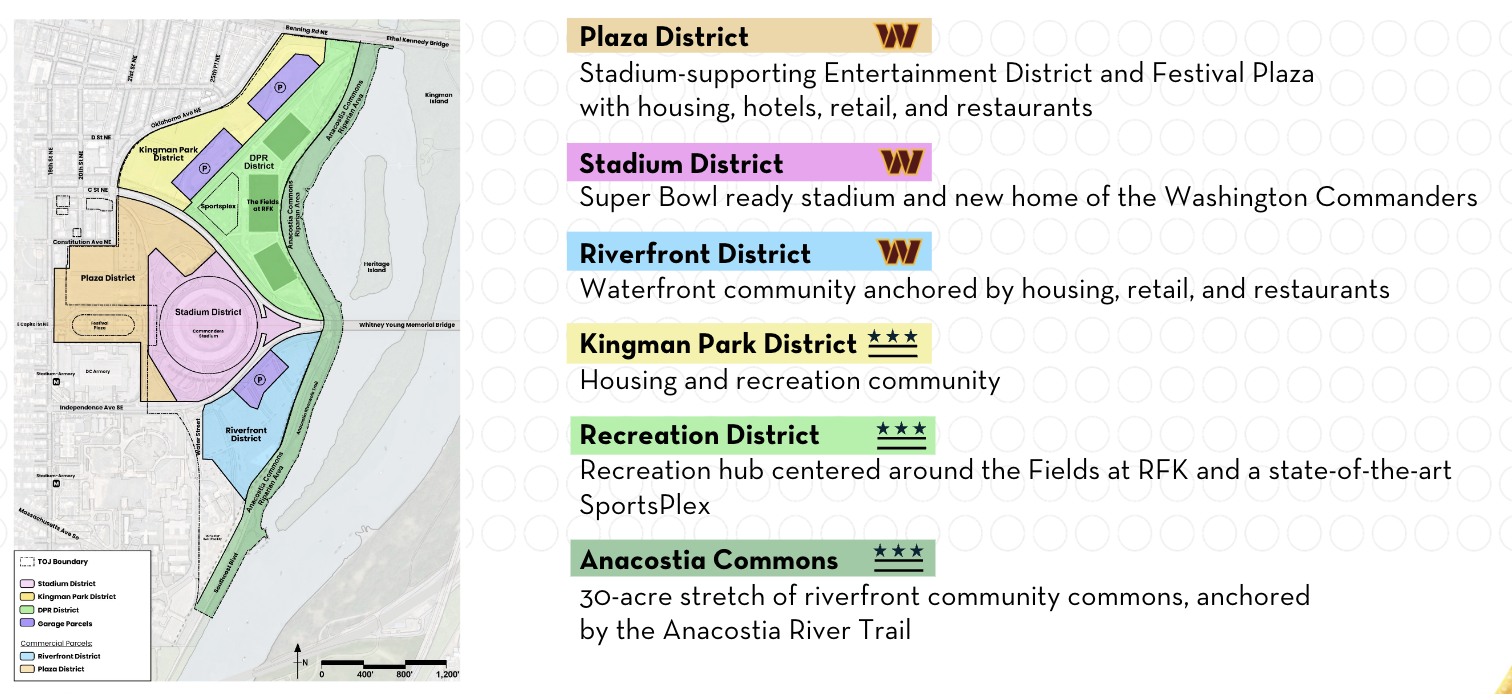
The big picture: A new community would emerge between a handful of mini-districts, per the designs.
- A "Plaza District" bordering the Hill East community has a "Festival Plaza" planned in front of the stadium. It envisions other entertainment offerings, housing, hotels, retail and restaurants.
- The "Riverfront District" places more homes, retail and restaurants along the Anacostia waterfront.
- The "Kingman Park District" would bring more housing and recreation facilities to the area.
- And the Anacostia River Trail will anchor a 30-acre stretch of land running along the waterfront.
On top of that, a public recreation district will build upon the Fields at RFK, an outdoor complex with turf fields.
- D.C. says it will build a $89 million SportsPlex for indoor track and gymnastics, among other features not found in the city's existing public rec centers.
👀 What's ahead
The D.C. Council will review the deal and hold public hearings. The Bowser administration hopes lawmakers will give approval this summer.
Friction point: Council Chair Phil Mendelson previously said he is opposed to public funding toward the stadium. And D.C. has a difficult budget year ahead, with cuts expected to public services due to federal job cuts and a predicted mild recession.
- Four council members attended the unveiling. Seven votes are needed for approval.
Target opening: Fall 2030.
2. 🏈 Touchdown du jour
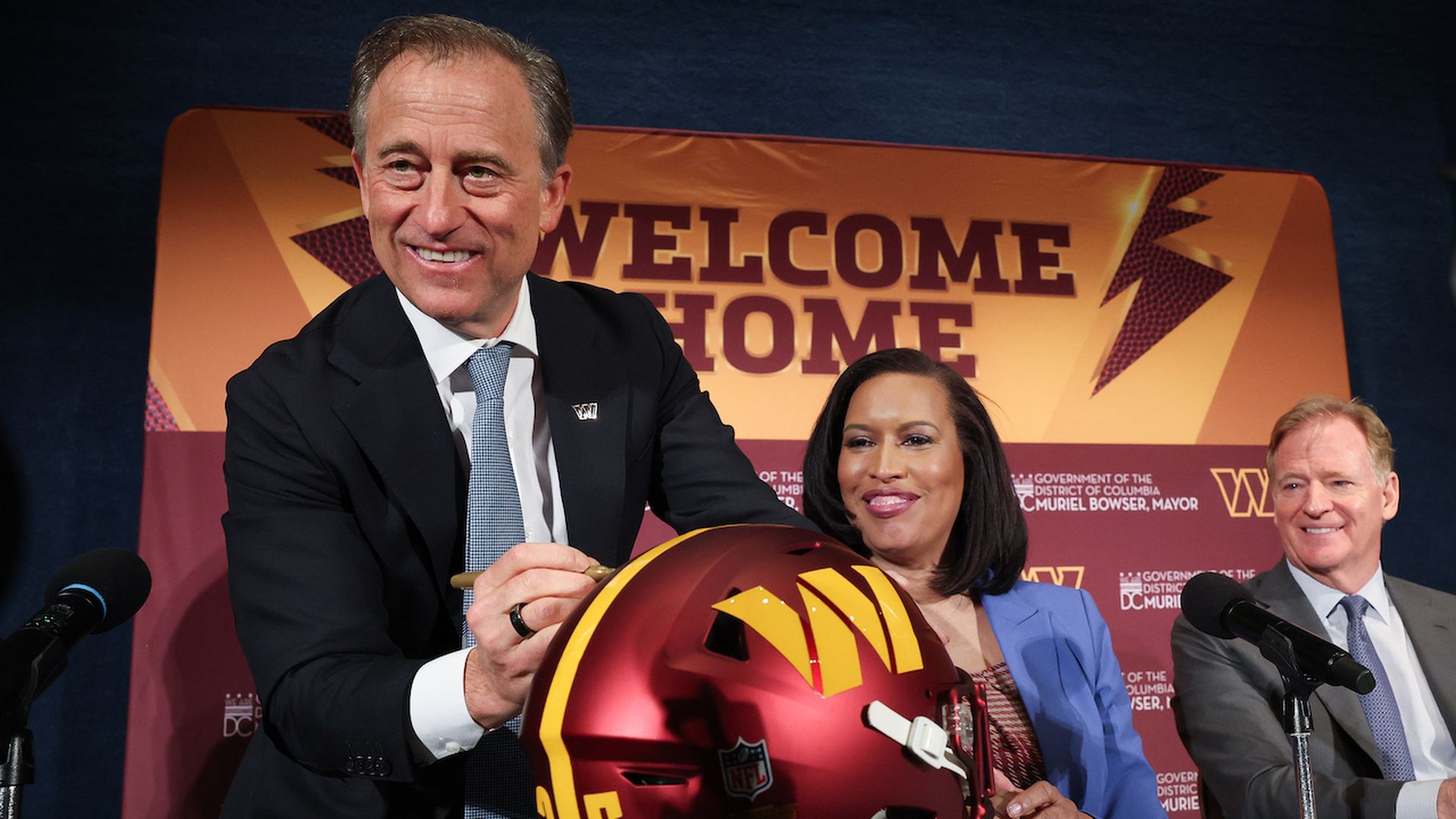
"Welcome home," Bowser said to kick off the RFK deal unveiling in downtown yesterday, next to NFL franchise owner Josh Harris and Commissioner Roger Goodell.
- All three spent their childhoods in D.C. during the franchise's Super Bowl-winning glory days.
3. Smithsonian denies artifact removal
The Smithsonian is pushing back against allegations that some artifacts are being removed from the African American Museum following President Trump's executive order to purge "improper ideology" from the broader institution.
The big picture: Alarm bells are ringing at museums and other institutions across D.C. amid Trump's DEI purge, sparking fears of historical and cultural erasure.
State of play: Civil rights leaders and museum insiders are raising concerns that some artifacts are being "quietly removed," according to multiple reports. Items cited include a Bible used in civil rights demonstrations belonging to pastor Rev. Amos Brown, and historical books.
- Brown says the Smithsonian recently informed him they would return the items, despite his wish for donation.
- The Smithsonian said in a statement Monday that returning artifacts is standard under loan agreements.
Smithsonian leaders emphasize that the institution rotates items to ensure preservation and exhibit variety.
- Any suggestion of alternative motives beyond that is false, the statement says.
Meanwhile, the Smithsonian is denying the removal of other artifacts, including the historic Greensboro sit-in lunch counter and a stool.
4. ⛓️💥 Trump's boundary-breaking 100 days

In only 100 days, President Trump has swiftly reshaped the federal government: redefining the scope of executive power, testing and defying the courts, and targeting his perceived enemies.
Why it matters: The president's team has been open about his second term's "flood the zone" strategy.
- The strategy has included an especially sharp u-turn on energy and climate policies — and efforts to greatly downsize EPA, NOAA, DOE and more.
Between the lines: Widespread protests ensued, with more to come.
- No Business as Usual, a newly formed DMV coalition of groups and individuals impacted by Trump policies, plan to disrupt rush hour tomorrow morning in Downtown D.C.
5. Around the Beltway: Replacing Rep. Connolly

Rep. Gerry Connolly (D-Va.) will not seek reelection following a cancer rebound. He will step down as the ranking member on the House Oversight Committee, which could pave the way for generational change. (Axios)
Trump signed an executive order yesterday directing federal agencies to document "sanctuary cities" that are not complying with his immigration agenda. (Axios)
💰 Wharf developers Hoffman-Madison sold their stakes in the $1.8 billion waterfront development to Canadian pension fund manager PSP Investments.
- Monty Hoffman tells WBJ that the decades-long project exceeded expectations, but a refinancing deadline gave them the opportunity to reinvest elsewhere. (Washington Business Journal)
📺 José Andrés has two new shows: "Yes, Chef!" a competitive cooking series with Martha Stewart on NBC (Mondays at 10pm), and a "Chef's Table" episode on Netflix (now streaming).
Fresh job openings around town
🤿 Dive into a new role with our Job Board.
- Accounting Associate at The American Council for an Energy-Efficient Economy.
- National Sales Director, Citywide at San Diego Tourism Authority.
- Insurance Agent Life and Health (Inside Sales) at Greater Than Care.
- Donor Relations Associate and Database Manager at Hudson Institute.
- Head of Software at C4ADS.
Want more opportunities? Check out our Job Board.
6. 🤝 Connecting America
Beloved Mexican chef Pati Jinich is known for her PBS show "Pati's Mexican Table," filmed from her Chevy Chase home. But today, she takes viewers beyond her kitchen in a new series: "Pati Jinich Explores Panamericana."
Why it matters: Discussions of borders, immigrants, and what it means to be American can now turn toxic, but Jinich brings infectious joy, curiosity, and appetite to her journey.
The big picture: Jinich's obsession with pathways is personal, as a Jewish Mexico City native whose grandparents fled the Holocaust.
- Now, she's tracing routes along the Pan-American Highway, from Alaska to Argentina, to illuminate our common threads.
What she's saying: "Without bias, without an agenda, it's just going to meet different people and see how different communities and regions are tackling the big challenges of our time," Jinich tells Axios.
- "The mission of the show is to reimagine what it means to be an American from a place of humility, of humbleness, of 'I want to learn more.'"
🎞️ Cuneyt is watching "Sinners."
🐦 Anna is testing out a new birdfeeder.
💍 Mimi is away for her wedding!
Want more Axios D.C. content? Check out our Instagram for extra stuff to do, behind-the-scenes photos, videos and more!
Today's newsletter was edited by Alexa Mencia Orozco.
Sign up for Axios D.C.


/2025/04/27/1745784925522.gif?w=3840)
/2025/04/28/1745874179503.gif?w=3840)