Smithsonian "bone doctor" targeted D.C.'s Black communities

Add Axios as your preferred source to
see more of our stories on Google.
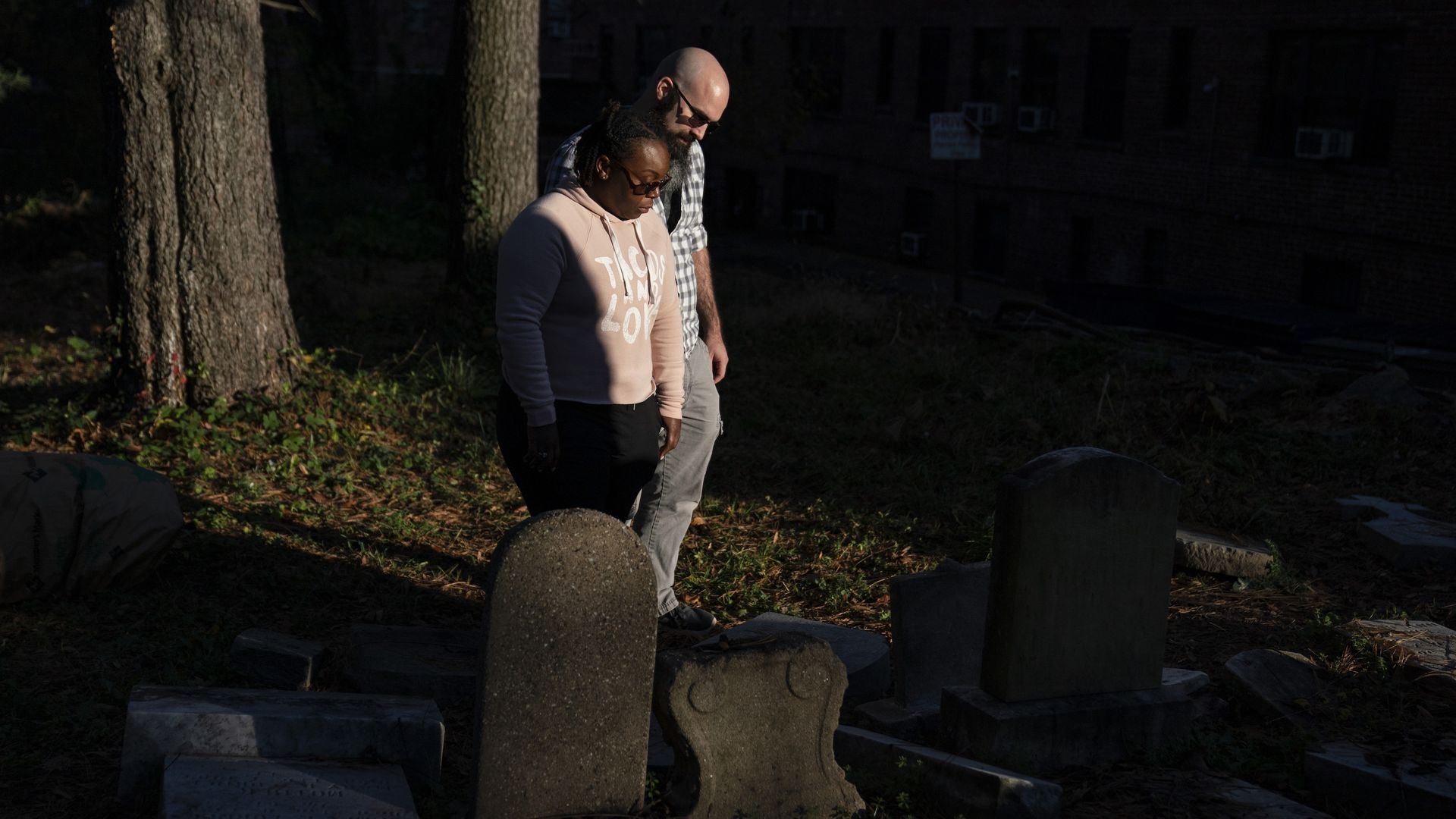
Michelle Farris and her husband, Tim Farris, look at gravestones in Mount Zion Cemetery in D.C. Moses, her distant relative, is buried in an unknown location. Photo courtesy of Carolyn Van Houten/The Washington Post
The Smithsonian targeted D.C.'s vulnerable populations — largely Black communities — in the early 1900s for "racial brain collection," a new investigation by the Washington Post reveals.
Why it matters: Smithsonian preyed on minorities in its backyard for decades, and despite recent pledges to repatriate remains, none of the 70-plus local brains have been returned.
Catch up quick: In August, the Post published a groundbreaking report on Smithsonian's "bone doctor," anthropologist Ales Hrdlicka, who scavenged human brains — largely from Black, Indigenous and Asian peoples — and more than 30,000 body parts from around the globe.
- The physical anthropologist, active in the later-discredited field of eugenics, was obsessed with comparing anatomical differences between races, and created a massive collection of body parts during his 40-year tenure at the Smithsonian.
Fast forward: The Post discovered that the Smithsonian has not repatriated the vast majority of remains in its possession — only around 6,300 of the 35,000-plus body parts gathered. The institution launched in 1991 a Repatriation Office in response to a new law requiring museums to contact Indigenous tribes and communities where remains were taken and offer to return them.
- No such law exists for Black people or other communities.
Smithsonian secretary Lonnie G. Bunch III has apologized for the Smithsonian's collection of remainsnand penned an op-ed late last month announcing the institution's new "Human Remains Task Force" to "rectify these wrongs."
Zoom in: Of the more than 280 brains the Smithsonian acquired from across the globe, more than a quarter were from local people, according to documents obtained by the Post. And 48 of those were from Black people — including fetuses, children, and adults. Most were acquired by the 1940s.
- Of the 70-plus local brains, the Post discovered proof of only three being donated to science. Hrdlicka used his connections with prominent local doctors, hospitals, medical schools, and D.C. Health Department's Anatomical Board to harvest organs from Black people.
The Smithsonian also possesses around 250 sets of remains gathered in D.C. by Hrdlicka and his successors, as well as another 4,000 body parts collected in Virginia and Maryland.
- Some were taken from graveyards for Black and Indigenous communities — including a large gravesite that once existed on the grounds purchased by the Smithsonian to build the National Zoo.
What they're saying: "There were powerless people at that time who were being targeted," Karen Mudar, a former case officer at the Natural History Museum's troubled repatriation office, told The Post. "It was very distressing. It felt like there was an injustice that had been done to people in the Washington, D.C., and Baltimore area of African American ancestry."
Between the lines: Many families, communities, and tribes are unaware that their members' remains are missing, or that they're at the Smithsonian.
- The Smithsonian requires that persons legally entitled to remains file a formal request for repatriation — an impossible task if you don't know they're there.
- Other than alerting tribes to Native American remains, the museum has not published an extensive list of names or identifying details related to body parts in its possession. Records show it has the names of nearly 100 people whose brains are in the collection.
The latest: Today, the Post launched a first-of-its-kind searchable database that catalogs 23,000 sets of remains acquired by the institution between 1868 and 1958.
- The database doesn't reveal sensitive or graphic information, but allows the public to search by providing files with details like names of tribes linked to remains, locations where remains were harvested, and the names of institutions that donated body parts.