Axios Crypto

January 19, 2023

👠 Bitcoin remains at a pretty strong price for the market mood, but bad news continues to roll in. The next shoe to drop might be getting ready to fall.
- Do you see anything we don't see? [email protected]
Today's newsletter is 1,177 words, a 4-minute read.
🗳 1 big thing: Gemini Dollar survives MakerDAO vote
Illustration: Gabriella Turrisi/Axios
With Digital Currency Group's crypto lending unit Genesis said to be imminently filing for bankruptcy (see below), a group of folks is reassessing the risk associated with one stablecoin in the mix: the U.S. dollar-pegged Gemini Dollar, Crystal writes.
Driving the news: MakerDAO, the original decentralized finance protocol, holds roughly 85% of GUSD's market capitalization, recently at around $600 million.
- Its members just completed a vote showing a split on whether it should maintain its GUSD holdings, or reduce those holdings backing its own stablecoin, DAI.
- The vote ultimately closed this morning with 50.85% in favor of maintaining the status quo, in spite of the risks. 49% cast votes to boot GUSD.
Why it matters: Chapter 11 cases involving crypto platforms in the U.S. have not yet tested what protections are afforded to exchange-issued U.S.-dollar-backed stablecoins.
- MakerDAO's vote shows that the group championing decentralization is not willing to step away from the very centralized, highly illiquid GUSD and the yield it gets from holding it.
The intrigue: MakerDAO would appear no different than Gemini's Earn customers who were also wooed by Gemini to tender their coins in exchange for an agreement that would give them yield. But their agreements are slightly different.
- Gemini's Earn customers were subject to an agreement including Genesis. MakerDAO's agreement with Gemini does not include Genesis.
- The SEC's complaint against Gemini and Genesis for selling unregistered securities, however, adds to the uncertainty around the Winklevoss-founded platform.
Between the lines: Tyler Winklevoss on Monday tried to soothe MakerDAO delegates saying "the issues related to Earn do not impact any other Gemini products," in a missive posted to their forum.
- Winklevoss claims that GUSD reserves are held in accounts at U.S. FDIC-insured banks, which include money market funds and U.S. Treasury notes.
- He says the cash portion of the reserves "may be eligible for FDIC 'pass-through' insurance for Gemini customers."
Yes, but: It's a big "IF" whether a GUSD holder might qualify for pass-through insurance, according to Steven Kelly, senior research associate at the Yale Program on Financial Stability.
- It would be at the discretion of the FDIC to apply "pass-through," and so far they haven't been keen, in part due to the rash of crypto firms' falsely advertising coverage, he says.
The big picture: GUSD isn't used very much besides on the Gemini platform and MakerDAO, which makes it highly illiquid relative to other dollar-pegged stablecoins.
- "The worst case scenario would involve troubles at Gemini that cause a delay in redemptions," according to Kaiko Research's Riyad Carey.
The bottom line: In the event that illiquidity prompts fear, GUSD could temporarily deviate from its peg. DAI may not rattle even then, and MakerDAO appears to be taking that risk for the 1.25% yield.
⚡️💵 2. What's this: CBDCs
Illustration: Annelise Capossela/Axios
Central bank digital currencies are not necessarily cryptocurrencies, but they are a response by governments to the competitive pressure that blockchain technology has put on money as we know it, Brady writes.
- CBDCs, as they're known, allow users to transact electronically, like cash (that is, without going through multiple payment processors on the back end, and, crucially, without fees — or very little).
- Whereas most stablecoins are receipts for dollars in bank accounts, a digital dollar CBDC would actually be a dollar, just like the paper ones.
- Officials at the Fed are divided over a CBDC for the U.S. dollar, but there's concern that if other nations build theirs up first, it could undermine the dollar's status as the global reserve currency.
In the Bahamas, an experiment with the Sand Dollar, a real on-the-ground CBDC, is underway. It's not getting used much yet, but one barber in Nassau really likes it and he tells people about it every day, one haircut at a time.
The bottom line: Bitcoin was the first money native to the internet, but euros and dollars and yen all could be.
🙇♂️ 3: The next bankruptcy
Barry Silbert, CEO of Digital Currency Group, at a conference in 2016. Photo: Michael Nagle/Getty Images
Genesis Global Capital, the crypto lending company that shut off withdrawals in November, may be very close to filing bankruptcy, The Block and Bloomberg reported yesterday.
Why it matters: With recession fears swirling, crypto's winter has lingered and continues to take down high-profile companies. Genesis, one of the digital asset market's marquee names, has been the subject of bad press and negative speculation for a number of weeks, Brady writes.
- According to a report by The Block, Genesis has been negotiating a prepackaged deal with its creditors, a type of bankruptcy process that resolves more quickly.
Details: Citing sources with knowledge of the situation, Bloomberg reported that the unit may file for bankruptcy as early as this week.
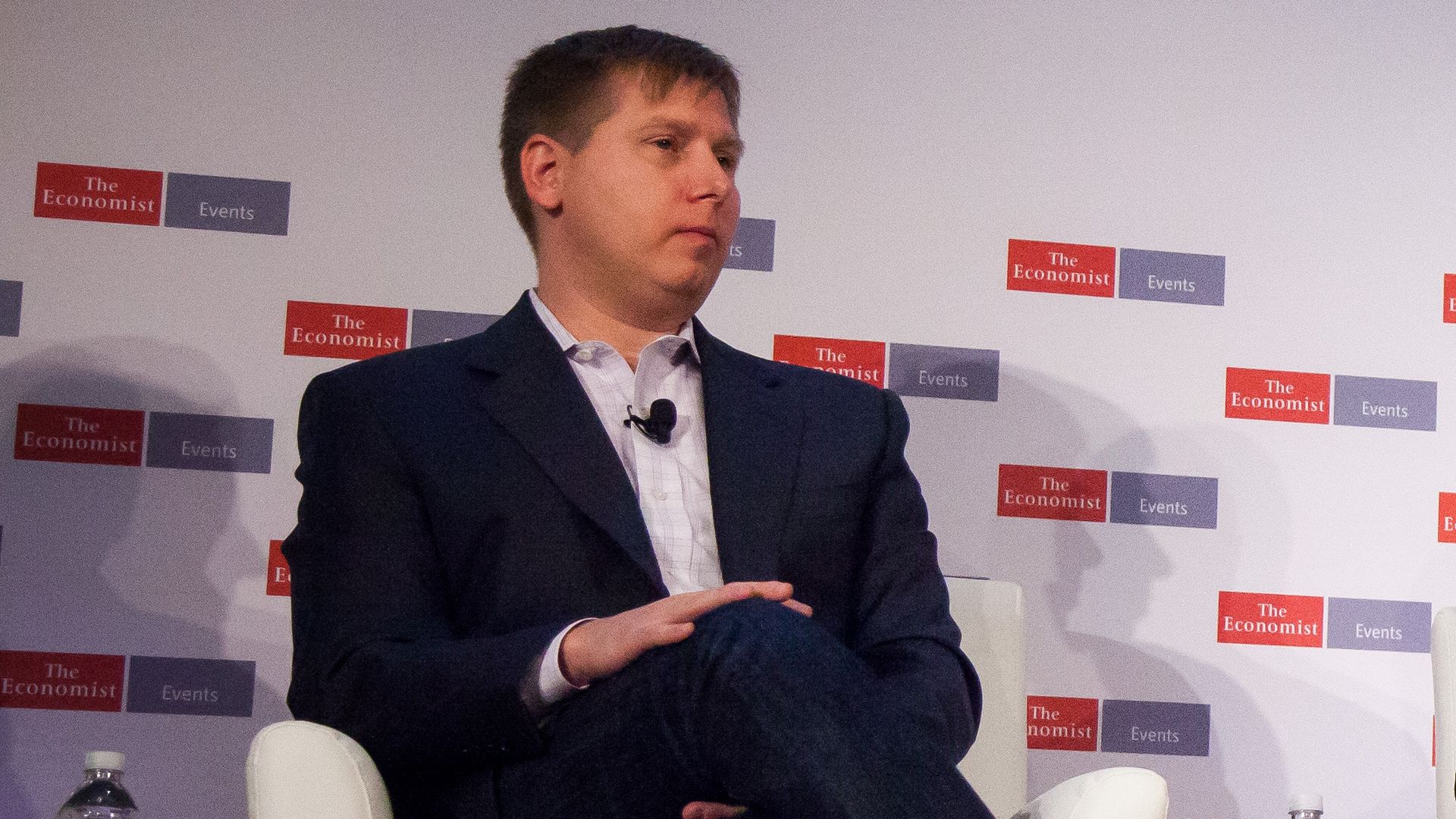
- Genesis is a part of the Digital Currency Group, the conglomerate of crypto firms led by Barry Silbert.
- Gemini, a business partner in the venture now under scrutiny by the SEC, has accused Genesis of failing to accurately state its financial health as it continued to allow Gemini's users to lend funds to Genesis as part of the Earn program.
Flashback: Customers have been unable to withdraw funds from Genesis since Nov. 16.
Genesis did not reply to a request for comment from Axios.
Zoom out: At least one facet of the DCG empire is reportedly for sale, according to the Wall Street Journal.
- CoinDesk, the crypto news site that many credit with the report that exposed Alameda Research and FTX, has retained the investment bank Lazard as it explores a partial or full sale.
The bottom line: Downturns always take down some companies and lead to a lot of layoffs. The crypto industry is very much waiting for the day when the last one has fallen.
👟 4. Catch up quick
⏱ Peter Thiel's Founder Fund unwound the last of its cryptocurrency positions in March 2022, ahead of the big disasters of the year. (Financial Times)
⛏ CleanSpark breaks ground on a 50-megawatt mining site in Georgia. (CoinDesk)
😖 A serious privacy screw-up by the SEC is reported to have gone down during its investigation of a company called Green. (Protos)
🎬 New FTX chief says crypto exchange could restart. (WSJ)
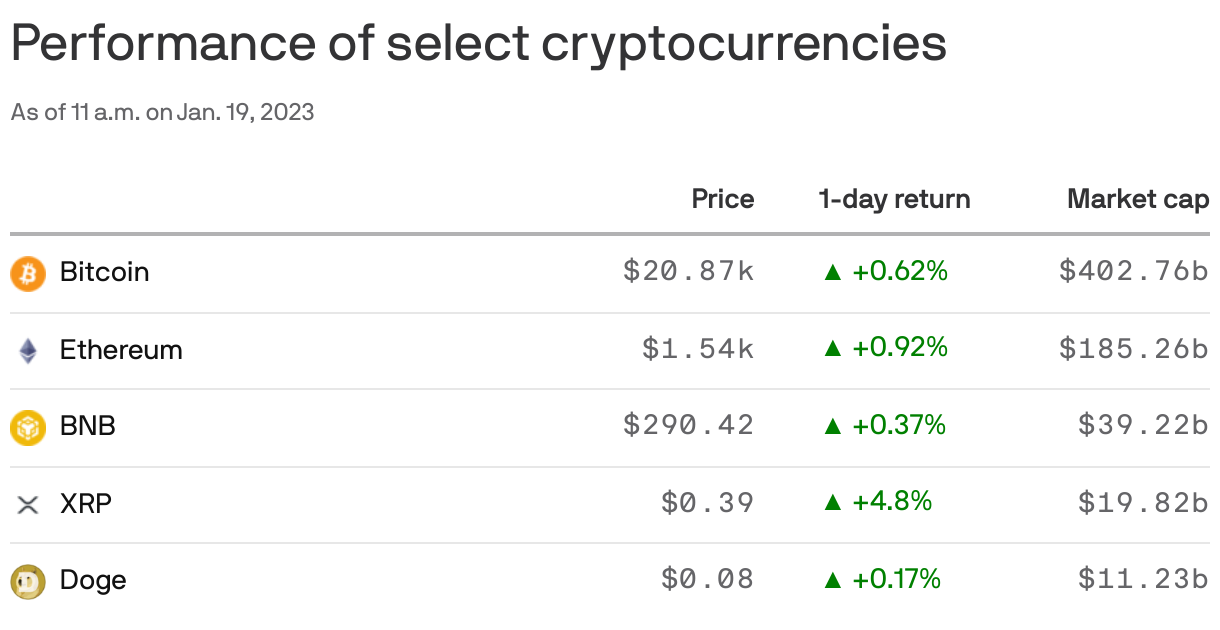
Top coins
🙋♀️ 5. Culture hash: Bitzwhotho?
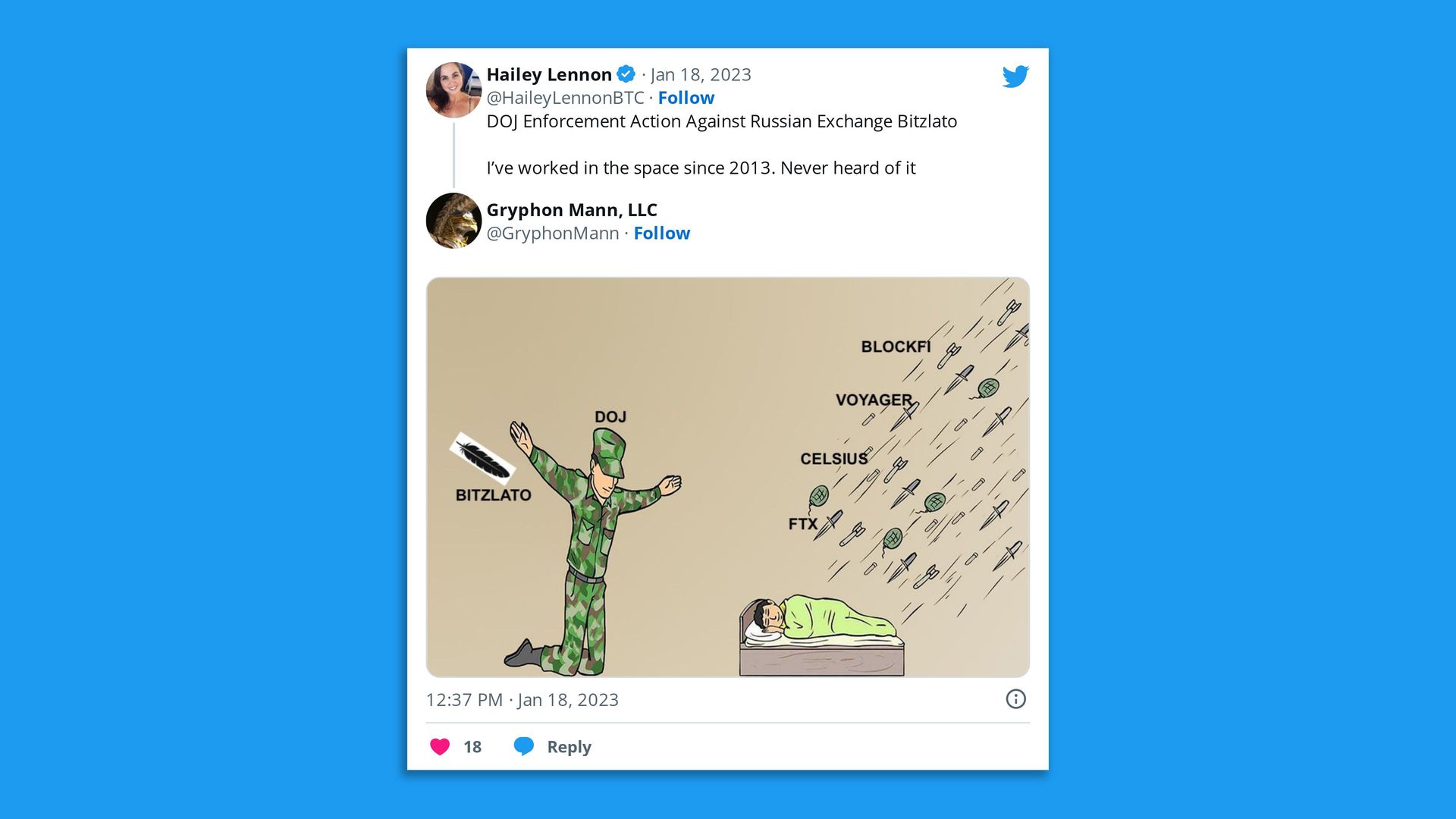
Screenshot: @HaileyLennonBTC & @GryphonMann (Twitter)
The DOJ hyped the Bitzlato news yesterday like a Sunday monster truck rally on the outskirts of a minor Midwestern city, Brady writes.
- When it came out, everyone on Twitter was like: What's Bitzlato, though?
Context: There's this story that cryptocurrency is mostly used for crime, but the truth is that less than 1% of it is. The actual criminals keep pretty quiet, while all the folks driving the crypto conversation at least believe they are acting within the law.
In the weeds: Bitzlato offered a peer-to-peer service. In other words, it enabled people who wanted to trade without anyone in the middle to find each other easily. This might have been especially appealing to people in black markets.
Our thought bubble: The angry cop voice that law enforcement officials use in these news conferences has become unconvincing. You can picture them in the bathroom, practicing looking stern.
- I kind of want to become a big-time cop just so I can hold a news conference about a big bust and deliver it in a breezy, jovial tone — shake things up, y'know?
This newsletter was edited by Pete Gannon and copy edited by Carolyn DiPaolo.
👋 That's all folks. —C & B
Sign up for Axios Crypto

Brady Dale covers crypto and blockchain impacts on markets and regulation.