Axios Crypto

January 31, 2023
Some crypto rails are permissionless, but the Fed's rails are not. Plus, a new bitcoin.
💌 [email protected]
Today's newsletter is 1,195 words, a 5-minute read.
🚳 1. Custodia was blindsided by the Fed
Illustration: Shoshana Gordon/Axios
The Federal Reserve Board's unanimous rejection of digital-assets-focused bank Custodia's 27-month effort to gain entry to the U.S. banking club came with an exclamation point, Crystal writes.
Why it matters: If Custodia was meant to serve as an example, crypto firms in the throes of playing "Mother, May I" with [name your banking regulator] are likely to be disappointed, regardless of standing.
- Quick take: Crypto firms should brace themselves for a lotta nos this year.
What they're saying: "We're the ones coming through the front door, asking for permission rather than forgiveness," Caitlin Long, chief of Custodia tells Axios. "That's what regulators say they want, but their actions prove otherwise."
Catch up quick: The Federal Reserve on Friday formally rejected Custodia's application to be included in its systems.
- A Fed "master account" would allow it to unlock direct access to payment rails that let traditional banks transfer money to each other.
- Without one, digital-assets-focused banks like Custodia have to rely on intermediaries that can.
The big picture: Posture from federal agencies, regulators and the White House, as indicated by their latest missives, show that any enthusiasm for allowing crypto into the broader financial system has been blunted by FTX's collapse.
- Think of it as another aftershock.
State of play: The digital assets industry can survive even if it is kept separate from traditional firms and banking services, says Long, but also, "it would be tougher."
The intrigue: "The Fed has historically said in governor speeches that they want to level the playing field for innovators and incumbents," Long said.
- Whether the Fed's latest actions actually level the playing field between them — or show preference for the latter — remains to be seen.
Our thought bubble: It's difficult to ignore what appears to be a coordinated crypto crackdown from the Fed, the White House and other major banking regulators via policy bulletins, coupled with enforcement action and application denials.
- It wouldn't be surprising to see crypto firms pulling their applications in anticipation.
- If the tallest kids in the class can't clear the hurdle for the rides at the county fair, what shot do the short kids have?
What's next: Long says Custodia intends to continue with its lawsuit against the Kansas City Federal Reserve and intends to re-apply for a master account at the right time.
The bright spot: The Fed's policy announcement confirmed Custodia as a bank, a status that was unclear for Wyoming-chartered special purpose depository institutions, Long said.
- The Fed also clarified that banks can provide custody services for assets like bitcoin and ether.
🕹 2. Virtual worlds boom


Tokens associated with virtual worlds had a great month, Brady writes.
- Bitcoin functions as something of a baseline in crypto. It's up, but not like MANA or APE.
Of note: It's pretty normal for altcoins to outperform bitcoin in a boom, but there might be more to this uptick than speculation.
- There is at least some demand to play blockchain-linked games. For example, apecoin is part of the Bored Apes universe. It has a thematically unappetizing game going now called Dookey Dash that folks are getting paid to play.
Be smart: Altcoin rallies can be a game of the greater fool. People who spot them early can do very well so long as they get out quickly enough.
- The fall tends to outpace the rise.
👯 3. A new bitcoin (derivative)

Illustration: Aïda Amer/Axios
Bitcoin needs a way to get to other blockchains in a way that feels bitcoin-y, Brady writes.
Why it matters: As holders of the oldest and most valuable cryptocurrency, many bitcoin investors want to use it to earn yield in decentralized finance (DeFi), but many bitcoiners also hate trusting strangers with their assets.
- Trusted bridges, like Wormhole and the Ronin bridge for Axie Infinity, led to some of the worst losses in 2022.
Driving the news: Bitcoin can only be used in DeFi using some kind of derivative, copies of real bitcoin secured for that purpose on the original blockchain.
- One casualty of the FTX failure has been the Ren Protocol, one of the more trustless ways to bridge bitcoin to other blockchains.
- Before FTX fell, there were over 4,000 BTC on Ren. Now, there are a little over 400.
Of note: Most of the bitcoin bridged to other blockchains takes the form of wrapped bitcoin (WBTC); 176,547 BTC ($4 billion) have been bridged using the fully trusted system created by the custody firm BitGo.
What they're saying: "Bitcoin is the most pristine digital asset, and if you want to make your bitcoin into a productive yield-bearing asset you shouldn't have to send that to an opaque liquidity provider," MacLane Wilkison, CEO of security platform NuCypher, tells Axios in an interview.
What we're watching: Threshold has launched a new version of tBTC, its more decentralized approach to bridging bitcoin from the original blockchain to Ethereum (for now, with others to come).
- The new version protects users by breaking operations into two parts: minters and guardians.
How it works: Guardians are stakers of Threshold's token, T, who control a series of bitcoin wallets that can be used to mint tBTC on Ethereum.
- A user sends their bitcoin to a wallet and indicates what Ethereum address the tBTC should be minted to.
- If more than 51 of 100 guardians approve the mint, then it goes to the minters to mint the tBTC that corresponds to the actual bitcoin deposited.
- Minters are a small group of blue chip DAOs (decentralized autonomous organizations) on the Ethereum blockchain, including Curve DAO, Yearn.Finance, Aave, Synthetix, Connext, Alchemix and Euler.
- They maintain a three-hour cooling off period between a mint and issuing tBTC. If nothing seems awry, they approve creating the tBTC.
The main threat minters are watching for are mints that don't have matching bitcoin in the Threshold wallets.
- The system has been designed to prevent such a malicious mint, but they are using minters at first as a safeguard. Eventually, the plan is to retire this backstop.
🫥 Bonus: Catch up on FTX
Former FTX CEO Sam Bankman-Fried. Photo: Lev Radin/Pacific Press/LightRocket via Getty Images
A New York federal judge on Monday ruled that the identities of former FTX CEO Sam Bankman-Fried’s additional bond guarantors should be made public.
- The ruling came after a number of news organizations challenged the redactions in court, writes Axios' Kia Kokalitcheva.
Some other notable twists in the FTX case:
- Federal prosecutors Friday sought to bar SBF from using encrypted messaging apps like Signal — citing his reported preference for those that auto-delete — and from contacting current and former FTX employees.
- Prosecutors argued that his recent attempt to contact FTX US’ general counsel, Ryne Miller, could be witness tempering.
Meanwhile, in bankruptcy court: Alameda Research on Monday sued crypto lender Voyager Digital, seeking to recoup at least $445 million in loan repayments, per The Block.
- And last week, lawyers for FTX said that a number of insiders, including former Alameda Research CEO Caroline Ellison, have not been cooperating with the company’s efforts to locate customer assets, per Coindesk.
What we’re watching: Everything. The FTX legal saga keeps going, on multiple fronts, and is not short on surprises and messiness.
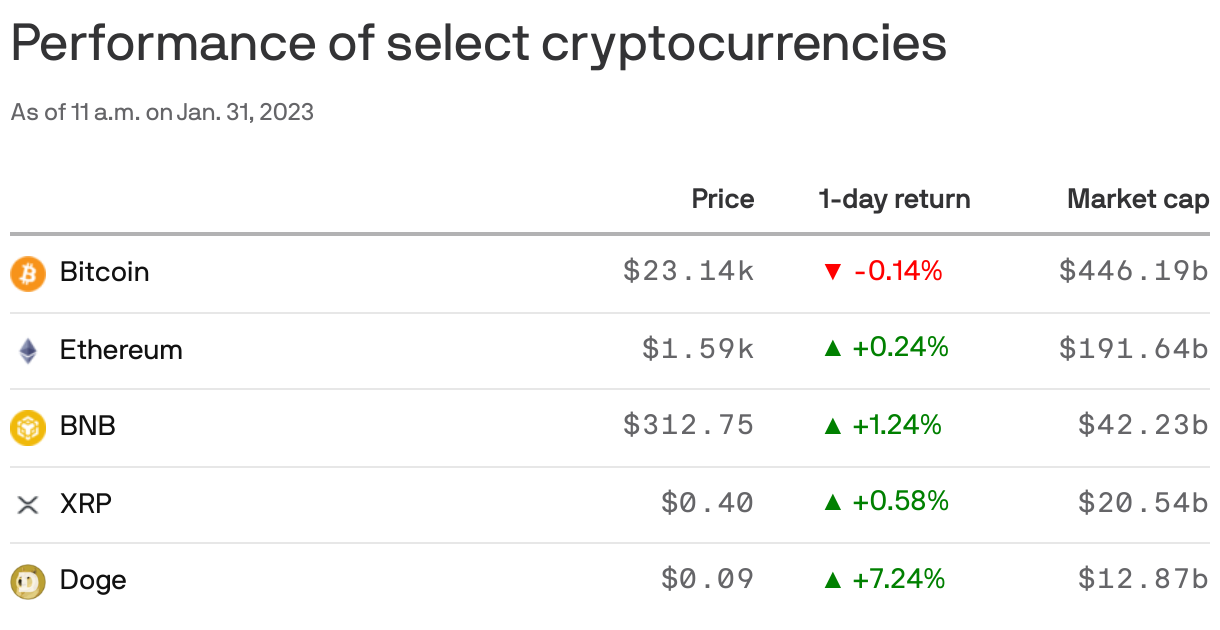
Top coins

This newsletter was edited by Pete Gannon and copy edited by Carolyn DiPaolo.
Brady has a book on the way, "SBF: How the FTX Bankruptcy Unwound Crypto's Very Bad Good Guy." Published by Wiley, it's slated to hit shelves in May —C & B.
Sign up for Axios Crypto

Brady Dale covers crypto and blockchain impacts on markets and regulation.