Axios Crypto

November 30, 2022
For a minute it looked like part of this newsletter would not be related to FTX today, but... nope. It all ties back to the big story today, too. πΆβπ«οΈ
- If something out there is interesting all of you besides the big disaster, please let us know: [email protected].
Today's newsletter is 1,415 words, a 5-minute read.
π 1 big thing: A phone call with SBF
Photo illustration: Gabriella Turrisi/Axios. Photo: Lam Yik/Bloomberg via Getty Images
Sam Bankman-Fried (SBF) had $100,000 left in his bank account last time he checked, the former FTX chief exec said in an interview with Axios Pro's Lucinda Shen.
Why it matters: The late Monday conversation came as FTX is working through a messy bankruptcy process and the company's creditors remain in the dark about what, if anything, they will be able to recoup.
What he's saying: "Am I allowed to say a negative number?" he said, when asked about his personal finances. "I mean, I have no idea. I don't know. I had $100,000 in my bank account last I checked."
- "It's complicated. Basically everything I had was just tied up in the company," he added.
- His personal wealth at one point reached $26.5 billion.
Yes, but: He said regulation and proper oversight could have helped protect FTX from its collapse.
- "I think one thing is... if you looked at the reporting, and CFTC applications, that would have been extremely helpful here on international rigor," he said.
- "There's certainly an extent to which I wish there had been someone, who wasn't me, who was in charge of managing conflicts of interest," he said, in a nod to the bankruptcy court claim that he ran FTX like a personal fief.
Zoom in: SBF, however, added that he bears the brunt of the blame.
- "I've been focusing on volume, rather than positions for balances," he said. "I should have been more responsible, and I should have been more on top of what was going on."
Shifting gears: SBF also spoke to questions around his Twitter stake, since Musk said last week that neither SBF nor FTX ever held a position in the privatized Twitter, a statement that contradicted a Semafor news report.
- Alameda Research owned the Twitter stake. A text message seen by Axios that SBF sent to Musk said the Twitter stake was worth around $100 million.
Details: "I believe that it was intended for Alameda to rollover at least $20 million or more," he told Axios. "I don't know for sure whether that ultimately happened."
- He noted that at least some of the Twitter stake may have been sold prior to Twitter's going private, but he could not confirm.
Background: SBF had offered to help Musk buy out Twitter in the spring, but he later backed out, Axios previously reported.
The intrigue: The Twitter stake was listed on a Nov. 10 balance sheet shown to prospective FTX investors before the company went bankrupt, according to the Financial Times.
The bottom line: Though pressed multiple times on whether he thought he or his firms might be criminally liable, SBF answered each time that he was more focused on customers right now than his own fate.
- However, he admitted, "This is worse than anything that I thought could happen."
π¨βπ§βπ¦ 2. Charted: Bitcoin diverging from... bitcoin?


Much of the wealth in the crypto market is in bitcoin, Brady writes.
- But the Bitcoin blockchain has little functionality beyond accounting for bitcoin, so if someone wants to use their bitcoin to finance a trade, they often need to copy it to another chain (usually, Ethereum).
Context: Historically, these copies trade basically on par with bitcoin proper, but, in light of all the uncertainty since the FTX implosion, two of them are starting to diverge.
- The REN protocol powers renBTC. The team behind it had been acquihired by Alameda Research. They are now unwinding the original product, and renBTC are becoming more scarce by the day. (We covered this on Nov. 22, too.)
- So, renBTC are trading above bitcoin's spot price right now.
- Meanwhile, wrapped bitcoin (WBTC) is the largest derivative. It's a centralized product created by BitGo. It's trading a little below bitcoin's price now, because the market seems nervous about centralized products post-FTX.
Zoom in: But what was that giant spike last night? I wish I knew for sure.
π 3. BlockFi moves to return deposits now, your honor

Illustration: Megan Robinson/Axios
BlockFi wants to urgently resume platform withdrawals, so customers can have their funds back, Crystal writes.
Why it matters: While that move seems logical (especially to customers), it would be precedent-in-the-making for future crypto cases, touching on the all-important hierarchy of unsecured creditors.
- "There are precedents in a non-crypto exchange situation. The law is very clear," Evan Jones, partner in the bankruptcy and restructuring group of OβMelveny & Myers, tells Axios.
- A client at a regulated broker-dealer would be first in line among unsecured creditors to get their money back in the event a firm failed, Jones explains, referencing those situations covered by the Securities Investor Protection Act (SIPA).
- "That law is developing with regard to crypto exchanges," he says.
Driving the news: During BlockFi's first hearing Tuesday in New Jersey, Kirkland Ellis partner Joshua Sussberg, representing BlockFi during the bankruptcy proceeding, said the firm intends to quickly file a motion requesting the resumption of customer withdrawals.
- "You would not be surprised, your Honor, from exchange to exchange the Terms of Use are not necessarily the same," Sussberg said, explaining that BlockFi has promised its Wallet customers that what's theirs is theirs.
- βWe do not believe this is the property of the estate."
Yes, but: That doesn't mean bankruptcy courts will allow BlockFi, FTX, Celsius and Voyager customers to be treated as SIPA liquidations would, in preference to general unsecured creditors.
- A creditors' committee would have to be formed and agree with BlockFi's plans.
The big picture: Terms of Service is "the key issue" in token ownership, according to Evans. They vary from platform to platform, and their makers may not necessarily have held up their end of the contractual agreement.
- After all, FTX's terms forbid trading with customer funds.
BlockFi's says: "The title to the cryptocurrency held in your BlockFi Wallet shall at all times remain with you and shall not transfer to BlockFi."
The bottom line: Customers are in uncharted waters.
π 4. Catch up quick
π§π· Brazil's newly passed cryptocurrency law, if the president signs it, would permit its use as payment, without becoming legal tender. (Decrypt)
πͺπΊ The ECB warns banks off bitcoin. (ECB)
π³ LedgerX, a solvent corner of the FTX empire, is preparing to send its parent companies $175 million. (Bloomberg)
βοΈ Serum is "defunct" β the SBF-supported Solana exchange directed users to move to the new fork made by independent developers. (Twitter)
πββοΈ 5. The senator has questions (a lot of them)
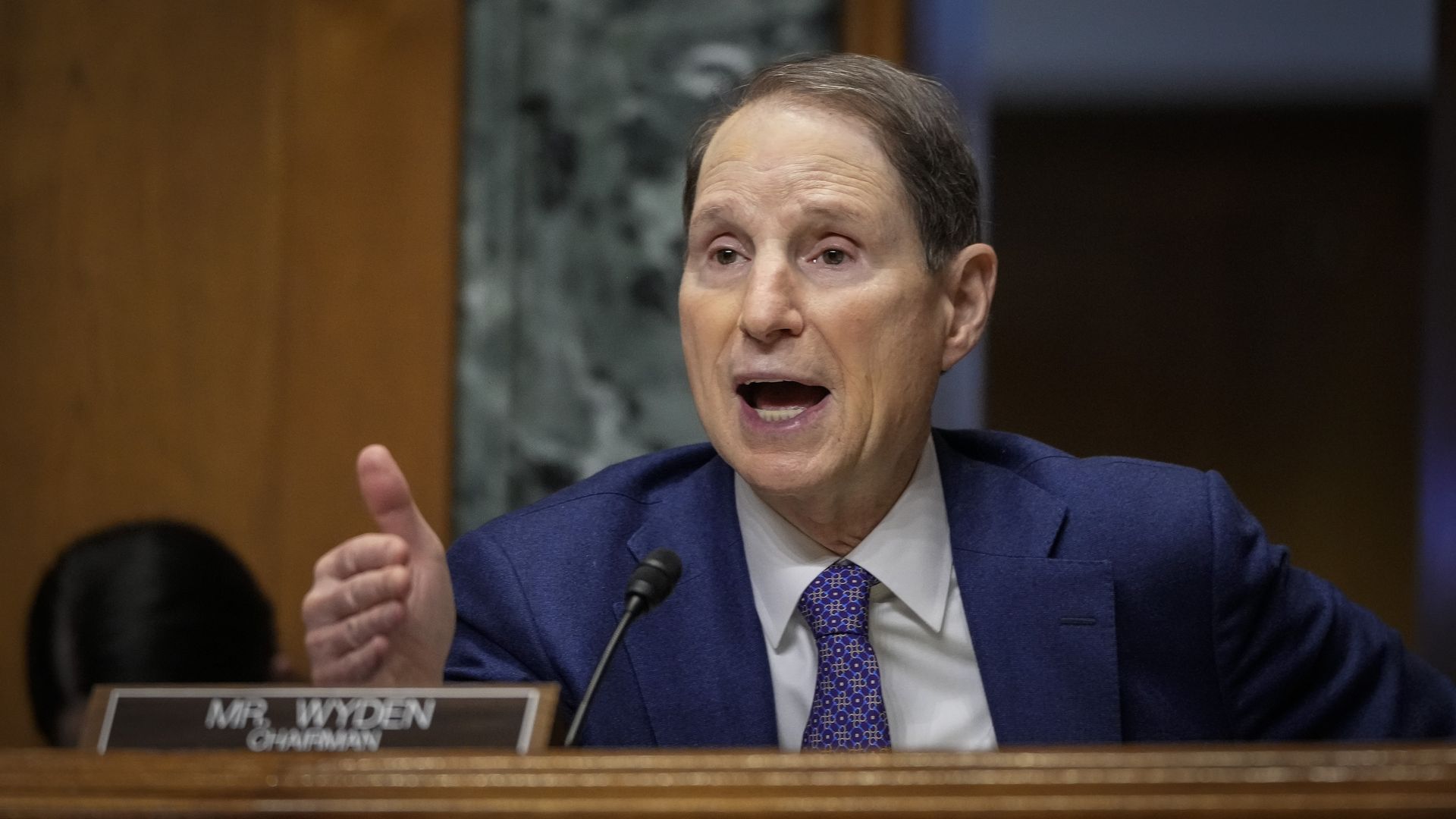
Sen. Ron Wyden, Feb. 8, 2022, during a Senate Finance Committee hearing. Photo: Drew Angerer/Getty Images
Sen. Ron Wyden (D.-Ore.) has some questions for the six leading cryptocurrency exchanges in the world β a lot of them, really, Brady writes.
Why it matters: The senator's office is using its position as a legislative office to press crypto firms to provide greater operational transparency to the public after FTX users were caught stunned by FTX's insolvency this month.
What they're saying: "As Congress considers much-needed regulations for the crypto industry, I will focus on the clear need for consumer protections along the lines of the assurances that have long existed for customers of banks, credit unions and securities brokers," Wyden, who chairs the Senate Finance Committee, said in a Tuesday statement.
- He's asking for answers by Dec. 12.
What we're watching: "December 12 gives the companies two weeks to respond, which Senator Wyden believes is appropriate given the potential risks to consumer assets," Keith Chu, a Wyden spokesman, told Axios.
- But... we couldn't help but notice that the House Financial Services Committee has scheduled its hearing "Investigating the Collapse of FTX, Part Iβ for Dec. 13.
By the numbers: His office sent 13 main questions, with another 7 sub questions.
In the weeds: Some are probably be questions the exchanges will be happy to answer. Others are likely to get side eye from exchange CEOs.
- The senator is asking them to send their full balance sheets.
- He also wants to know whether they owe anyone any money and how leveraged they would describe their operations.
- How the exchanges use customer data to inform trading by the company or its staff.
Nerd alert: The senator's office is adding his weight to a demand blockchain denizens have been making of centralized exchanges for years: provide proofs-of-reserve.
π Our thought bubble: The senator has also asked about any insurance that firms have taken out to protect deposits. The blockchainerati will be delighted when and if "SAFU" is read into the Congressional Record.
Of note: Wyden's office confirmed that this was simply a letter, without any accompanying authority to compel firms to respond.
Axios has contacted all six exchanges the senator's office contacted β Binance, Bitfinex, Coinbase, Gemini, Kraken and KuCoin.
- Binance US and Kraken both told Axios that they plan to respond to the senator's query. The others have not yet responded at time of writing.
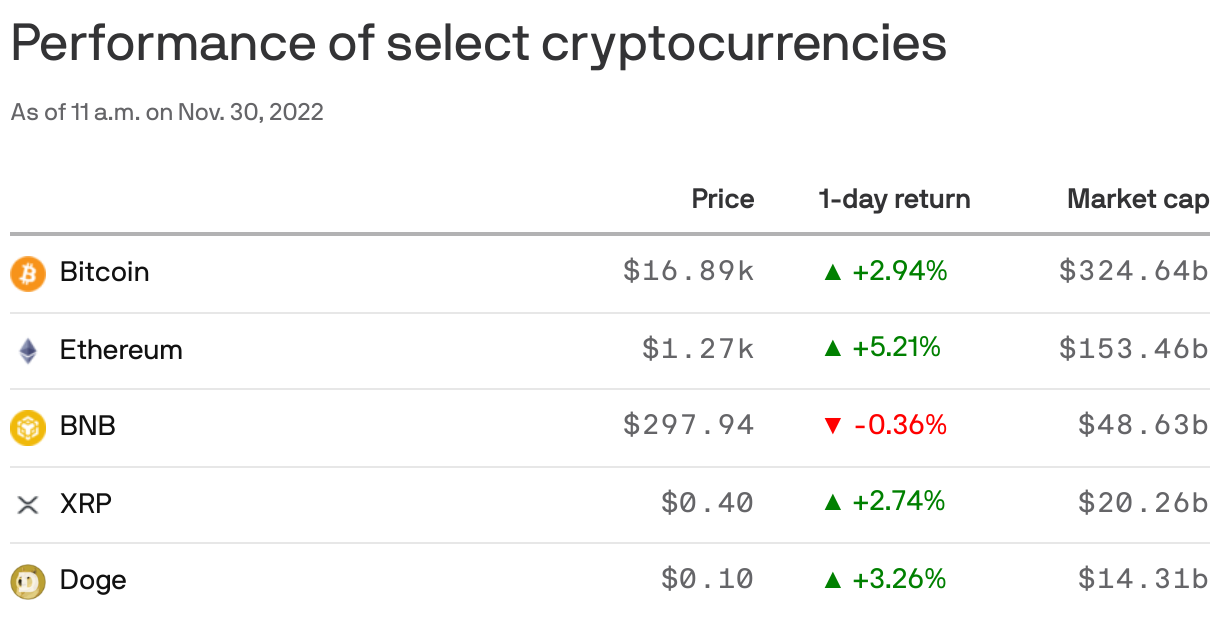
Top coins

This newsletter was edited by Pete Gannon and copy edited by Rob Reinalda.
All the trader types are saying that the big candle on bitcoin and ether price last night wasn't the Brazil news, but it sure seems like the market must have been reacting to something tangible. βC & B
Sign up for Axios Crypto

Brady Dale covers crypto and blockchain impacts on markets and regulation.