Axios Communicators

August 07, 2025

Welcome back!
- π Join us for Axios' inaugural Media Trends Live event in NYC on Sept. 18.
- Axios' Sara Fischer and Kerry Flynn will be joined on stage by Shari Redstone, CondΓ© Nast CEO Roger Lynch, Associated Press CEO Daisy Veerasingham, Feed Me founder Emily Sundberg and more.
- Reserve your spot here.
Today's newsletter, edited by Christine Wang and Kathie Bozanich, is 1,658 words, a 6.5-minute read.
1 big thing: The latest culture war brought to you by American Eagle

American Eagle's ad featuring actress Sydney Sweeney has ignited a new brand-driven culture war about beauty standards, race and representation.
Why it matters: Consumers are quick to slap a red or blue label on a brand or company, and the jeans maker is the latest to find itself in the political crosshairs.
Catch up quick: "Genes are passed down from parents to offspring, often determining traits like hair color, personality and even eye color," Sweeney says in the ad. "My jeans are blue."
- The ad ignited online debate, with some praising it for being "anti-woke" and others raising concerns about it approaching a positive portrayal of the discredited belief of eugenics.
- Critics β and former employees β were quick to point out this ad felt like a departure from the company's commitments to inclusive advertising and sizing.
Meanwhile, the ad became even more politicized after President Trump praised Sweeney for being a registered Republican and the company for being "anti-woke."
- "The tide has seriously turned," the social media post said. "Being WOKE is for losers, being Republican is what you want to be."
- Soon after, figures on the right β such as Defense Secretary Pete Hegseth and Rep. Nancy Mace (R-S.C.), who is running for governor β appeared in memes showing their "great" jeans.
By the numbers: While the campaign first went viral on social media, it also garnered coverage in roughly 3,000 news articles. Those generated more than 50 million readers, according to Memo readership data shared with Axios.
- The overwhelming majority of readers β roughly 29 million β came from left-leaning news outlets, per Memo.
- American Eagle's mention volume jumped 18x following the campaign launch, according to Signal AI data, but sentiment toward the brand plummeted from +50 to -31.
What it's saying: In response to the backlash, American Eagle said on Instagram the ad campaign "is and always was about the jeans. Her jeans. Her story."
- "We'll continue to celebrate how everyone wears their AE jeans with confidence, their way. Great jeans look good on everyone."
Between the lines: American Eagle's statement was not the apology some consumers expected, and indicates a major shift in the way corporate America reacts to controversial moments, says Nathan Miller, founder and CEO of crisis management firm Miller Ink.
- "The corporate comms script is that you apologize when you offend people. ... Now, they do the cost-benefit analysis and realize if you apologize, it's not going to placate the critics and it will also promote further ire" from those that initially applauded the campaign, he said.
The big picture: Brands are taking what experts call "calculated risks" by abandoning diversity, equity and inclusion commitments.
- "You're seeing a lot of brands trying to distance themselves from what was previously described as 'woke culture,' and they believe there's a market for those who don't abide by the cultural norms that were previously enforced," Miller says.
The other side: A brand should at the very least acknowledge when it offends its consumer base, says Lola Bakare, marketing strategist and author of "Responsible Marketing."
- "What I saw [in American Eagle's response] was hostility. ... It was shocking and there was really no acknowledgement of the feedback they got from the people who they want to buy their stuff," she said.
- American Eagle "blamed the people who were offended for being offended," which likely decreased its market share, she added.
The bottom line: The Sweeney ad shows "how quickly brand campaigns can take on political weight," says Kara Hauck, senior vice president at Sable Strategy.
- "It's not uncommon for cultural moments to catch the attention of this administration. ... All it takes is a single offhand comment at a press conference and suddenly your marketing campaign is propelled into the political realm," she said.
- "It's a reminder to communicators and marketers alike that the line between pop culture, consumer marketing and politics is thinner than ever."
2. Bonus chart: American Eagle's Trump bump


American Eagle shares rose more than 23% on Monday after Trump declared that the jeans featured in the Sweeney ad are "flying off the shelves."
Yes, but: Shares remain higher than before the Sweeney campaign, but stock is down roughly 27% year-to-date.
- There is no indication the jeans are selling in high quantities, and foot traffic in American Eagle stores is down roughly 4%, according to data provided by geospatial insights company PassBy.
The intrigue: Consumer PR firm Shadow was running point on the ad launch, according to a press release.
- However, after the continued backlash, strategic communications firm Actum was brought in to handle the crisis response, according to Modern Retail.
- American Eagle and Actum did not reply to Axios' request for comment.
3. Exclusive: Shamrock Capital acquires Penta Group
Shamrock Capital β the Los Angeles-based investment firm specializing in media, entertainment, communications, sports and marketing β has acquired Penta Group, a stakeholder management firm based in Washington, D.C.
- Falfurrias Capital Partners, which took a majority stake in 2021, has exited, and financial terms were not disclosed.
Why it matters: It's the latest private equity deal within the communications advisory space.
State of play: This week, Teneo announced a minority investment from LGT Partners, valuing the firm at $2.3 billion. Also, KKR secured a 30% stake in FGS Global in 2023, valuing the firm at $1.4 billion.
- Shamrock Capital also backs entertainment communications firm The Lede Company and Highwire, a tech and health care public relations agency.
- Penta says it brought in over $100 million in revenue this year, half of which is attributed to its proprietary AI, data and predictive analytics work.
Catch up quick: The firm was founded as Hamilton Place Strategies in 2009 by George W. Bush administration alums Tony Fratto, Matt McDonald and Stuart Siciliano.
- In 2022, Ballast Research, Hamilton Place Strategies, Flag Media Analytics, Alva, Gotham Research Group, and Decode M merged to create Penta.
- Since then, Penta acquired the global public affairs firm Hume Brophy and brand communications consultancy Copperfield Advisory.
Between the lines: Communications is experiencing a digital transformation, and Penta is positioning to be known as the firm with the most advanced data tools and capabilities to analyze and predict stakeholder needs and expectations.
What they're saying: "We think that managing across all stakeholders is here to stay and we think that data is going to be central to our value proposition of understanding [stakeholders] inside out and outside in," says McDonald, Penta's CEO.
- "We think that there's going to be more channel agnostic approaches β the blending of marketing, communications, getting information from AI and social. All of these channels are going to continue to be in flux, and we're positioned for that."
4. Americans now support corporate activism again


U.S. adults' stance on corporate activism has flip-flopped, according to a Bentley University-Gallup report released yesterday.
Why it matters: After years of decline in support, more Americans across demographics and political affiliations want businesses to take a public stance on hot-button topics, including free speech, immigration policy, diversity, climate change and health care issues.
- "The data underscore an important insight for businesses," the report said. "What they say, and who they say it to, matters."
By the numbers: 51% of U.S. adults in the May survey said they believe companies should take public stances on current issues, per the poll.
- That's a 13 percentage point increase from last year and a reversal of a downward trend that began after 2022.
Flashback: Last year, 38% of respondents said they thought businesses should take a public stance on current events.
- At that point, the biggest drops in sentiment were within groups of people who were previously the most receptive β Democrats, Americans under 45, Black Americans and Asian Americans.
State of play: Now, 71% of Democrats and 33% of Republicans support businesses taking public stances.
- Support has risen for businesses to take a public stance on free speech, immigration policy and international conflicts.
The intrigue: While Americans support businesses speaking out publicly, they're more apprehensive about their own employers communicating on most topics.
- 60% of employed respondents said they'd prefer their employers not to communicate a stance on current events. The exceptions are mental health, health care issues, diversity and inclusion and free speech.
5. πReading list
Here are some other stories that caught our attention ...
- π£οΈ CEO tough talk continues. 5 things the AT&T CEO's sweeping memo says about where corporate America is headed. (Business Insider)
- Plus: "We don't believe in work-life balance ..." Cognition CEO Scott Wu wrote amid layoffs and employee buyouts. (Tech Crunch).
- ποΈ Gen Alpha's spending power. 42% of all household spending is influenced by 8- to 14-year-olds β particularly when it comes to food and entertainment. (Axios)
- π£ Obama alum David Plouffe is joining public relations firm Orchestra as a partner. The firm also recently brought on former SKDK CEO Josh Isay, who will co-lead the firm's advisory practice with Plouffe. (Axios)
- πΈ Publicis Health is acquiring life sciences comms firm P-value Group for between $250 million and $300 million. (Axios)
- π€ Trump Media Group will partner with Perplexity to launch public beta testing of Truth Social AI (Barron's)
- Of note: An Axios analysis found that responses tend to cite Trump-friendly media sources, like Fox News, Washington Times or Epoch Times. (Axios)
6. ποΈ 1 newsy thing to go
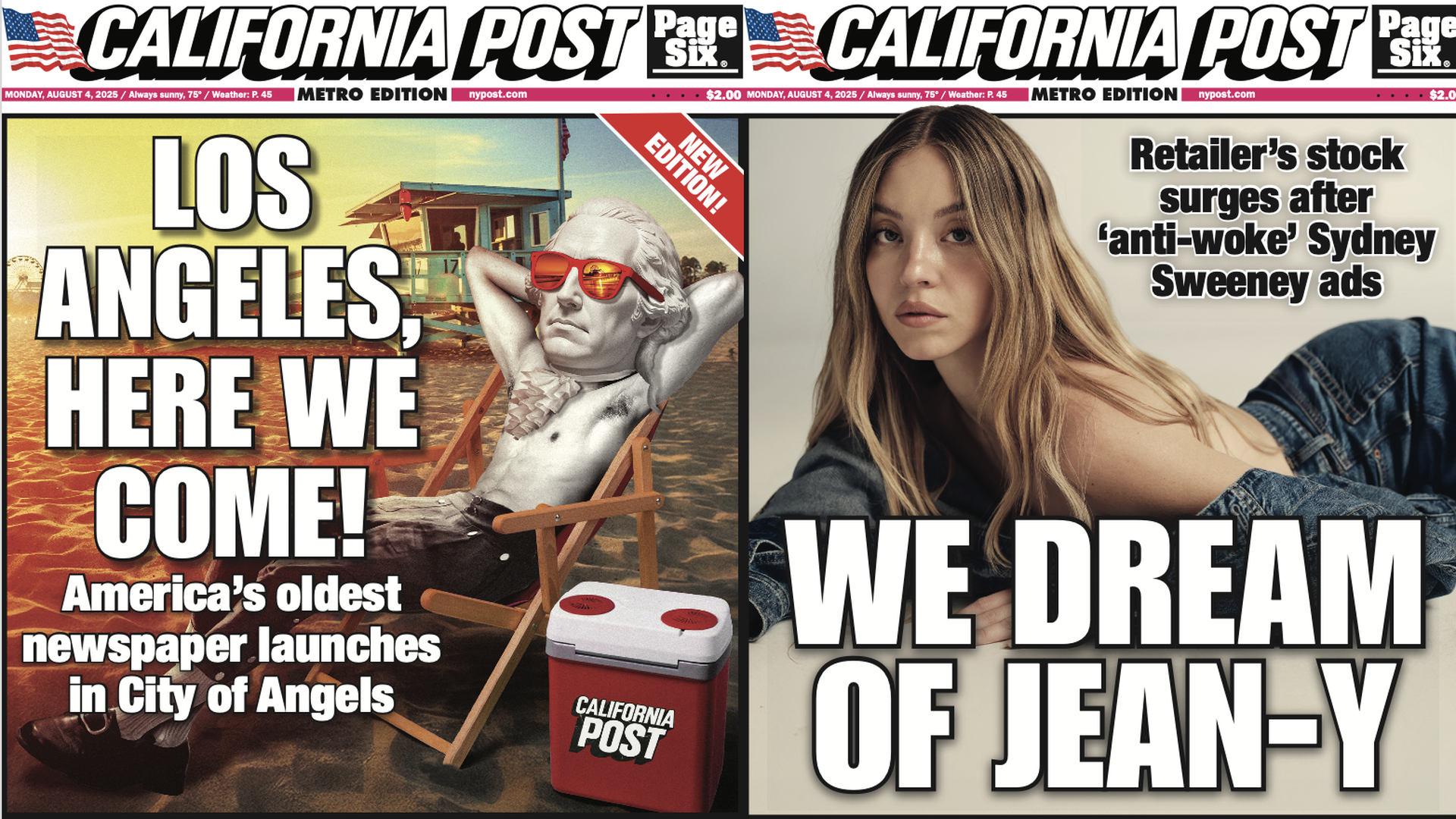
In case you missed it, New York Post Media Group, a subsidiary of Rupert Murdoch's News Corp., will launch a new, daily Los Angeles-based newspaper called The California Post in early 2026, reports Axios' Sara Fischer.
Why it matters: You'll have a new outlet to pitch β or at the very least, monitor.
- Los Angeles is home to the second-largest concentration of Post readers, per News Corp.
- NYPMG also owns the New York Post, Page Six and Decider.
β Thanks for reading! For more, join Axios Communicators Pro.
Sign up for Axios Communicators