
Axios Communicators

February 16, 2023
Welcome back!
- đ Mark your calendars: Join Axios Communicators at SXSW in Austin, Texas, on March 13. Then, meet us in D.C. for the second annual What's Next Summit on March 29. Register here.
Today's newsletter is 1,251 words, a 4.5-minute read.
1 big thing: Corporate communicators activate on Twitter
Illustration: Shoshana Gordon/Axios
Top communicators are increasingly taking to Twitter to explain, persuade and clap back on thorny issues.
Why it matters: While many in politics have been taking this approach for years, it's a new strategy for corporate communicators who typically opt for strategic silence.
Driving the news: Activision Blizzard's new head of corporate affairs, Lulu Cheng Meservey recently raised eyebrows with a series of tweets directed at the Federal Trade Commission (FTC).
- In a thread viewed more than 1 million times, she made the case that the breakout success of HBO's "The Last of Us" was proof the FTC didnât need to block Microsoftâs $69 billion Activision bid to preserve game industry competition between Sony and Microsoft, Axios' Stephen Totilo reports.
What theyâre saying: Meservey believes that being more direct, more transparent and speaking plainly is key to addressing these complicated regulatory or corporate issues.
- âProbably going to do more like that,â Meservey tells Totilo regarding the Twitter thread. âIf there are things that we think people should know about, we should just go ahead and say it out loud.â
- "People are not accustomed to companies speaking directly and bluntly, and so it comes off as a campaign or a shift. But [no one on my team] has the direction or the instinct to lay low. ... We want to actually talk as much as possible â that's our job."
- It's a tactic Frank X. Shaw, Microsoft's chief communications officer, has also embraced.
Zoom in: Binance's chief strategy officer Patrick Hillmann is known for his sharp-tongued tweets but believes it's the most effective way to engage with the crypto community and push back.
- "Crypto Twitter is fascinating because it's vitriolic, yet highly revealing," Hillmann tells Axios. "A lot of our users pay attention to crypto Twitter, so we mandate that everyone on our team does too."
- "When a news story comes out that I really don't think got it, and I'm worried that that's going to become a narrative, the quickest way for me to respond is to just push back on Twitter."
Yes, but: This spin approach must be endorsed internally at the highest level.
- "I adopted [this strategy] from my CEO, who is also very aggressive on Twitter â and it just works," says Hillmann. "It doesn't mean we're always right, but it does mean that sometimes journalists see it and say, 'Let me just dig into that a little bit more,' which helps. "
- Perhaps the most aggressive executive is the chief twit himself, Elon Musk, who reportedly boosts his own tweets to garner more influence and is known for playing fast and loose with business-related posts.
- "I recommend communicating a lot on Twitter," Musk recently said at the World Government Summit."I would encourage CEOs of companies, legislators and ministers to speak authentically and explain policies. ... Do your tweets yourself to convey the message that you want directly."
Between the lines: If you want to grab the attention of journalists, Twitter is a good place to start.
- 94% of U.S. journalists use social media for their jobs and the vast majority favor Twitter, a Pew Research study found.
- Yes, but: It's not an effective way to reach the general public â only 13% of whom regularly get their news from the platform.
To bridge the gap, the tweets need to be interesting enough to become news stories in and of themselves.
- Meservey's "The Last of Us" tweets generated 21 stand-alone articles and attracted more than 650,000 readers, according to Memo readership data shared with Axios.
The bottom line: If you have the stomach for it, bold communications directed at specific reporters or niche audiences can be an effective way to garner attention, push back on a narrative and sway public opinion.
2. The rise of the de-influencing
Illustration: Gabriella Turrisi/Axios
Social media users are flipping the art of influencing on its head by telling people what not to purchase.
Whatâs happening: More people on TikTok and Instagram are using their platforms to "de-influence" and push back against the growing pressure to spend cash on viral trends, Axios' Erica Pandey writes.
Why it matters: Itâs a real threat to the $16 billion influencer marketing economy, not to mention brand reputation.
By the numbers: The number of American consumers who research products on social networks has increased 42% since 2015, according to GWI, a market research firm.
- Yes, but: They don't research price. Gen Z â the generation most deeply steeped in social commerce â is 23% more likely to make impulse purchases and 27% less likely to spend time finding the best deals, per GWI.
State of play: Social media influencers could be losing their ... er ... influence.
- The number of Gen Zers interested in influencers has dropped 12% since 2020, and the number who take note of what influencers wear has fallen 16% since then, per GWI data.
- As a result, influencers â and others â are making viral videos listing trendy makeup products or shoes that arenât worth the money, or what to cut when planning trips or weddings.
- âThe hashtag #deinfluencing has racked up more than 76 million views on TikTok,â notes "Today."
What to watch: How brands react to, push back on or get ahead of the de-influencing trend.
3. Employees aren't getting the message
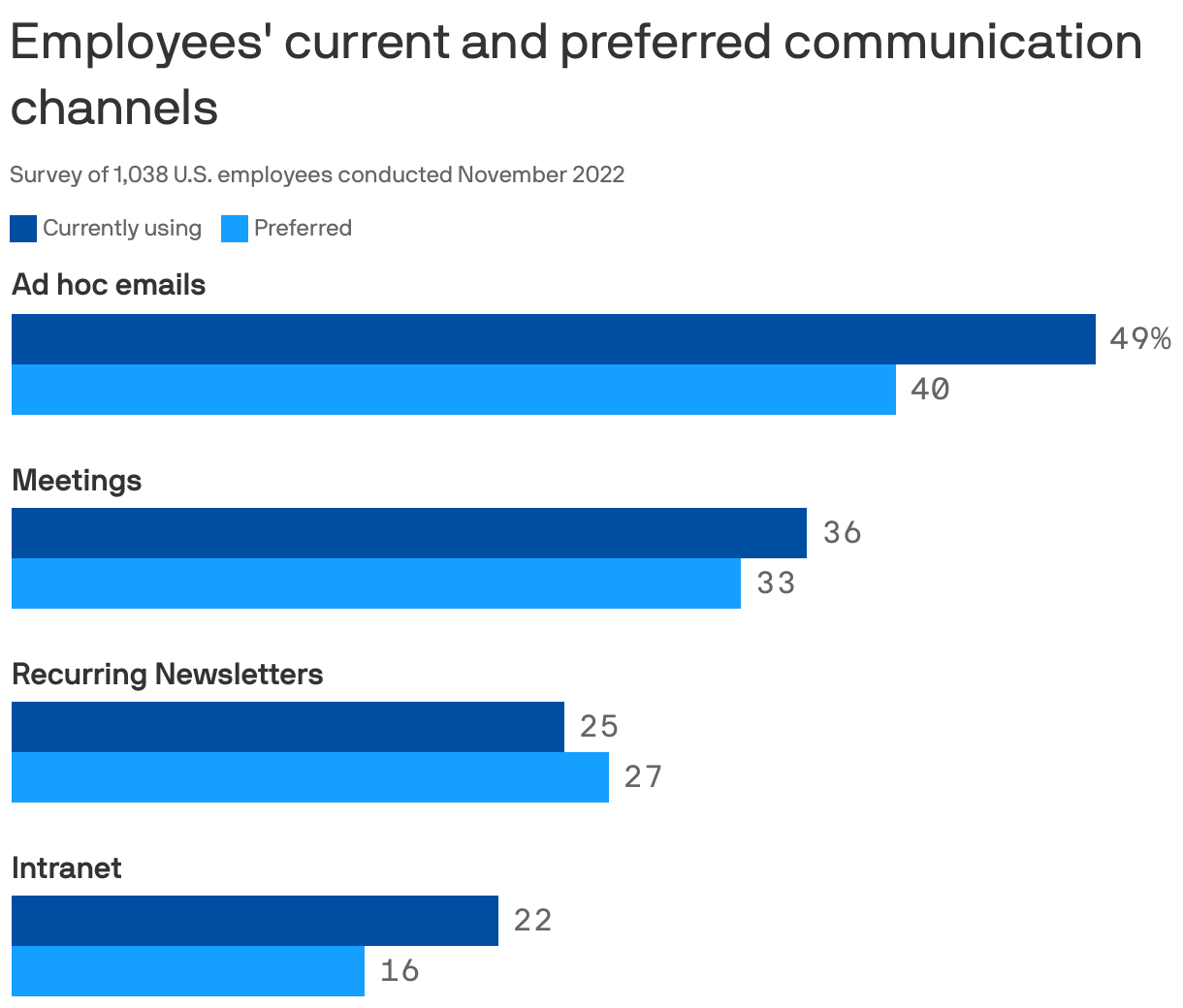
Open embedded content from datawrapper.dwcdn.netCorporate leaders think their internal communications are sticking, but employees aren't so sure.
The big picture: People spend an average of 26 seconds reading a piece of content and decide in 17 milliseconds whether to keep reading.
- So leaders â and their communication teams â have to do more to deliver information that is worthy of employees' time and attention.
Driving the news: Our former colleagues at Axios HQ* surveyed 1,038 employees and 540 leaders from small, mid-size and large companies within the U.S. to dig into current workplace communication trends.
Some interesting nuggets ...
- Two-thirds of leaders said theyâre in sync with employees, yet only 44% of employees feel the same way, and a majority of employees don't know how to access company-wide information like goals, strategies and updates.
- A majority of employees want corporate messages to be delivered to their inbox â not shared solely in meetings or across intranets â and newsletters are the only method of communication employees said theyâd like to see more of.
*Disclosure: Axios HQ was spun out of Axios into a separate, stand-alone company last year. Learn more about it here.
4. Communication skills are in high demand

Illustration: Shoshana Gordon/Axios
Communication is one of the most sought-after skills in today's job market, a new LinkedIn study found.
By the numbers: The top three skills across all industries are management, communication and customer service.
- Communication skills rank in the top three for business, sales, project management and recruiting and is a top-five skill for finance, accounting and marketing.
What they're saying: Strong communication helps combat turnover by keeping virtual, hybrid and geographically dispersed teams aligned.
- "People donât just leave jobs, they leave people," Linda Jingfang Cai, vice president of talent development at LinkedIn, told Axios.
- "When you hire managers who can communicate well, you create a workforce culture that is supportive, psychologically safe and agile in a world of work that is constantly changing â a culture people wonât want to leave."
The bottom line: You don't have to work in communication to harness the skill. It's one that transcends all industries and is particularly critical for people managers.
5. Quote du jour
"Itâs never occurred to me that I shouldnât tell a powerful person that theyâre wrong.ââ Risa Heller in New York Magazine's must-read profile of the "crisis communications warrior."
đ¤ Thanks for reading! And special thanks (as always!) to editor Nicholas Johnston and copy editor Kathie Bozanich.
Invite your friends and colleagues to subscribe.
Sign up for Axios Communicators

Unpacking the topics and trends driving Communications.