Axios Communicators

January 16, 2025

👋🏻 Welcome back!
- Here's a list of resources for those affected by the California wildfires and ways to help.
Today's newsletter is 1,884 words, 7 minutes.
1 big thing: Corporate DEI retreat

Several of America's largest companies have buckled to the pressures of political and shareholder activists by rolling back their commitments to diversity, equity and inclusion.
Why it matters: Calls for ending these corporate initiatives have become more fervent in the past year and are expected to intensify in Trump's second term.
The big picture: Companies have been talking about DEI less and reframing the narrative when they do.
- Mentions of DEI and "diversity equity and inclusion" in earnings calls have dropped roughly 82% since Q2 of 2021.
- The Society for Human Resource Management (SHRM) dropped the word "equity" from its strategy, while corporate communicators have started to lean more heavily on terms like "belonging" and "diversity of thoughts and perspectives."
Companies across industries — like Amazon, Boeing, Ford, McDonald's, Meta, Toyota and Walmart — have rolled back their DEI commitments and/or programs in recent months.
- Meanwhile, Apple, Costco and Delta are among those that have publicly defended their diversity, equity and inclusion policies.
Zoom in: Brown-Forman, Lowe's, Meta and McDonald's have publicly cited the legal environment — due to the Supreme Court's 2023 decision to strike down affirmative action at colleges — as the basis for their DEI policy changes.
What they're saying: "Of course, the Supreme Court decision was one of the sparks that made movement in terms of having companies reconsider DEI," says Ann O'Leary, partner and co-chair of government controversies and public policy litigation practice at Jenner & Block.
Yes, but: "If you take it from a purely legal perspective, I think that the legal risk mitigation is low in terms of continuing to be able to do DEI practices," she added.
- "What we're seeing is companies looking at the holistic picture— like social media campaigns that have been run against companies and the political environment in which you have not only Trump, but his closest advisors, such as Elon Musk, going after particular companies around DEI. But we're also seeing companies really taking a close look at why they're doing what they're doing."
Go deeper... See which companies are rolling back DEI and which stand firm (full list).
2. Meta's MAGA PR playbook

Meta founder and CEO Mark Zuckerberg rolled out a MAGA-centric PR strategy that has caused chatter in the tech world.
Why it matters: The strategy was deliberately packaged to appeal to an audience of one — Trump — and his most loyal followers.
Here's the Meta formula, as reported by Axios' Mike Allen and Jim VandeHei:
- Put a Trump friend on your board (Ultimate Fighting Championship CEO Dana White).
- Promote a prominent Republican as your chief global affairs officer (Joel Kaplan, succeeding liberal-friendly Nick Clegg, president of global affairs).
- Align your philosophy with Trump's on a big-ticket public issue (free speech over fact-checking).
- Announce your philosophical change on Fox News, hoping Trump is watching. In this case, he was. "Meta, Facebook, I think they've come a long way," Trump said at a Mar-a-Lago news conference, adding of Kaplan's appearance on the "Fox and Friends" curvy couch: "The man was very impressive."
- Take a big public stand on a favorite issue for Trump and MAGA (rolling back DEI programs).
- Amplify that stand in an interview with Fox News Digital. (Kaplan again!)
- Go on Joe Rogan's podcast and blast President Biden for censorship.
- Host an inaugural ball reception honoring Trump.
- And light up social media with all the fireworks.
What they're saying: "It's hard to break through in this media environment. It sends a signal," a source familiar with the strategy told Mike and Jim.
Yes, but: Internal and external backlash is already brewing.
- Communicators we've spoken to say they have seen an uptick in employee inquiries about how their executives are engaging with the incoming administration.
What to watch: How tech leaders continue to position themselves closely with Trump.
- Amazon founder Jeff Bezos, TikTok CEO Shou Zi Chew, Google CEO Sundar Pichai and Zuckerberg are planning to sit on the dais during Trump's inauguration, according to several reports.
💭 Our thought bubble: Sharp pivots like this might seem to make sense right after an election, but watch out for ripple effects it might have on key stakeholders.
- Plus, as reported by Axios' Marc Caputo, it's a mistake to assume Zuckerberg's strategy will lead to any quid pro quo from the Trump team.
Go deeper... Keep reading.
3. Health care execs talk Trump 2.0
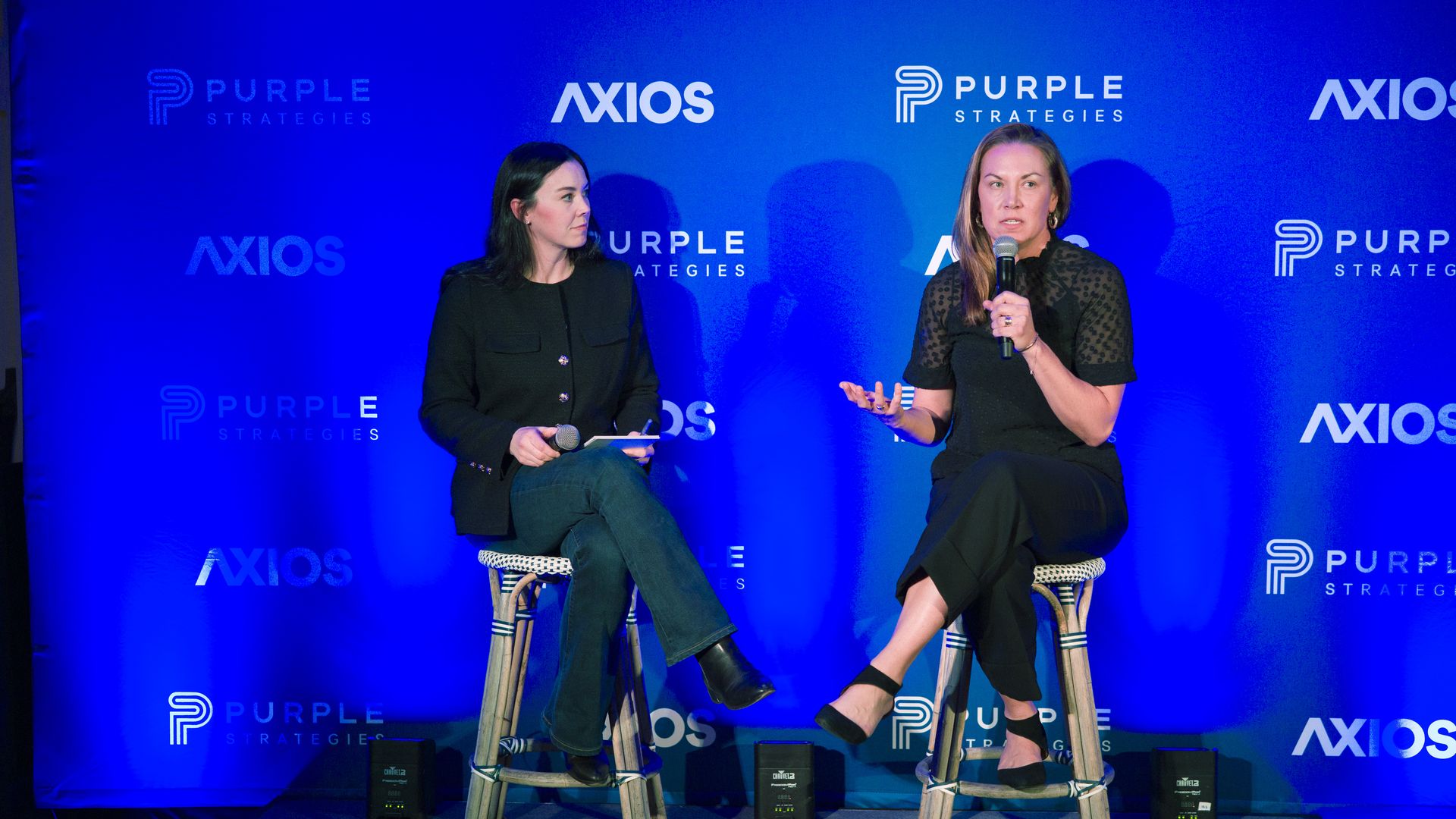
Health care leaders feel optimistic about the incoming Trump administration, they told a room of more than 150 people at Monday's Axios event in San Francisco.
Why it matters: A new Washington means new communication opportunities and risks for those in the health care and pharmaceutical space.
State of play: Hims & Hers chief corporate affairs officer Khobi Brooklyn said the opportunity-to-risk ratio is about 1:1.
- "We need to be engaging with policymakers as much as we need to be engaging with customers," Brooklyn said. "We want to engage with the administration as they come in and let them know that we're here. We're a voice. We want a seat at the table."
PhRMA CEO and president Stephen Ubl, who led the trade organization during Trump's first administration, said it's important "to not be distracted and to continue to focus on your core priorities."
- "We've all probably learned to block out the noise. There's going to be a lot of day-to-day ups and downs, and we're going to try to remain focused on the core issues that we care about," he said.
- Plus, he sees other issues like tax policies and immigration taking precedence in the early days of the administration.
Of note, Hims & Hers and PhRMA have contributed to Trump's inaugural committee, as reported by Axios' Tina Reed.
The big picture: The health care industry has seen a decline in reputation since the COVID-19 pandemic.
- Americans' satisfaction with almost every major part of the health care system has dropped since 2010, according to a recent Gallup analysis, and the U.S. health care system ranks as one of the most inefficient among high-income countries, according to a Commonwealth Fund report.
This has led to more misinformation, distrust and public skepticism of the health care industry.
- "People are concerned about ingredient safety, vaccine safety, the food supply. And it's going to be something that isn't going to go away and something that the health care industry is going to have to address because it's not fringe, and RFK Jr. and MAHA-ers have broad support," said Purple Strategies managing partner and chief operating officer Kristen Morgante.
What they're saying: "If we don't tell our story, somebody else will," Ubl told the audience.
- "The media environment has been evolving. It's balkanized. You get your information from various different sources, and there are more ways than ever to communicate and get information, which is great. But we have to make sure that we're using our unique ways to address this new environment that we're working in."
Between the lines: Under the new administration, one area that might create communication challenges and risk for Hims & Hers is hormone-based therapies.
- "As we move into the next year, we are looking at new [treatment] categories that carry stigma, but that can be really impactful in people's lives — menopause is a great example of that," said Brooklyn.
- "There's a lot of work for us to do, both with the administration and with our customers, to talk about what treatments look like, what can be impactful and what is safe," she added.
What we're watching: The experts Axios had on stage all seemed optimistic about the Trump administration's appetite for innovation and disruption.
4. AI super users
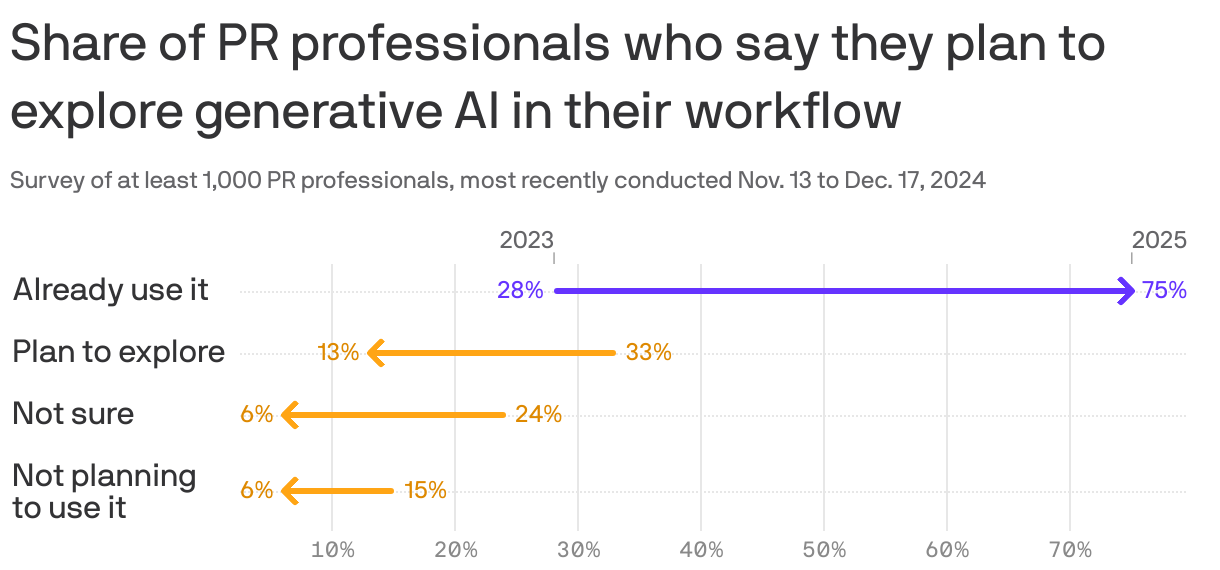
Three out of four communicators use generative AI at work, according to a new report shared exclusively with Axios.
- Why it matters: This is nearly three times more than in March 2023.
By the numbers: Media monitoring platform Muck Rack surveyed 1,013 PR professionals from Nov. 13 to Dec. 17, 2024 and found widespread adoption of the technology, with only 6% saying they have no interest in using the tools.
- 9 in 10 say AI allows them to work faster and roughly 8 in 10 say it boosts the quality of their work.
Yes, but: Trainings and guidance on best practices are still lacking.
- More than half of all those surveyed say their companies do not have AI policies, standards and guidelines in place.
- However, agencies are more likely to offer training (43%) than in-house teams (31%).
The other side: Three out of four PR pros who use AI say the biggest risk is talent development, should younger practitioners become too reliant on the tools.
- Other concerns include privacy, plagiarism, output quality and the environmental impact of AI.
5. 👀 Also on our radar
- 💼 Corporate spinoffs grow in size and complexity as boards and C-suites at major companies opt to tackle giant separations before an activist investor does it for them. (Axios)
- 🤐 JPMorgan shuts down internal message board comments following return-to-office backlash and employees discuss unionizing (Entrepreneur/ Barron's).
- 📉 New Gallup report: American workers' enthusiasm for their jobs falls to a 10-year low (Axios)
- 🌎 Trump will appear virtually at the World Economic Forum on Thursday, Jan. 23. (Axios)
- 💭 Several companies react to the California wildfires in support of Los Angeles-based employees. (Fortune)
- ▶️ Substack rolls out live video for its publishers. (Tech Crunch)
- 📍OpenAI will underwrite the expansion of Axios in four new Local newsrooms: Pittsburgh, Pa.; Kansas City, Mo.; Boulder, Colo.; and Huntsville, Ala.
6. Communicator Spotlight: Gemma Hart of Danone North America

As senior vice president of corporate affairs at Danone North America, Gemma Hart is responsible for "being a translator and the connector," she told Axios.
- Why it matters: Hart's team is focused on proving how its reputational work feeds into the business strategy.
🗣️ What she's saying: "The mindset of driving commercial benefit is a big shift, and one that obviously takes a lot of work," she told Axios.
- "I think it's part of a bigger trend from the last 10 years or more, where we as a function have gone from originally being seen as the keepers of the media universe and potentially employees, to connecting the dots across all of our key stakeholders in the business and looking to drive commercial value and driving business growth through what we're doing."
📍How she got here: Hart got her start in the London office of strategic communications advisory Brunswick Group, where she spent more than a decade.
- She then served as vice president, communications at Anheuser-Busch before joining Danone in 2019.
🏗️ How it's structured: Hart reports to Danone North America's general secretary Nancy Dowling and oversees a team of 14 responsible for communications and government affairs.
👀 She's watching how executives are communicating more — and in atypical ways — on social media.
- "I think LinkedIn continues to be increasingly relevant, and there are a couple of leaders that have been doing very unexpected things. One example is [Blackstone chief operating officer] Jon Gray — and I think his communications team has done an amazing job bringing their business to life in little short LinkedIn videos."
🧠 Best career advice comes from her mom: Be kind.
- "It's so simple. What we do is all about relationships and building human connection, and so I try really hard to live that one."
Go deeper... Read her spotlight in its entirety.
7. 📸 1 picture to-go

🙏🏻 Thanks again to everyone who attended our Axios Live event in San Francisco this week.
🙏🏻 Thanks for reading each week. And as always, thanks to editors Nicholas Johnston and Chris Speckhard!
Tell your friends and colleagues to subscribe here.
Sign up for Axios Communicators