Axios China

December 13, 2023
Welcome back to Axios China. Today we're looking at the House China committee's big report on economic coercion. We're also diving into gender inequality in real estate ownership, deflation and more.
- Forward this newsletter to your friends and colleagues who are interested in China. They can subscribe here to receive Axios China in their inbox every Wednesday.
Today's newsletter is 1,683 words, a 6½-minute read.
1 big thing: House committee says China's economic system is "incompatible" with WTO
Illustration: Sarah Grillo/Axios
The House select committee on the Chinese Communist Party yesterday released a landmark report declaring China's economic system to be "incompatible with the WTO." The report proposes nearly 150 recommendations to restore U.S. economic and tech competitiveness.
Why it matters: The future of the World Trade Organization may be at stake. The committee calls for like-minded countries to form a new multilateral organization that excludes non-market economies if China's approach to economic governance can't be brought into line with WTO standards.
- Many U.S. lawmakers now identify competition with China as America's defining challenge this century.
- The bipartisan report represents the culmination of the committee's findings since it was established nearly a year ago.
What they're saying: The report calls for countries to work together to counter China's economic aggression. "If this cannot be achieved within the confines of the WTO, then a new multilateral effort by likeminded market economies" is needed, the report states.
- "Because the PRC's state-led economic system is antithetical to the founding principles of the WTO, actions to defend the United States and global economy against PRC economic aggression are consistent with the U.S. commitment to a multilateral trading system based on market-oriented principles."
Flashback: China was admitted into the WTO in 2001 with the expectation that its trend toward market-oriented reform would continue.
- Instead, the Chinese government has maintained and expanded non-market policies, including the widespread use of subsidies and dumping to dominate targeted industries, denial of market access as a form of political coercion, opaque auditing practices, and others.
- Cases brought against China through the WTO's dispute settlement mechanisms haven't fundamentally changed Beijing's economic practices.
- Decisions in the WTO are typically made by consensus among member states, meaning that China could block attempts to change WTO rules in ways that target Beijing.
The report also calls for renewing the China Safeguard Act, which expired in 2013. That act allowed the U.S. to impose tariffs on goods from China that caused "market disruptions." It could also be used to target practices that harm U.S. industry.
- The report recommends passing legislation that requires major U.S. firms to publicly disclose China-related risks and market exposure.
- The report's "offensive strategy to invest in innovation" zeroes in on the development of emerging technologies — AI, quantum computing, biotechnology and others — and recommends several measures to attract experts in these fields and to address concerns about research security and intellectual property theft.
- It also proposes small- and medium-sized businesses that focus on these technologies receive a capital gains tax exemption.
The report also emphasizes securing mineral supply chains and the green energy transition.
- Years of government subsidies and other preferential policies have allowed Chinese battery manufacturers and EV makers to establish growing global dominance over those industries, shutting out competitors in Europe and the U.S.
- The report recommends passing legislation to direct the U.S. International Development Finance Corp. to prioritize investments in minerals and energy projects.
- It also advocates for creating a "resilient resource reserve" of cobalt, manganese, graphite and rare-earth elements.
The bottom line: "Never before has the United States faced a geopolitical adversary with which it is so economically interconnected," the report states.
- "Addressing this novel contest will require a fundamental reevaluation of U.S. policy."
2. Book: Women shut out of China's real estate-fueled wealth creation
Book cover: Bloomsbury
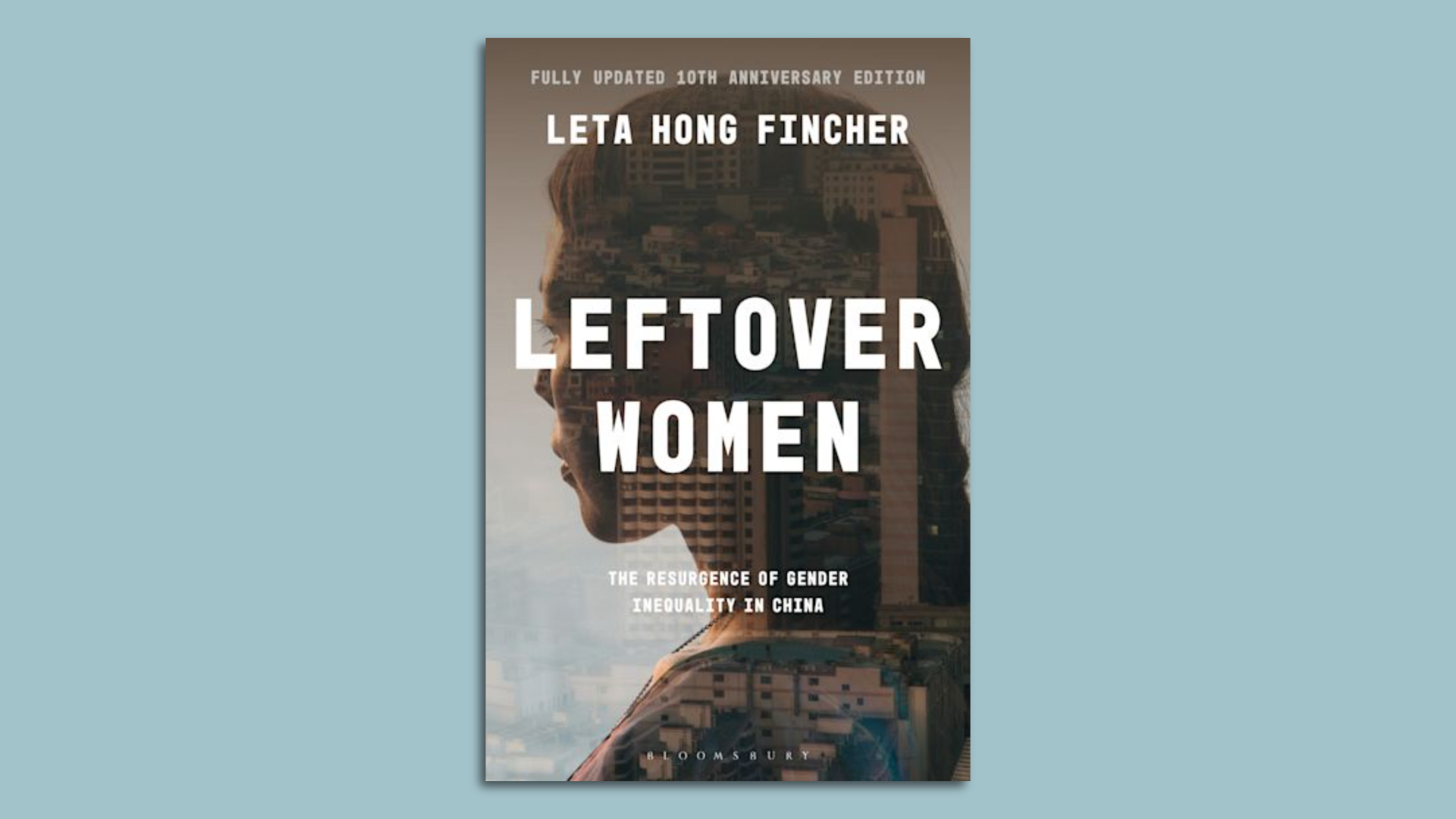
China's real estate boom over the past 20 years created new wealth at an astounding rate. But Chinese women were largely shut out of this real estate bonanza, academic and journalist Leta Hong Fincher writes.
The big picture: State-backed and social pressure to marry, the association of masculinity with home ownership, and China's real estate laws meant many women handed over their salaries to pay for a mortgage in their husband's name alone.
- But now more women are choosing to forgo marriage altogether, in part due to the inequality it can foster, Hong Fincher writes in the updated 10th anniversary edition of her book "Leftover Women: The Resurgence of Gender Inequality in China."
Between the lines: The term "leftover women" refers to the derogatory — and propaganda-driven — term for women who reach the age of 27 without being married.
- The book's title also refers to how women were often left out of the real estate market.
- "Most residential real estate wealth in China is concentrated in the hands of men," she writes.
- "The extraordinary pressure on educated women to marry has had damaging consequences because so many women have been afraid to walk away from an unequal financial arrangement with their boyfriend or husband."
Details: In China, men are typically expected to own apartments if they want to get married. Parents of sons do their best to help cover down payments, and parents of daughters expect their future son-in-law to have a home.
- As a result, parents of daughters are far less likely to help buy homes for their daughters, though they may offer large sums to their sons or other male relatives for home ownership, Hong Fincher writes.
- This dynamic was exacerbated beginning in the late 2000s as Chinese state media began stigmatizing unmarried women. The government at that time was increasingly concerned about the extremely high male-to-female ratio in China due to sex-selective abortions of female fetuses.
- In such an atmosphere, women began to fear they might scare off suitors if they were too demanding, and thus they became more willing to hand over their own money to their husbands to help cover the mortgage payments for homes listed only in the man's name, according to Hong Fincher's research.
A personal account: I lived in China at the height of the state media campaign promoting the idea of "leftover women." It was a true cultural phenomenon.
- I turned 27 in 2012, as did many of my Chinese female classmates in graduate school there, and we often spoke of our fear of becoming "leftover women" or of reaching our "expiration date" of 27 without getting married.
3. Catch up quick
1. Chinese military forces came near Taiwan's territorial waters four times in November in what Taiwanese sources say is a campaign of voter intimidation ahead of the presidential election, Reuters reports.
2. Hong Kong saw record low voter turnout in its elections on Sunday, the first since a "patriots only" overhaul permitted only Beijing-friendly candidates to run, CNN reports.
- Just 27.5% of eligible voters went to the polls, compared with 71% in 2019, the last time elections were held.
3. Ernst & Young's legal affiliate in Hong Kong, LC Lawyers, will cease operations in Hong Kong by the end of January, Bloomberg reports.
- Law firms in China and Hong Kong have faced increasingly difficult operating conditions as Chinese authorities have expanded national security legislation to include tight limits on data gathering and cybersecurity.
4. A Chinese ship and a Philippine boat collided near a contested reef close to the Philippines — the latest flashpoint in a long-running maritime territorial dispute in the South China Sea, the BBC reports.
4. China's economy is heading deeper into deflation


Prices in China continued to fall during November, as the country slips into a deflationary funk, Axios' Matt Phillips writes.
Why it matters: Deflation is a manifestation of the deep problems within the world's second-largest economy.
The big picture: China's economy has stumbled as it tried to emerge from the government's zero-COVID lockdown policies.
- The country is also facing a massive housing bust, the rapid outflow of capital, and a loss of confidence among both domestic businesses and consumers who are uncertain about President Xi Jinping's commitment to economic growth.
Yes, but: While most of the decline in prices was driven by swings in more volatile food and energy categories, the underlying "core" inflation reading was also unimpressive.
- China's core CPI was essentially flat — it went up just 0.6% year over year.
What they're saying: "The lingering softness in core CPI suggests domestic consumer demand conditions may have remained weak," wrote JPMorgan analysts of the recent report on prices.
- "Core CPI inflation remained weak, likely reflecting sluggish domestic economic momentum in the near term," wrote Goldman Sachs analysts.
The bottom line: Such deep issues in an economy this large will ripple out into world markets.
- For example, the recent weakness in global crude oil prices is closely tied to the sputtering economy in China, the world's largest importer of oil.
5. What I'm reading
Stealth war: China's cyber army is invading critical U.S. services (Washington Post)
- "The Chinese military is ramping up its ability to disrupt key American infrastructure, including power and water utilities as well as communications and transportation systems. ... The intrusions are part of a broader effort to develop ways to sow panic and chaos or snarl logistics in the event of a U.S.-China conflict in the Pacific."
- "Among the victims are a water utility in Hawaii, a major West Coast port and at least one oil and gas pipeline. ... The hackers also attempted to break into the operator of Texas's power grid, which operates independently from electrical systems in the rest of the country."
RMB rising: Dollar dominance monitor (Atlantic Council)
- The Atlantic Council's GeoEconomics Center has launched this monitor that "presents indicators for tracking China's progress in creating an alternative financial infrastructure."
- "[I]n recent years, and especially since Russia's invasion of Ukraine and the Group of Seven (G7)'s subsequent escalation in the use of financial sanctions, some countries have been signaling their intention to diversify away from dollars. ... China has been expanding its alternative payment system to its trading partners and seeking to increase international usage of the renminbi."
6. 🐦 1 tweet to go: David Cameron's about-face on China
Screenshot: @FCDOGovUK/X
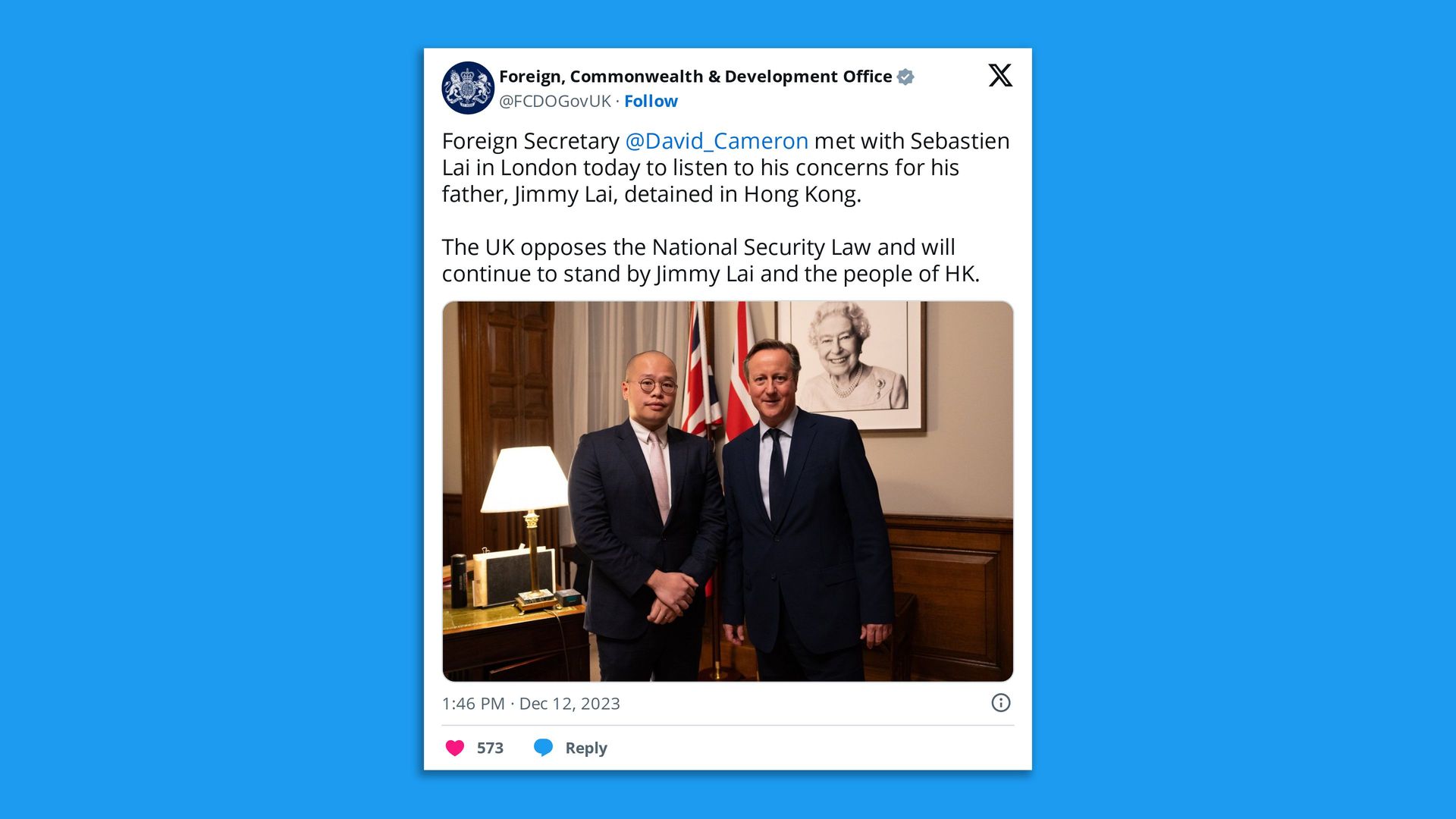
On Dec. 12, the U.K.'s new foreign secretary and former Prime Minister David Cameron met with Sebastien Lai, the son of Hong Kong media tycoon Jimmy Lai, who is now in prison in Hong Kong awaiting trial on national security charges due to his pro-democracy advocacy.
The big picture: Meeting with the son of one of Beijing's fiercest critics is a new look for Cameron, Axios' Dave Lawler writes.
- Outreach to China was a pillar of his foreign policy during his tenure in Downing Street from 2010 to 2016, at which time he heralded a "golden era" in China-U.K. relations.
What he's saying: "My views evolved because a lot of the facts changed," Cameron said last week.
A big thank you to Alison Snyder for edits, Sheryl Miller for copy edits, Matt Phillips and Dave Lawler for contributing, and the Axios visuals team.
Sign up for Axios China

Analysis and intel from Bethany Allen-Ebrahimian, authority on Beijing intrigue and intentions.


