David Cameron changes his tune on China


Add Axios as your preferred source to
see more of our stories on Google.
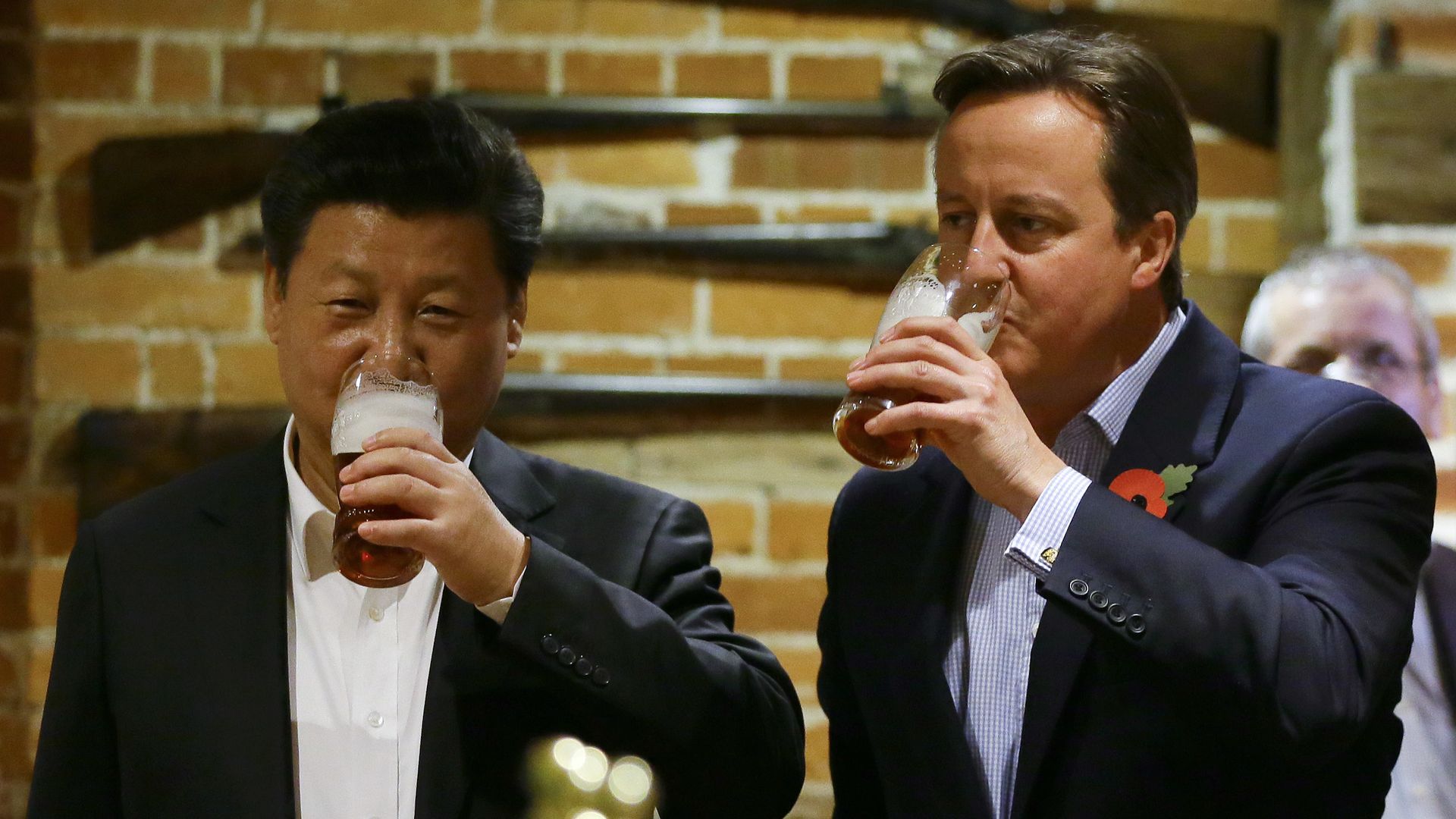
Then-Prime Minister David Cameron (right) and Chinese President Xi Jinping raise a pint during Xi's 2015 state visit to the U.K. Photo: Kirsty Wigglesworth/WPA Pool/Getty
U.K. Foreign Secretary David Cameron described China on a visit to Washington this week as an "epoch-defining challenge" — a sharp shift from his approach as prime minister and in business dealings more recently.
Why it matters: Outreach to China was a pillar of Cameron's foreign policy during his tenure in Downing Street from 2010-2016, at which time he heralded a "golden era" in China-U.K. relations.
- Times have changed, and so apparently has Cameron, who was unexpectedly named foreign secretary last month after seven years out of politics.
What he's saying: "My views evolved because a lot of the facts changed," Cameron said when asked by Axios about the shift.
- He cited abuses against the Uyghurs in western China, Beijing's crackdown in Hong Kong, the emergence of "Wolf Warrior diplomacy," and China's efforts at economic coercion against Australia and Lithuania.
- The U.K. approach now involves "hardening" systems to protect against Chinese cyberattacks and other acts of "aggression," "aligning" with the U.S. and other key partners on China, as well as "engaging" China on climate change and "some bilateral trade issues," Cameron said.
- Cameron was speaking to a small group of reporters at a briefing on Thursday evening following a meeting with Secretary of State Tony Blinken. He said he and Blinken had a "good discussion" on China and will "continue to work together very closely."
Driving the news: The primary focus of Cameron's visit to Washington was to push for continued support for Ukraine.
- If Russia is allowed to succeed in Ukraine, he told MSNBC, "the only people that will be smiling will be President Putin and President Xi, and I don't think any of us want that to happen."
Flashback: Cameron declared a "golden era" in relations during a 2015 state visit from Xi, who was then three years into his tenure and not yet seen in such adversarial terms in Western capitals.
- Cameron's appointment as foreign minister has reignited controversies over his decisions to welcome Chinese investment in critical areas like nuclear power and 5G telecommunications, the South China Morning Post notes.
- After leaving office, he tried to launch a U.K.-China investment fund and traveled to China several times, the FT reports. As recently as two months before becoming foreign secretary, he was seeking investment for a port project in Sri Lanka that is part of China's Belt and Road Initiative, Politico reports.
Between the lines: Cameron's resignation in 2016 came at something of a hinge moment in relations between China and the West.
- The shift was spurred on by the election of a hawkish U.S. president in Donald Trump, as well as increasingly assertive steps taken by Beijing.
- In Thursday's briefing, Cameron laughed off the suggestion that there might be any lingering concerns in Washington about his previous dovishness on China, noting that the U.K. posture toward China was in sync with the U.S. approach.
The bottom line: "Yes the position has evolved, but for good reasons," Cameron said.
