Axios AM

September 28, 2024

๐ Hello, Saturday! We're bringing you a special AM takeover about the stunning divisions between young men and young women across politics, work, religion and dating.
- Erica Pandey is your weekend maestro. This special issue is possible thanks to Dave Lawler, Noah Bressner and experts across the Axios newsroom.
Smart Brevityโข count: 1,886 words ... 7 mins. Edited by Kathie Bozanich.
๐จ Situational awareness: Hezbollah confirms its longtime leader, Hassan Nasrallah, was killed in the Israeli air strike on the militia's central headquarters in Beirut yesterday. Keep reading.
1 big thing: Generation-defining split
A flood of data reveals a little-discussed, future-defining trend: Men and women are going separate ways.
- The split is clear in politics, religion, education and the labor market, Axios' Erica Pandey reports.
Why it matters: For the next generation, gender is becoming the biggest predictor of how you think, act and vote.
"There's a much broader story here," says Daniel Cox, director of the Survey Center on American Life. "Even after all the votes are tallied and we've moved on from the 2024 election, we're not going to have resolved any of the cultural and relational tension between young men and young women."
- You see it in politics: Women are turning left. Men are turning right.
- You see it in religion: For the first time ever recorded in the U.S., young men are more religious than young women.
- You see it in education: There are 2.4 million more women on U.S. college campuses than men, the American Institute for Boys and Men (AIBM) notes. Those degrees are often resulting in higher-wage jobs for women in big cities.
- You see it in the labor market: Wages and labor force participation have increased since the 1980s for college-educated men and women, and for working-class women. But they have stagnated for working-class men, who are also now significantly less likely to be employed than four decades ago, according to AIBM's analysis.
- You see it in visions for the future: Men are more likely than women to want marriage and kids, according to Pew Research Center.
๐ฎ What we're watching: The polarization is even stronger among adults under 25, Cox notes. Social media content and algorithms may be one key reason.
- Men are constantly fed social media content that's negative toward women, and vice versa. Videos breaking down bad dates from the perspective of either the man or the woman are a viral example of that trend.
- Gen Z-ers are 15 points more likely than other generations to say social media has negatively impacted their outlook on men, and 10 points more likely to say so for women, Morning Consult finds.
The bottom line: "We live in a very individualistic culture, and, for a lot of people, the primary relationship they have is with a partner or a spouse," says Cox. For heterosexual couples, this polarization is making finding a partner trickier.
- "This has tremendous implications for how men and women relate to one another in the dating space."
2. ๐ณ๏ธ Politics fracture

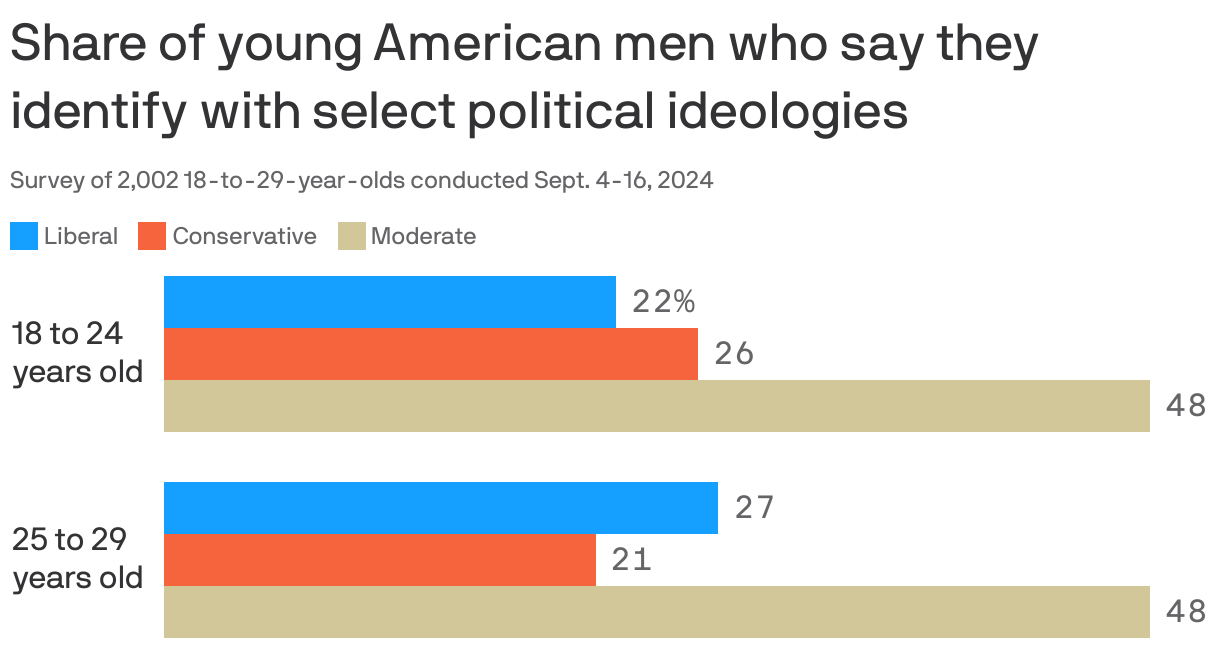
A new trend has emerged in American politics: The very youngest voters โ 18-to-24-year-olds โ say they're more conservative than the cohort that's just older, Axios' Noah Bressner writes from the latest Harvard Youth Poll.
Why it matters: This new trend โ true for both genders and emerging only in the last few years โ is especially pronounced with men.
- The younger generation of men is more likely to identify as conservative than as liberal, a stunning flip.
๐ Zoom in: 26% of men ages 18-24 say they identify as conservative โ five points higher than 25-to-29-year-old men.
- Among women, the younger group is more conservative by three points.
- Moderates make up the biggest chunk of both men and women young voters.
Between the lines: They were hardest hit by COVID and felt ignored by the establishment, John Della Volpe, director of polling at the Harvard Kennedy School Institute of Politics, told Axios this month.
- The youngest members of that group were just 10 years old when Donald Trump was elected president, and see this chaotic political era as normal.
- "They think of Trump as an anti-hero and not a villain. ... I think it's less about policy and much more about personality," Della Volpe said.
๐ Reality check: The youngest age group still appears to favor liberal positions on some issues as much as those ages 25 to 29, Anil Cacodcar, the student chair of the Harvard Youth Poll, noted.
- In a poll earlier this year, the younger group was just as likely to say basic health insurance is a human right and government should spend more to reduce poverty.
3. ๐ผ Labor market flips

Men long dominated the job market. Not quite anymore.
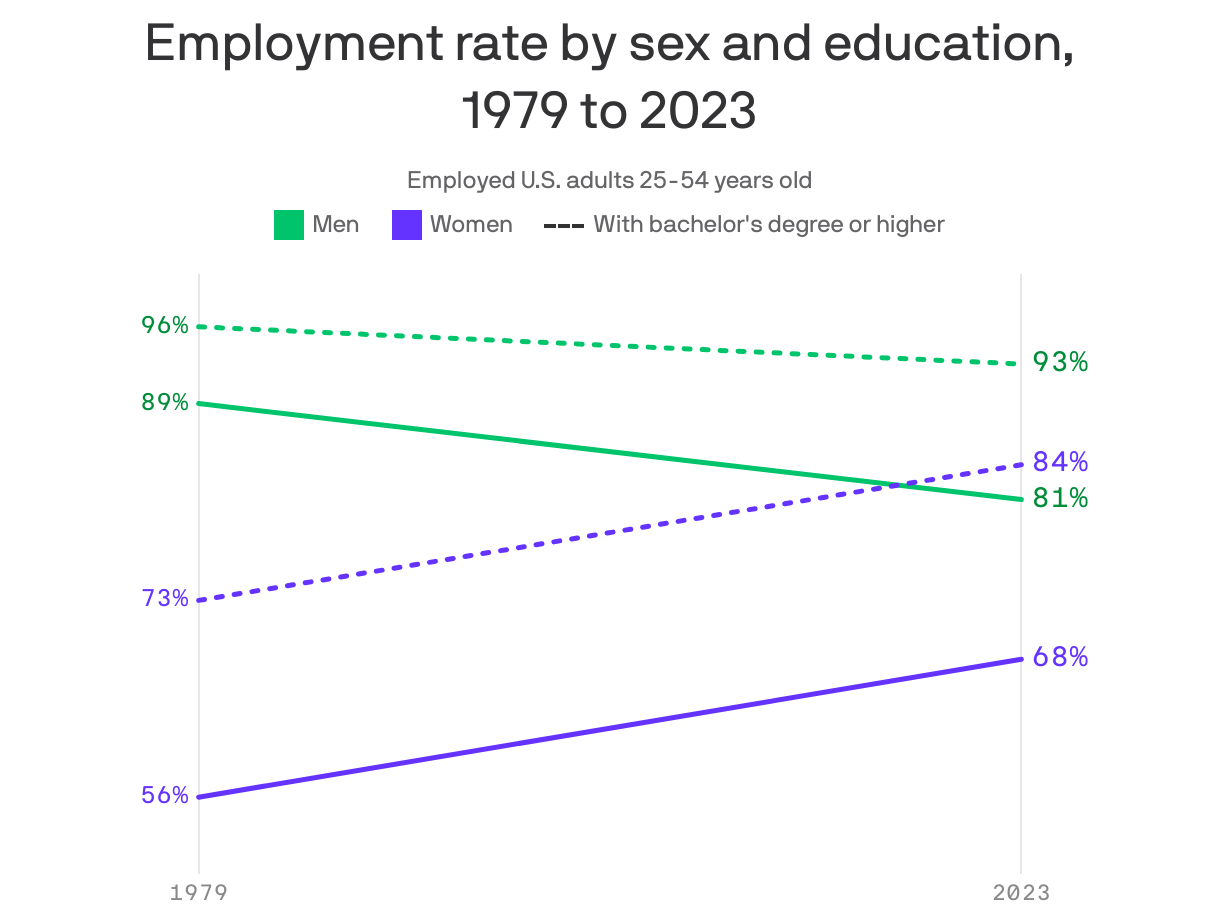
- For decades, the share of working-age men in the labor market has been declining โย particularly for those without college degrees. At the same time, women of all education levels have flooded the workforce, Axios' Emily Peck reports.
๐ The big picture: For women, this is a remarkable achievement. More are gaining economic power and independence, alongside a hard-fought decline in workplace discrimination.
- For men, it's been more of a mixed bag. For those with college degrees, it's a positive story. The decline in employment is happening primarily because they're staying in school longer and delaying entry into the workforce.
Some are also leaving the workforce to be caregivers โ an avenue typically unavailable, and sometimes unimaginable, for older generations.
- For men without college degrees, the past few decades have been hard. The decline in manufacturing and factory jobs that used to offer good, stable livelihoods has hurt. So has the opioid crisis.
By the numbers: Between 1979 and 2023, the share of college-educated working-age men with a job declined from 96% to 93%, according to government data analyzed by the American Institute for Boys and Men.
- The fall was steeper for men without bachelor's degrees, from 89% to 81%.
๐ฅ Reality check: Men still out-earn women, on average, and control the upper ranks of most big companies.
4. ๐ฅ Plight of working-class men

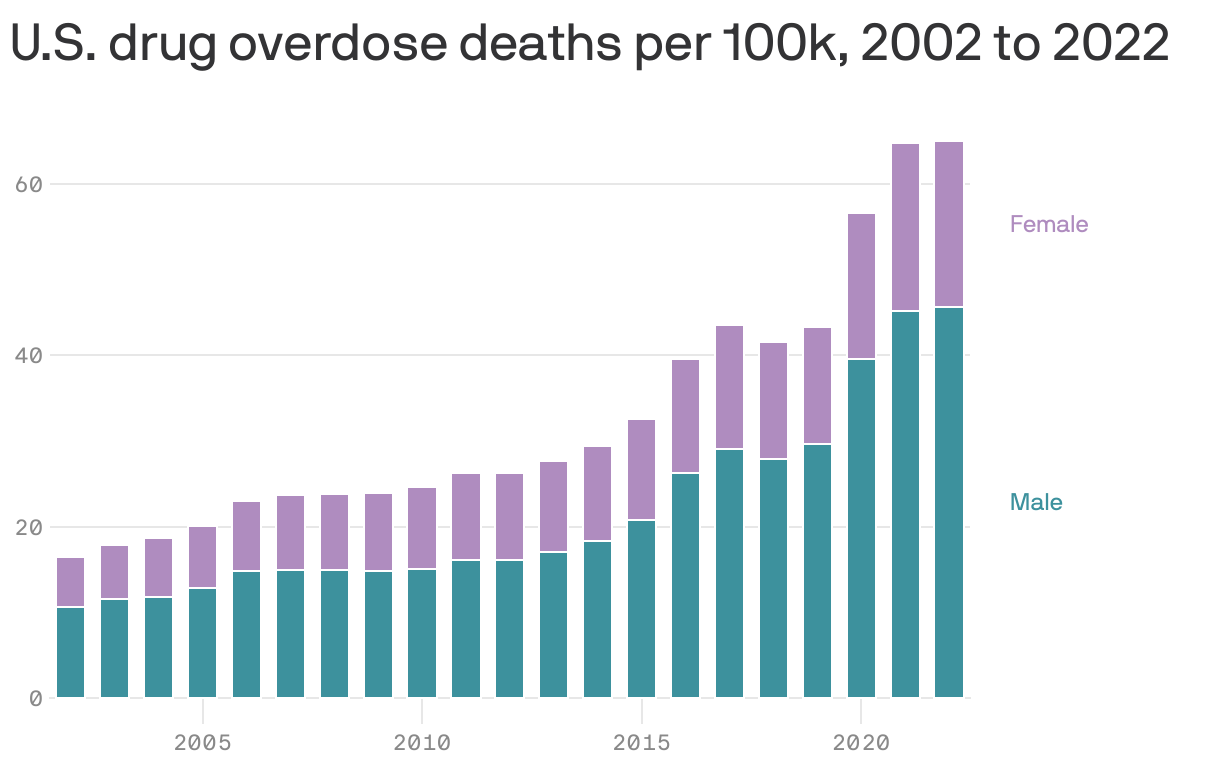
The rise in overdose deaths, and the gender disparity in suicides, point to a stark reality:
- By many metrics, working-class men are worse off today than they were 50 years ago, Axios' Erica Pandey writes.
Zoom in: They're faring worse than working-class women and non-working-class people of both genders on multiple fronts โ from mental health to economic status to social lives.
- Working-class men are most likely to have no close friends and least likely to be married or have children, according to a report from the American Institute for Boys and Men (AIBM).
- They make up the majority of fatal drug overdoses, alcohol-related deaths and suicides. However, after years of sharp rises, overdose deaths are starting to fall.
๐ญ Zoom out: Massive changes in the U.S. economy, like women's workforce rise and the shift from producing goods to selling services, have resulted in some working-class men feeling left behind and not needed, says Richard Reeves of AIBM.
- But this is tricky to talk about because a lot of those changes have been positive, particularly those for women.
5. โช Women leave church
There's a growing religious divide among younger Americans: Gen Z women of almost all faiths are more likely to be "religiously unaffiliated" than Gen Z men, Axios' Russell Contreras reports.
- Why it matters: While the overall trend of each generation being less religiously observant than their elders is decades old, the gender split is new.
The exodus of young women can be seen in particular in white evangelical congregations, which are becoming smaller and more male.
๐งฎ By the numbers: A survey by the nonpartisan Public Religion Research Institute (PRRI) found that 39% of Gen Z women identify as religiously unaffiliated, compared with 31% of Gen Z men.
- Only 8% of Gen Z women identify as white evangelicals, compared with 13% of Gen Z men.
๐ The intrigue: Some experts think churches need to change their structures or even theology to retain more young women.
"For the whole lifetime of Gen Z, the dominant form of Christianity has been the era of conservative evangelical dominance," Rev. Brian Kaylor, editor-in-chief of the historic Baptist journal "Word&Way" tells Axios.
- Most denominations of evangelicalism are politically conservative and don't allow women to become pastors or church leaders. Gen Z women aren't putting up with that, Kaylor says.
6. ๐๏ธ We're sorting ourselves

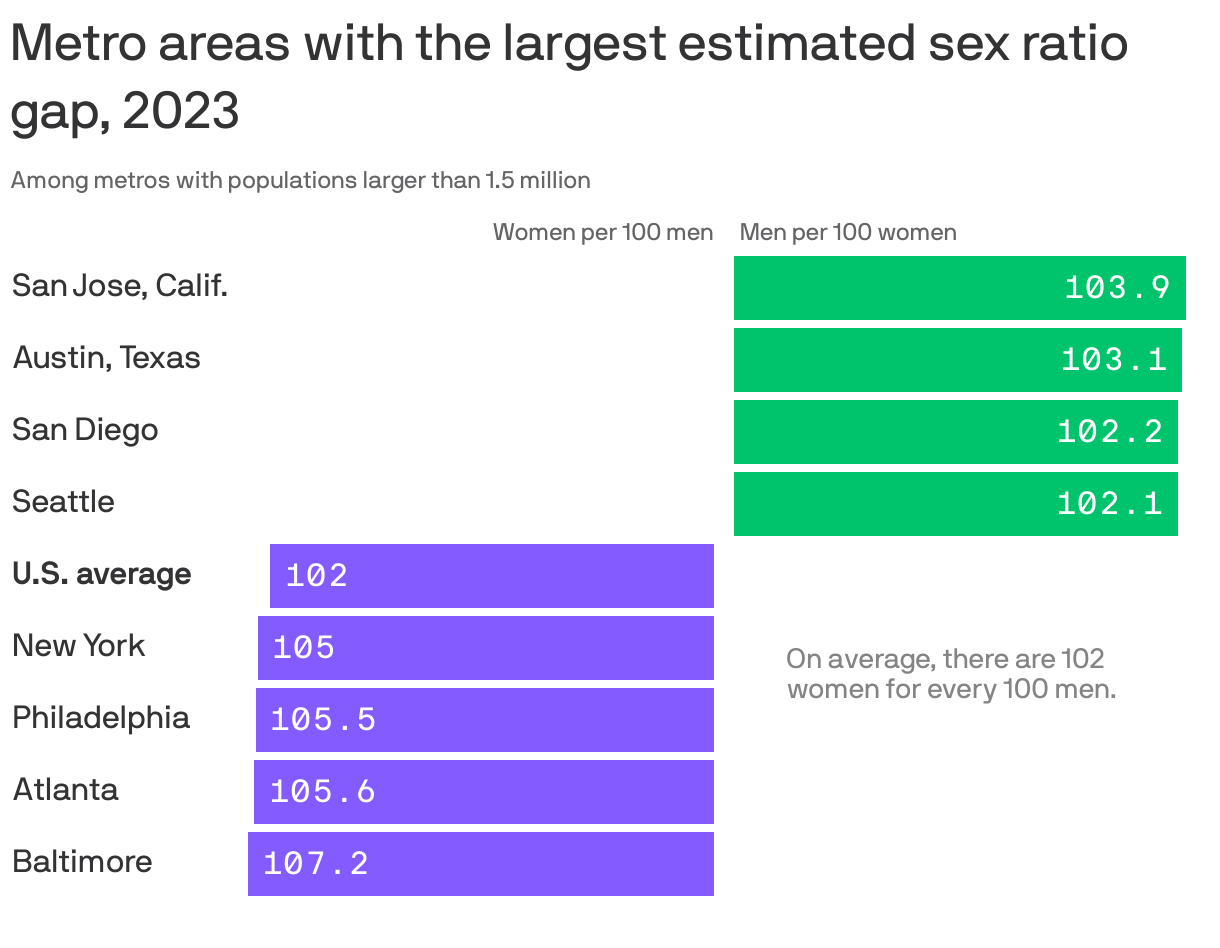
America's gender split is turning into a regional rivalry: men in the West, women in the East.
- Why it matters: Geographical gender differences โ if they grow โ could help drive deep rifts in American society, Axios' Noah Bressner reports.
๐ค Zoom in: The divide is driven by institutions and industries with deep gender imbalances that are especially clear in the West, AP notes.
- The San Diego metro area, dotted with military bases, has almost 104 men for every 100 women, according to census data. Men make up more than 80% of America's armed forces.
- Silicon Valley, Austin and Seattle host a big share of U.S. tech companies, which employ a workforce that is almost two-thirds male.
๐ Between the lines: Big cities and areas with college campuses typically have more women than men, the Census Bureau said in a report last year.
- Among large U.S. counties, the three with the largest ratio of women compared to men were all home to universities.
Women most heavily outnumbered adult men in Baltimore, Atlanta, Philadelphia and New York when considering metro areas with more than 1.5 million residents.
- One possible explanation is mass incarceration, which has removed hundreds of thousands of men from African American neighborhoods.
7. ๐ก Family gets political
Intensely personal decisions about children and family have become a fierce political battleground โ and, here too, there's a gender split, Axios' Erica Pandey reports:
- 50% of men younger than 50 who don't have kids say they don't want them, compared with 64% of women, according to a recent Pew survey.
- 57% of young men (18-34-year-olds) without kids say they want to be parents someday, compared with 45% of young women, another Pew study found.
๐ Why it matters: The U.S. fertility rate has plummeted, mirroring trends in other developed countries, and hit a record low of 1.62 births per woman in 2023.
- That trend has very real implications for America's future and economic growth, especially if immigration is limited. Experts say simply telling women to have more kids โ irrespective of whether they want to, whether they're able to, or whether they can afford to โ is missing the point.
8. ๐ท 1 for the road: Dating divide
Ideological differences among young people are coming up on first dates and often complicating them, Axios' Erica Pandey writes.
- Why it matters: Political views are becoming an increasingly important factor โ and dealbreaker โ in dating.
By the numbers: 24% of Gen Z-ers say they've been asked about political beliefs on a first date, The Harris Poll's chief strategy officer Libby Rodney tells Axios from fresh data. And 16% of them admit to lying about it.
- 28% of Gen Z and Millennials say they've broken up with someone over political beliefs.
๐ฅ๏ธ Silver lining: We chill out as we get older, The Harris Poll found.
- Nearly half of Millennials (48%) and Gen X (49%) say they've been in a serious relationship with someone with different political beliefs.
๐ฌ Please invite your friends to join AM.
Sign up for Axios AM