Millennials, Gen Xers lead jump in "religiously unaffiliated"

Add Axios as your preferred source to
see more of our stories on Google.
Older Millennials, younger Gen Xers and those living in the American West are driving the surge of Americans who identify as "religiously unaffiliated," according to the latest census of religious diversity in the U.S.
Why it matters: The new data show that the number of white Christian Americans continues to shrink while the ranks of the unaffiliated swell in a historic shift in attitudes toward religion.
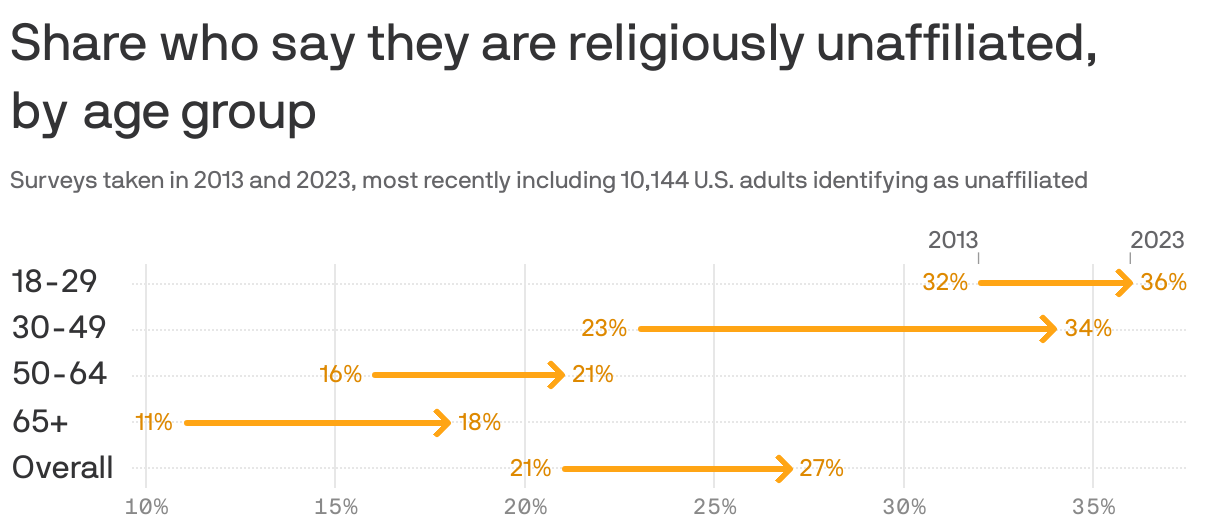
By the numbers: Every age group has seen declines in religious affiliation during the past decade, but the largest jumps are among Americans ages 30 to 49 — older millennials and younger Gen Xers, the data from the nonpartisan Public Religion Research Institute show.
- From 2013 to 2023, the percentage of religiously unaffiliated among that age group skyrocketed nearly 48%.
- Those 18 to 29 — mostly older Generation Zers — also saw increases in the number who identified as religiously unaffiliated, growing from 32% to 36%.
- Even among Baby Boomers and older Americans, who remain the nation's most religious generations, the number of religiously unaffiliated increased from 11% to 18%.
- Overall, 27% of all Americans now consider themselves religiously unaffiliated, up from 21% a decade ago.
The big picture: The percentage of Americans identifying as white Christians has declined from 57% to 41% since 2006, but they remain dominant in setting public policy and are overrepresented in Congress, especially among Republicans.
- Analysts say that could be a recipe for more political conflict, as GOP policies tied to conservative Christianity become less popular among the religiously unaffiliated and others.
- Conservative Christians, for example, have been a driving force behind new restrictions on abortion rights — even though nearly two-thirds of Americans generally support such rights.
Zoom in: Religiously unaffiliated Americans are primarily concentrated in the western United States, from New Mexico — long a stronghold of Hispanic Catholics — to Washington State, the census found.
- Counties of more than 10,000 people with the largest concentrations of religiously unaffiliated residents were San Juan County, Wash. (62%), and Gunnison County, Colo. (61%).
- Los Alamos County, N.M., (53%), home of Los Alamos National Lab and one of the highest concentrations of scientists, was ranked the fifth-most religiously unaffiliated.
Between the lines: White evangelical Protestants are spread across the country but are mainly in counties in the South and Midwest, the survey found.
- Marion County, Ala. (72%) and Johnson County, Tenn. (71%) had the country's highest concentrations of white evangelical Protestants.
- Because of sharp declines over the past two decades, white evangelical Protestants now make up the same percentage of Americans white mainline/non-evangelical Protestants. They both account for 13% of the population.
- The face of Catholicism is changing as well, with Hispanic Catholics now approaching the percentage of white Catholics (8% vs. 12%).
The intrigue: Only 12% of those identifying as Republicans are religiously unaffiliated, compared to 27% of the country and 33% of Democrats.
- Two-thirds of Democrats remain affiliated with a religious tradition.
What they're saying: "I think it is a warning sign. The Republican makeup of the party is overwhelmingly white and Christian, and you juxtapose that against a changing America," PRRI CEO Melissa Deckman tells Axios.
- Deckman says many older Americans have joined younger generations in concluding it's OK to be religiously unaffiliated because there's no longer social stigma to it.
- PRRI founder and president Robert P. Jones tells Axios the Republican Party's racial and religious demographics generally match that of a typical 70-year-old American, while Democrats match Gen Z's religious and racial makeup.
- "If I were a Republican operative...this would keep me up at night," Jones said.
Methodology: The 2023 American Values Atlas is based on a random sample of 40,000 adults (age 18 and up) living in all 50 states, plus the District of Columbia, who provided their religious affiliation between Jan. 1, 2023, and Dec. 31, 2023.
- They are part of Ipsos' KnowledgePanel®.
- The margin of sampling error is ±0.7 percentage points at the 95% confidence level, for results based on the entire sample.
