Axios AM

June 07, 2025

π₯ Hello, Saturday! Smart Brevityβ’ count: 1,740 words ... 7 mins. Thanks to Erica Pandey for orchestrating. Edited by Lauren Floyd.
1 big thing: Brain drain begins
The Trump administration's spending cuts and restrictions on foreign students are triggering a brain drain β and American scientists are panicking, Axios' Erica Pandey reports.
- Why it matters: U.S. researchers' fears are coming true. America's science pipeline is drying up, and countries like China are seizing the opportunity to surge ahead.
"This is such a race for being the science powerhouse that you never fully recover," says Marcia McNutt, president of the National Academy of Sciences. "You might accelerate back up to 60, but you can't make up for those years when you were at a standstill while the competition was racing ahead."
πͺ Driving the news: The National Science Foundation, which funds much of America's fundamental science research, is already doling out grants at its slowest pace in 35 years, The New York Times reports.
- More cuts to science could come with the "big, beautiful bill."
- The Trump administration also says it will "aggressively revoke" visas for Chinese students studying in "critical fields."
πΌ By the numbers: While American universities are rescinding offers to incoming PhD students, other countries are recruiting heavily β setting aside cash for U.S. scientists and even sending personal emails.
- The journal Nature analyzed data from its jobs platform to track where scientists are looking for work. In the first few months of the Trump administration, there were jumps in the the number of U.S. applicants looking for jobs in Canada (+41%), Europe (+32%), China (+20%) and other Asian countries (+39%), compared with the same period in 2024.
- "This is a once-in-a-century brain gain opportunity," the Australian Strategic Policy Institute wrote in a brief.
π« Case in point: France's Aix-Marseille University, which made headlines for earmarking millions of dollars for U.S. scientists, closed its application window after receiving a flood of apps.
- After American Nobel laureate Ardem Patapoutian's federal grant was frozen, he got an email from China offering 20 years of funding if he relocates his lab, The New York Times' Kate Zernike writes. He declined.
The other side: The White House argues that its changes to the system will usher in a golden age of science and rebuild public trust. President Trump has also suggested that spots freed up by rejecting international students could be filled by American applicants.
- But professors say this isn't entirely realistic."In hard sciences, in astronomy and physics and computer science, for example, there's no way you would fill that hole with local applicants of comparable quality," says Chris Impey, an astronomer at the University of Arizona.
2. πͺ Scoop: Trump's Army parade

Army officials are preparing to display rocket launchers and missiles along with more than a hundred military aircraft and vehicles next weekend at the D.C. parade celebrating the Army's 250th anniversary, Axios' Alex Isenstadt reports.
- Why it matters: President Trump has envisioned the June 14 parade β which is scheduled on his 79th birthday β as a show of U.S. military might.
π Zoom in: Such a display of military equipment is rare in the United States, and critics of the event have expressed concerns about that imagery as well as the damage that heavy military vehicles could pose to the city's streets.
- But officials are eager to showcase U.S. weaponry such as the High Mobility Artillery Rocket System (HIMARS), which is used to launch rockets and has been used in Afghanistan, Iraq and Syria.
There also will be a static display of precision-guided missiles, the officials said, and a flyover by F-22 fighter jets.
- About 7,000 military personnel will be involved in the parade, which will run along Constitution Avenue NW. It's projected to cost about $45 million β roughly one-third of that for post-parade street repairs.
3. π Musk's money vs. Trump's power
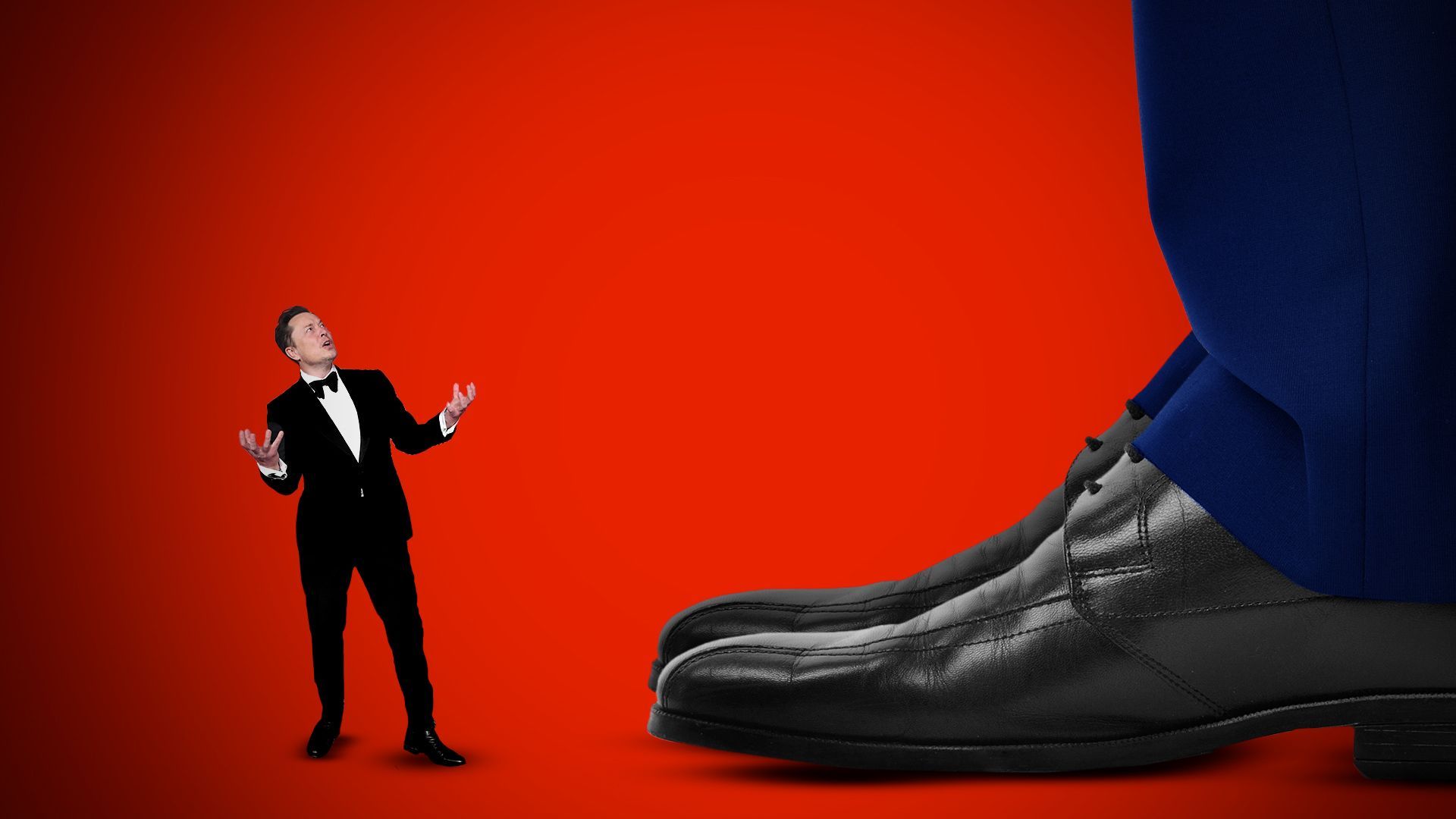
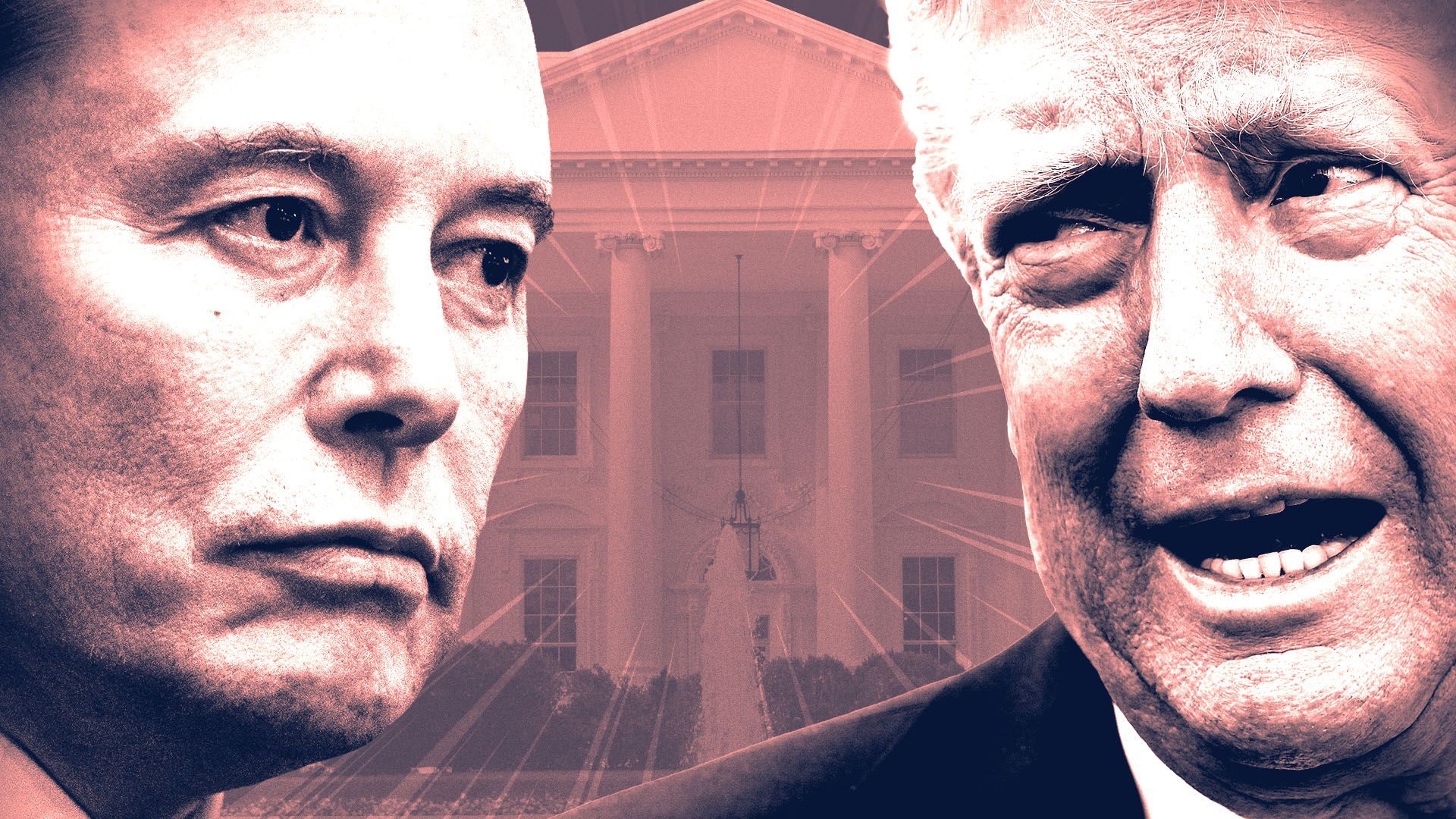
Elon Musk might have hundreds of billions of dollars and a social media megaphone, but President Trump's power over the levers of government may put Musk's business empire at much more immediate risk, Axios managing editor for business Ben Berkowitz writes.
- The big picture: Virtually everything Musk does has huge regulatory exposure, from cars to spaceflight to neural implants.
π Zoom out: Trump, thus far, has played the whole thing relatively cool, saying he doesn't really care if Elon turns on him.
- But he's also operating from a position of strength, as he clearly knows β thus, the threat on Truth Social to cancel all of Musk's government contracts. When YouGov polled more than 3,800 Americans on that question Thursday, those with an opinion supported ending Musk's contracts by a 2-1 margin.
- Yesterday morning, Trump had no hesitation about telling many of Washington's top political reporters he didn't care to speak to Musk β even amid reports Musk very much wanted to speak with him.
π¨ There's a laundry list of ways Trump could squeeze Musk:
- Terminating contracts for space launches, Starlink Internet access and the like.
- Ending support for electric vehicle purchases, and the charging infrastructure to power those cars.
- More regulatory oversight of everything from Tesla's self-driving algorithms to Neuralink's implants.
- Further housecleaning of the loyalists seeded throughout the government, like the move to withdraw the NASA nominee who was a key Musk ally.
- The ultimate lever: Security clearances, a favorite Trump tool, and a question that has lingered around Musk for years.
4. π Winning the breakup
Here's who's winning amid Elon Musk's explosive breakup with President Trump, Axios' Nathan Bomey writes:
- π Chinese EV makers: Any sign of trouble for Tesla is good news for businesses like booming EV maker BYD, which already sells more vehicles than Tesla. Musk has cited Chinese EV companies as Tesla's biggest competition.
- π¦Ύ OpenAI: Musk and OpenAI have been feuding over the latter's now-abandoned attempt to turn into a for-profit. The president may now be more inclined to side with the ChatGPT creator and its boss, Sam Altman, who made a U.S. investment announcement earlier this year that Trump touted and Musk questioned.
- π Blue Origin: Jeff Bezos' space company could reap the rewards if NASA seeks alternative partners to replace Musk's SpaceX.
- π Tesla short-sellers made an estimated $4 billion on Thursday "in one of their biggest single day gains ever," The Wall Street Journal reported, citing data from S3 Partners.
Reality check: Musk remains the world's richest person by a long shot, and his businesses continue to rake in investment capital.
- But the Trump-Musk split portends a seismic shift in corporate power dynamics.
5. βοΈ AP ban stays

A panel of judges from a U.S. federal appeals court said yesterday that parts of the White House's ban on the Associated Press could remain, dealing a devastating blow to the AP.
- Why it matters: Press freedom advocates are closely watching the AP's case for any precedents it could set around free speech protections for journalists, Axios media trends expert Sara Fischer reports.
ποΈ The AP said, "We are disappointed in the court's decision and are reviewing our options."
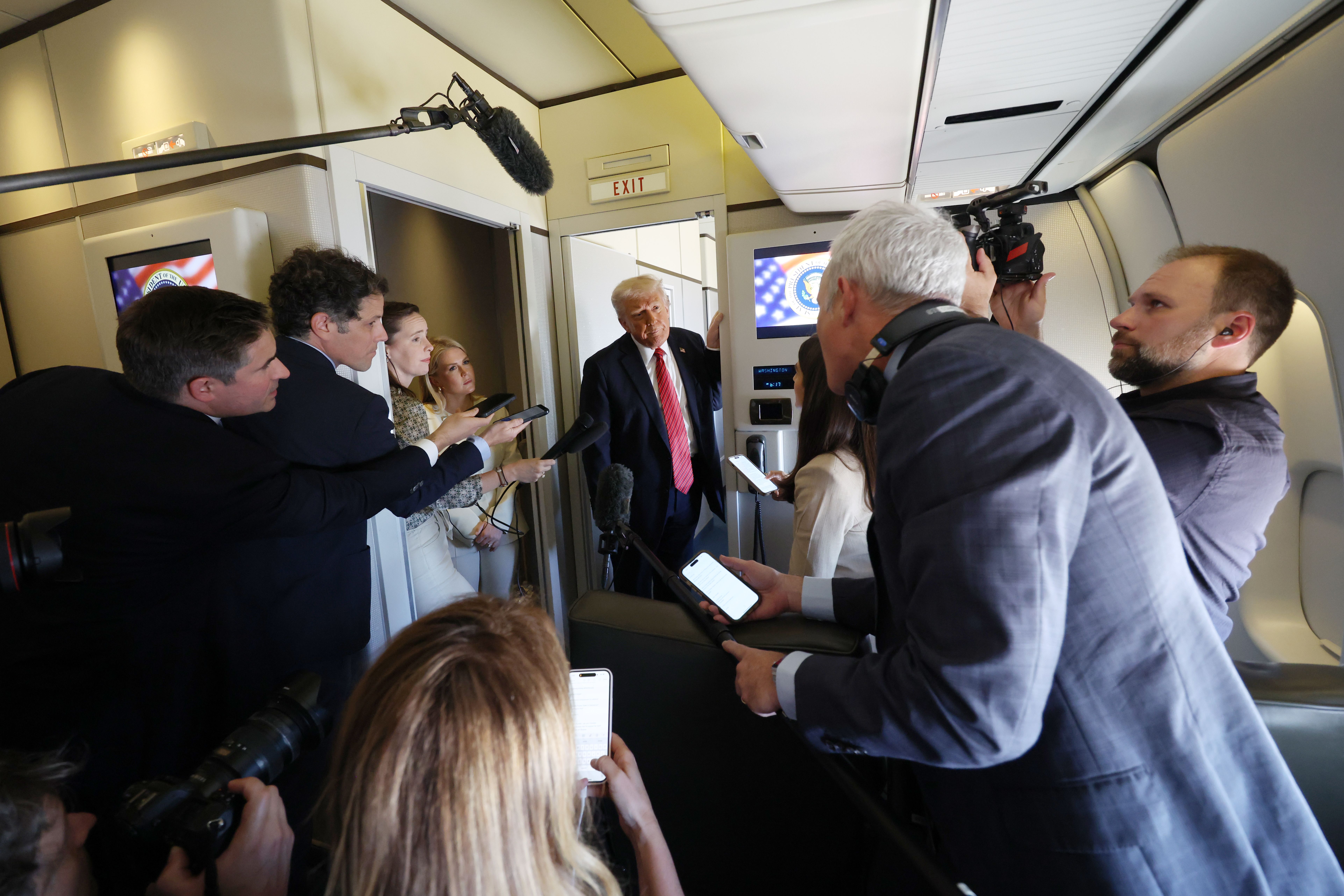
- "VICTORY! As we've said all along, the Associated Press is not guaranteed special access to cover President Trump in the Oval Office, aboard Air Force One, and in other sensitive locations," White House press secretary Karoline Leavitt said on X.
Catch up quick: The AP sued three Trump administration officials in late February for blocking its reporters from events like Oval Office meetings and Air Force One press pools, citing a violation of its First Amendment rights.
- In April, a federal judge sided with the Associated Press, and the White House appealed the decision.
π Yesterday's decision allows most of the White House's ban of the AP to go back into effect while the case is still litigated.
- The panel ruled that presidential spaces like the Oval Office and Air Force One aren't subject to First Amendment protections, but upheld a lower court ruling that said the White House must allow access to larger spaces, like the East Room.
6. π³οΈ Virginia's DOGE test
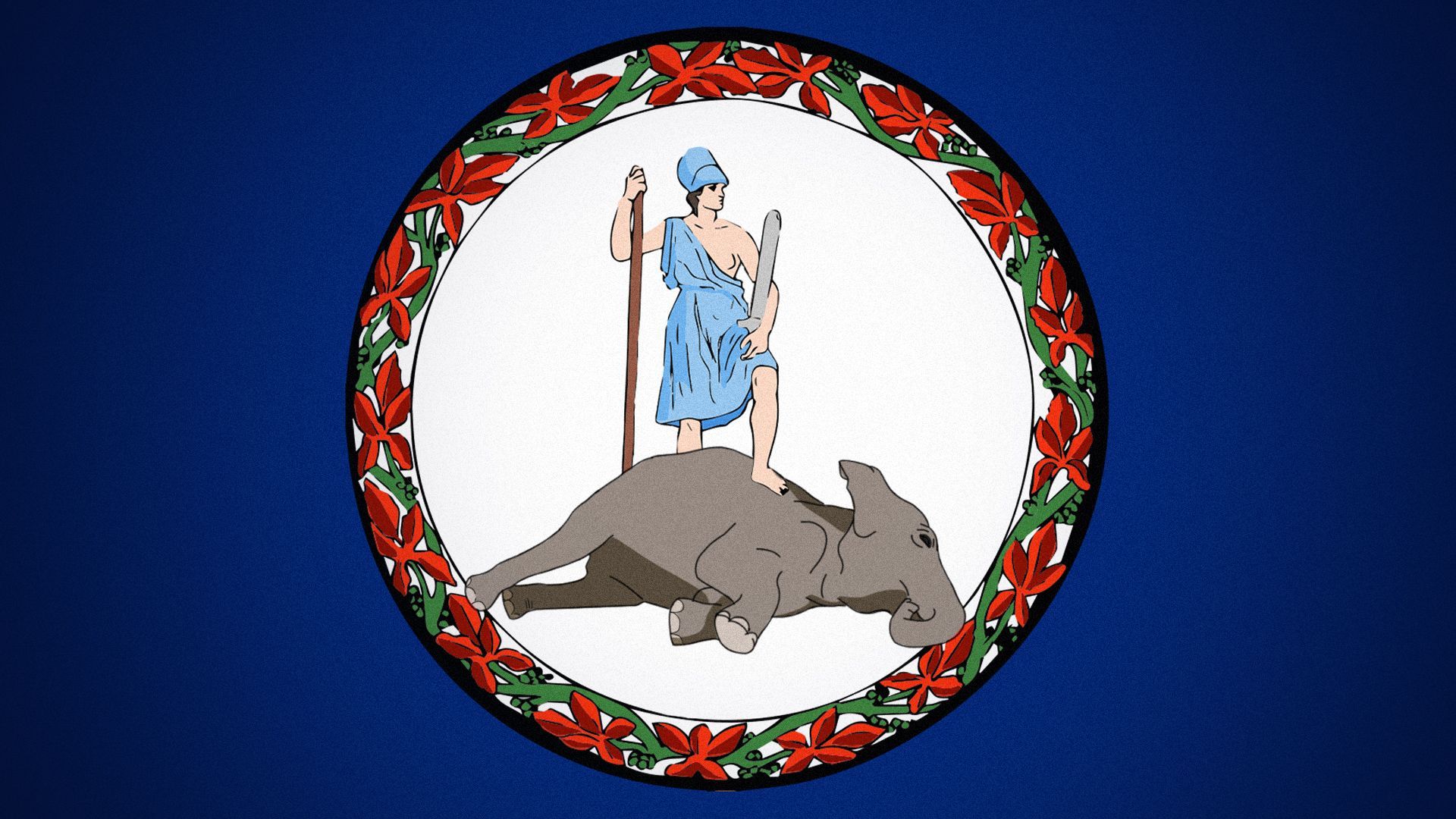
Republicans are increasingly worried that budget cuts by Elon Musk's DOGE could cost them dearly in November's vote for Virginia governor β an early electoral test of President Trump's policies.
- Why it matters: Virginia has one of the highest percentages of federal employees in the country β more than 5% of the state's workforce by some estimates. Republicans' internal polls are starting to show the damage from tens of thousands of federal layoffs, Axios' Alex Isenstadt reports.
"I suspect this will be an albatross around the neck of every Republican candidate this year," said Virginia Republican Bill Bolling, a former lieutenant governor.
π By the numbers: A private poll done for the campaign of a statewide Republican candidate suggested that just 39% of voters had a favorable view of DOGE.
- Nearly half of voters surveyed said they knew of someone impacted by the DOGE cuts, according to results shared with Axios.
- The poll showed Republican Lt. Gov. Winsome Earle-Sears trailing former U.S. Rep. Abigail Spanberger (D) by single digits, outside the margin of error.
π Between the lines: DOGE could especially hurt Earle-Sears' campaign for governor in Northern Virginia and Norfolk, sections of the state where huge segments of the population are federal workers or have jobs tied to the government.
- Those areas played a role in Republican Gov. Glenn Youngkin's win in 2021.
7. π Homes get older


The median U.S. home bought last year was 36 years old β the oldest since at least 2012, Axios' Sami Sparber writes from Redfin records.
- A major construction slowdown "has fast-tracked the aging of America's housing stock," the real estate site reports.
The median age of homes sold in 2024 hit 69 in Buffalo, New York, the oldest among the metros analyzed.
- In Provo, Utah, it was 6.
8. π± 1 for the road: Bans go bipartisan

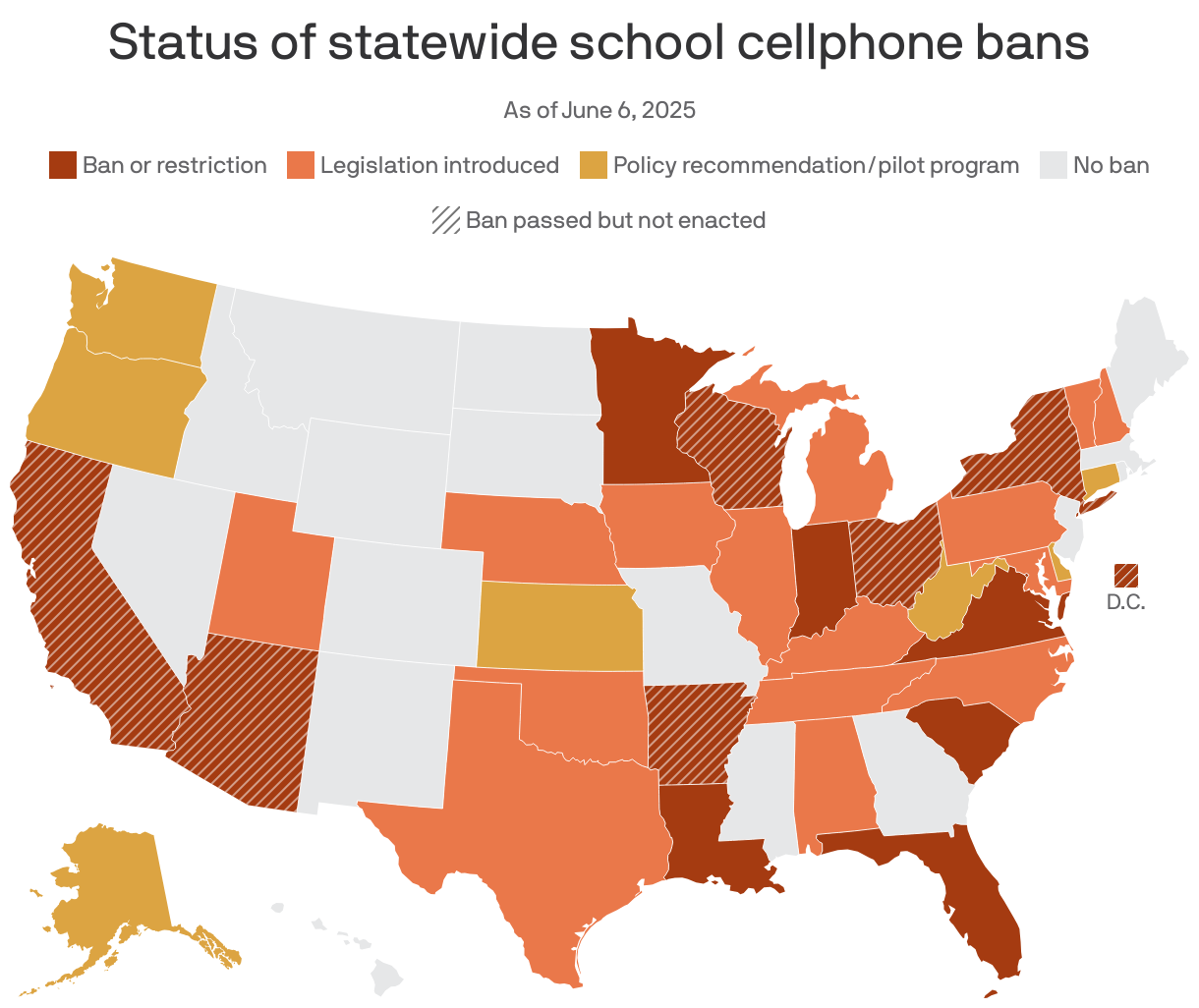
D.C.'s public schools will enforce a cell phone ban starting next school year, the district said yesterday.
- Why it matters: D.C. joins nearly half the country in the bipartisan push to limit students' cellphone use in the classroom, Axios' April Rubin writes.
ποΈ Phone bans have gained momentum across Democratic and Republican state legislatures in recent years.
The policies seek to help students focus during class as they struggle to recover from pandemic learning loss.
- Screen time is also partly at fault for a youth mental health crisis, research has found.
π¬ Thanks for starting your weekend with us! Please invite your friends to join AM.
Sign up for Axios AM


/2025/06/06/1749246912683.gif?w=3840)