Bezos vs. Musk: Space tycoons with dueling visions for humanity's survival


Add Axios as your preferred source to
see more of our stories on Google.
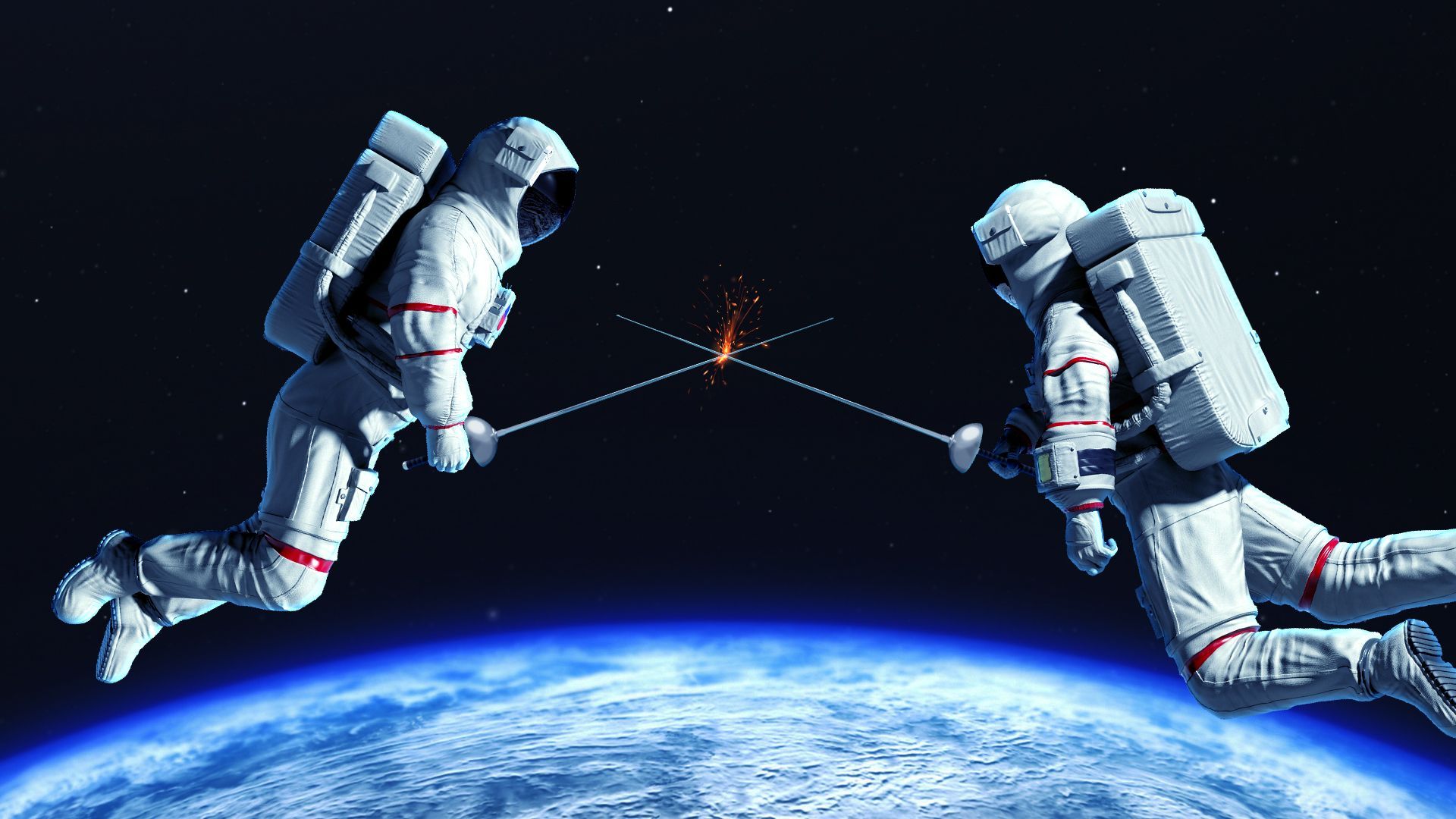
Illustration: Maura Losch/Axios
The world's two richest men and biggest space entrepreneurs both believe humanity's survival depends on life beyond Earth — for very different reasons.
- Blue Origin founder Jeff Bezos explained this week that his vision is to move all polluting industries into space to preserve Earth.
- His rival Elon Musk envisions inhabiting space as a way for humanity to live on beyond Earth, if a cataclysm strikes our planet.
Why it matters: Both are pouring tens of billions of dollars into space travel with those endgames in mind.
- "These are visions of potential futures, and there is a long gap between achievement and vision," John Logsdon, founder of the Space Policy Institute at George Washington University, tells Axios.
Bezos' vision is for Blue Origin to lay the groundwork such that "the next generation, or the generation after that, will be able to move polluting industry off Earth, and then this planet will be maintained as it should be," he said Wednesday at the NYT's DealBook conference.
- In Bezos' view, human civilization needs to continually use more and more energy in order to advance, but Earth's resources are finite and must also support many forms of life beyond humans. That means tapping natural resources beyond Earth.
- "There is no plan B. We have to save Earth. We've sent robotic probes to all of the planet solar system. This is the good one, and we must save it," Bezos said.
- Bezos has also previously spoken about his dream of building enormous space stations (known as O'Neill cylinders) in relative proximity to Earth's orbit, to allow people to travel back and forth.
Musk's SpaceX, meanwhile, is actively drawing up plans for what life could look like on Mars, including specialized spacesuits and domed habitats, per the NYT.
- Musk has repeatedly argued that a mass extinction event on Earth, such as an asteroid strike, is inevitable. "Either become a spacefaring civilization or die," he posted on X in September. "Those [are] the two choices."
- Ultimately, he envisions transforming Mars to turn the Red Planet green (one tool he has floated: nuclear detonations).
- He has admitted in the past that developing a martian civilization could take centuries, but reportedly claimed earlier this year that one million people will move to Mars within two decades.
Reality check: Few believe that timeline is anywhere close to realistic. Even in the longer term, "I don't know why a million people would want to go to Mars," Logsdon says. "What would the economics of that be?"
- Other experts have noted that when pondering the survival of the species, preserving human life on Earth is quite a bit simpler than developing it on Mars.
- The obstacles to Bezos' vision of a network of colossal space stations — such as maintaining a supply of food and water in an entirely artificial environment — are hardly less daunting.
Between the lines: Both billionaires could make an astronomical amount of money from their space ventures even if their dreams of building space civilizations don't come to fruition.
- SpaceX is considering selling shares at a whopping $350 billion valuation, Bloomberg reported this week. That's because its Starlink satellite system and Starship mega-rocket — developed to fund and power Musk's Mars ventures — are already so valuable to governments and militaries here on Earth.
- Blue Origin is growing more slowly, but Bezos argued Wednesday that it will ultimately be more profitable than Amazon.
