Axios AM

May 19, 2024
โ๏ธ Hello, Sunday! Erica Pandey โ [email protected] โ is your host.
- Smart Brevityโข count: 1,588 words ... 6 mins. Edited by Donica Phifer.
1 big thing: Booming business of eternal youth

Illustration: Annelise Capossela/Axios
Consumers, especially the rich, are spending big on the colossal, growing longevity industry โ spas, food subscriptions, gym memberships and pills, Axios' Erica Pandey writes.
๐ Why it matters: The wellness industry is worth nearly $500 billion in the U.S. and $2 trillion globally, McKinsey says. But there's a growing gap between what's available to wealthy consumers and everyone else.
- Many new offerings come at sky-high prices.
State of play: The wellness market is doubling down on rich customers with exclusive, luxury, hyper-personalized offerings, according to the Global Wellness Institute, an industry research group.
- Think invite-only Pilates classes at $75 a session, $200,000 facelifts โ and elite clubs charging thousands in monthly fees for saunas and ice baths.
- Equinox, the high-end gym chain, just rolled out a $40,000-per-year longevity add-on. Customers will get access to individually tailored training and nutrition plans, sleep coaching and more. There's a waitlist.
- Costs are even increasing on the cheaper end: Planet Fitness announced its first membership price hike in 26 years earlier this month.
Zoom in: Then there's an even higher tier โ Silicon Valley billionaires chasing the fountain of youth.
- Entrepreneur and venture capitalist Bryan Johnson famously spends $2 million a year on health and longevity treatments, including weekly acid peels and blood transfusions from his teenage son.
- He eats a strict vegan diet, does daily meticulously planned workouts and takes near-constant blood, stool and urine tests to monitor his health, Bloomberg's Ashlee Vance reports.
- Tech titans Sam Altman, Jeff Bezos and Mark Zuckerberg have all invested millions in anti-aging startups.
๐ฎ What's next: As more people have access to personalized fitness data through phones, watches and rings, look for tailored workouts and diets to gain popularity.
2. Bibi blocks meetings with U.S. officials

Photo illustration: Shoshana Gordon/Axios. Photo: Noam Moskowitz/picture alliance via Getty Images
Israeli Prime Minister Benjamin Netanyahu has banned Israel's intelligence and security chiefs from meeting with U.S. officials and lawmakers multiple times since the war in Gaza began, U.S. and Israeli officials tell Axios' Barak Ravid.
- Why it matters: Netanyahu seems to be trying to control what American politicians and diplomats hear from Israel โ at a time when his government is deeply divided over his war strategy, and relations with the U.S. are growing more tense, the officials said.
๐ What we're hearing: For decades, congressional delegations and senior White House and State Department officials who've visited Israel routinely have met with the heads of its military and security services.
- But over the past few months, Netanyahu โ who is directly in charge of the Mossad intelligence agency and Shin Bet security agency, and must approve their meetings with U.S. politicians and officials โ has tried to prevent several such meetings.
Three weeks ago, Netanyahu banned the directors of Mossad and Shin Bet from meeting with Sen. Marco Rubio (R-Fla.), the U.S. officials said.
- Rubio, vice chair of the Senate Intelligence Committee, requested the meetings during his visit to Israel last month. Netanyahu met with Rubio himself.
๐ Between the lines: The leaders of those agencies think Israel needs to craft a clearer strategy for post-war Gaza.
- In the past few days, Defense Minister Yoav Gallant and cabinet Minister Benny Gantz have publicly demanded that Netanyahu draft a post-war strategy.
- Netanyahu rejects the need for a strategy until Hamas is defeated.
3. ๐บ Amazon's big league ambitions
Illustration: Natalie Peeples/Axios
Amazon wants Prime to be to sports streaming what ESPN was to cable.
- The big picture: Streamers are battling for live sports rights and the advertising dollars that come with them, Axios' Tim Baysinger writes.
- Amazon is closing in on a deal to make it one of three partners with the NBA, a source with knowledge of those talks confirmed to Axios.
๐ Zoom in: Adding the NBA would be the latest salvo for Amazon's quickly-growing sports business.
- The tech giant is heading into its third season as the exclusive home of the NFL's "Thursday Night Football" โย for which it's paying $1 billion per year.
- Amazon extended its deal with the WNBA for two more seasons. And next year, Prime will begin streaming NASCAR races.
4. ๐ฆพ Elon's AI play
Photo illustration: Sarah Grillo/Axios. Photo: Dimitrios Kambouris/Getty Images for The Met Museum/Vogue
The pitch to invest in Elon Musk's xAI: It's an opportunity to join "the Muskonomy" of ventures fronted by one of the world's wealthiest men.
- Why it matters: xAI is said to be raising as much as $6 billion to catch up to rivals like OpenAI and Anthropic, and it needs a compelling story for investors, Axios' Kia Kokalitcheva writes.
The big picture: xAI's close relationship with X โ formerly known as Twitter โ is key to its potential success and one aspect of the "Muskonomy," according to the deck prepared by Brookfield late last year and seen by Axios.
- "The fuel for AI is data," notes one slide. "X represents the world's most timely dataset of real-time human conversations, interests, and trends for xAI to form its intelligence. X's dataset will also become valuable as it progresses on its 'everything app' vision."
Kia's thought bubble: The deck is a long and detailed way of making an argument Musk's supporters have long bought into.
- The billionaire will turn anything into a success, so its best to buy a seat early.
5. ๐ Axios interview: Sweetgreen secrets

Illustration: Shoshana Gordon/Axios
Sweetgreen CEO and co-founder Jonathan Neman is trying to reach profitability by steering the salad chain toward suburban expansion, in-store automation and beefed-up menus (literally).
- "So much of our business was heavily dependent on urban and office traffic before COVID," Neman told Axios' Hope King last week on "Leading Indicator," a podcast from Public, an investing platform.
- "[W]e've only gotten back to 50% of pre-COVID levels," Neman added. "We've now seen ... this is the new normal."
Sweetgreen has about 230 locations. "We think that there can be thousands," Neman said, noting that fast-casual competitor Chipotle plans to double its footprint to 7,000 stores.
- "Four years ago, the company was 75% urban," Neman said. "Today, we're 50-50 and starting to lean more suburban โ a product of what the country looks like โฆ and [because] we had already penetrated" urban markets.
- Sweetgreen caters to higher-income households. Although the chain has passed some of its higher operating costs on to customers, consumers haven't really pushed back.
๐ค For the busiest restaurants, Sweetgreen sees huge potential in its Infinite Kitchen system, which automates and speeds up assembly.
- The average Q1 margin for the two first Infinite Kitchen stores was 28%, or 10 points higher than the average store.
๐ฅฉ To attract more male customers and create more dinnertime demand, Sweetgreen recently added a "caramelized garlic steak" topping.
- Over time, Sweetgreen wants the mix of its business from lunch and dinner to reach a 50-50 split, Neman told Bloomberg.
๐ฎ What's next: Sweetgreen sees potential in using AI to create personalized nutrition products and menus.
- The company's current AI use is more mundane โ for sales forecasts.
6. ๐ Detroit's history of unequal schools

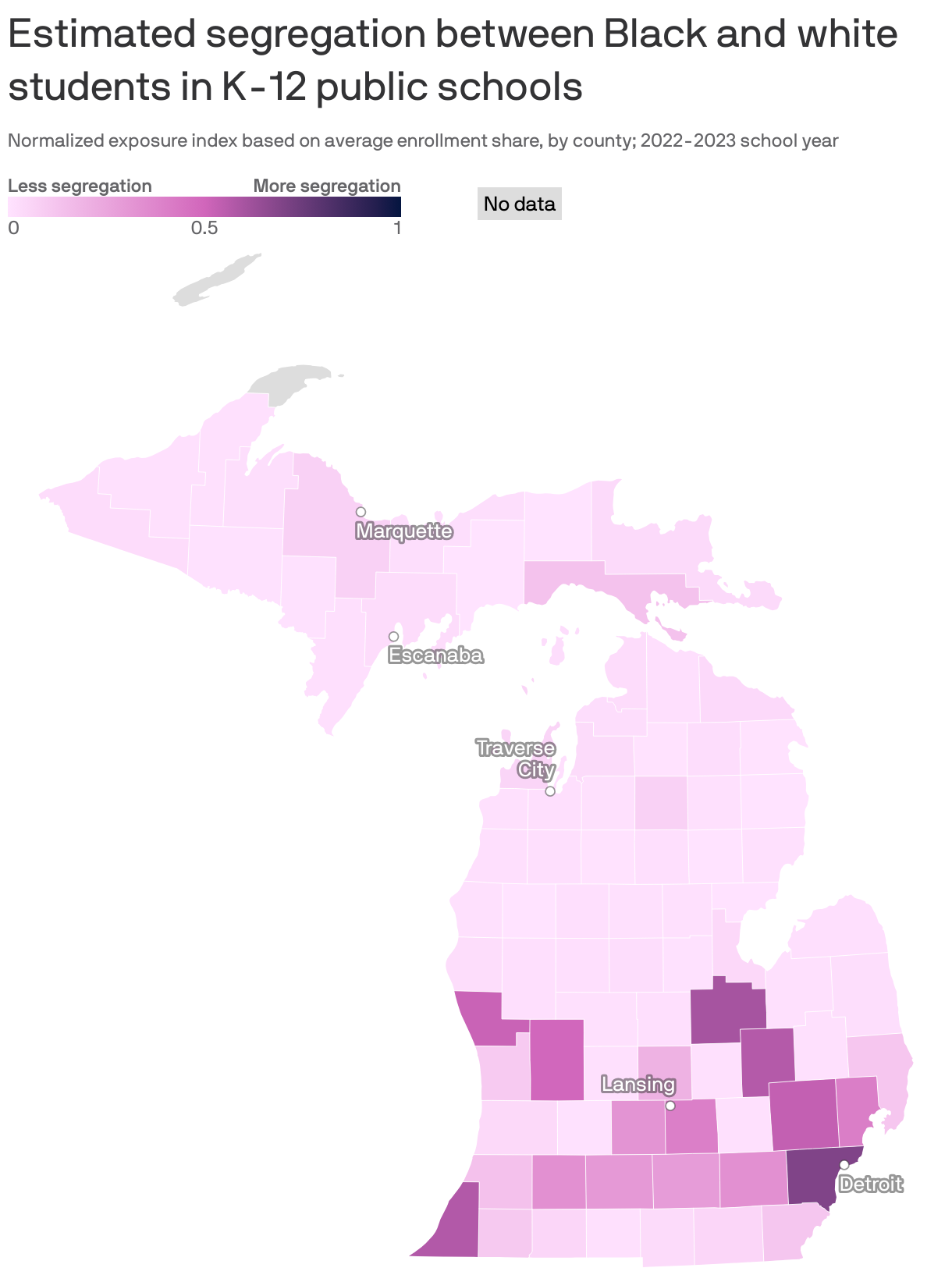
Friday marked the 70th anniversary of the landmark Brown v. Board of Education ruling, and schools are growing more segregated in many U.S. cities.
- Spotlight: In and around Detroit, a legacy of redlining, systemic racism, population loss are among factors that have perpetuated inequitable school districts. There's a long history of whiter, wealthier schools with more funding per pupil, Axios Detroit's Annalise Frank writes.
By the numbers: The Detroit-Warren-Dearborn metro area's students in 2022 were 55% white, 27.4% Black and 7.3% Hispanic. 48% of students were eligible for free lunch, according to the Educational Opportunity Project at Stanford University.
- The same project zoomed in on Detroit public schools. They were 80% Black โ similar to the city's 77% Black population โ and 13% Hispanic, 4% white and 87% free-lunch eligible.
Between the lines: "We can get lost in the conversation around schools not being diverse" instead of focusing on whether every school has equal access to funding, says Aja Denise Reynolds, a professor at Wayne State in Detroit.
- "I think that's a better place that we put our energy, versus 'schools aren't diverse.'"
Keep reading ... Catch up on Axios' Brown v. Board anniversary coverage.
7. ๐ฅ Remembering Alice Stewart

Alice Stewart, a CNN commentator and longtime political adviser, has died at 58.
- Law enforcement officials believe it was a medical emergency, CNN reports.
Stewart got her start as a local reporter in Georgia. She went on to serve as communications director for the presidential campaigns of Mike Huckabee, Michele Bachmann, Rick Santorum and Ted Cruz before joining CNN.
- "We always invited her to come on my show because we knew we would be a little bit smarter at the end of that conversation," Anchor Wolf Blitzer said on CNN yesterday.
"Alice was wonderful and talented and a dear friend," Cruz said. "She lived every day to the fullest, and she will be deeply missed."
8. ๐ฟ Beverage wars: Booze v. weed
Illustration: Sarah Grillo/Axios
THC-infused drinks are popping up at more liquor stores. They come in pretty cans and fruity flavors, like blood orange cardamom and grapefruit rosemary, and yes, they're legal.
- Internet searches for THC-laced drinks have been at an all-time high in 2024, Bloomberg reports.
Turf war: Alcohol distributors โ who are mixing up their offerings as beer sales plummet โ and marijuana companies both want a stake in this growing market, Axios' April Rubin writes.
๐ What we're watching: A loophole in the 2018 farm bill helped break open the marijuana drinks market โ and government regulators are catching on.
- Some states have started to regulate these drinks, but alcohol distributors are lobbying to continue making them.
๐ฌ Was AM forwarded to you? Get your own!
Sign up for Axios AM

Catch up with the most important news of the day