Axios AI+

August 30, 2023

Ina here. Today's Axios AI+ is 1,296 words, a 5-minute read.
1 big thing: Walmart to equip 50,000 office workers with generative AI app
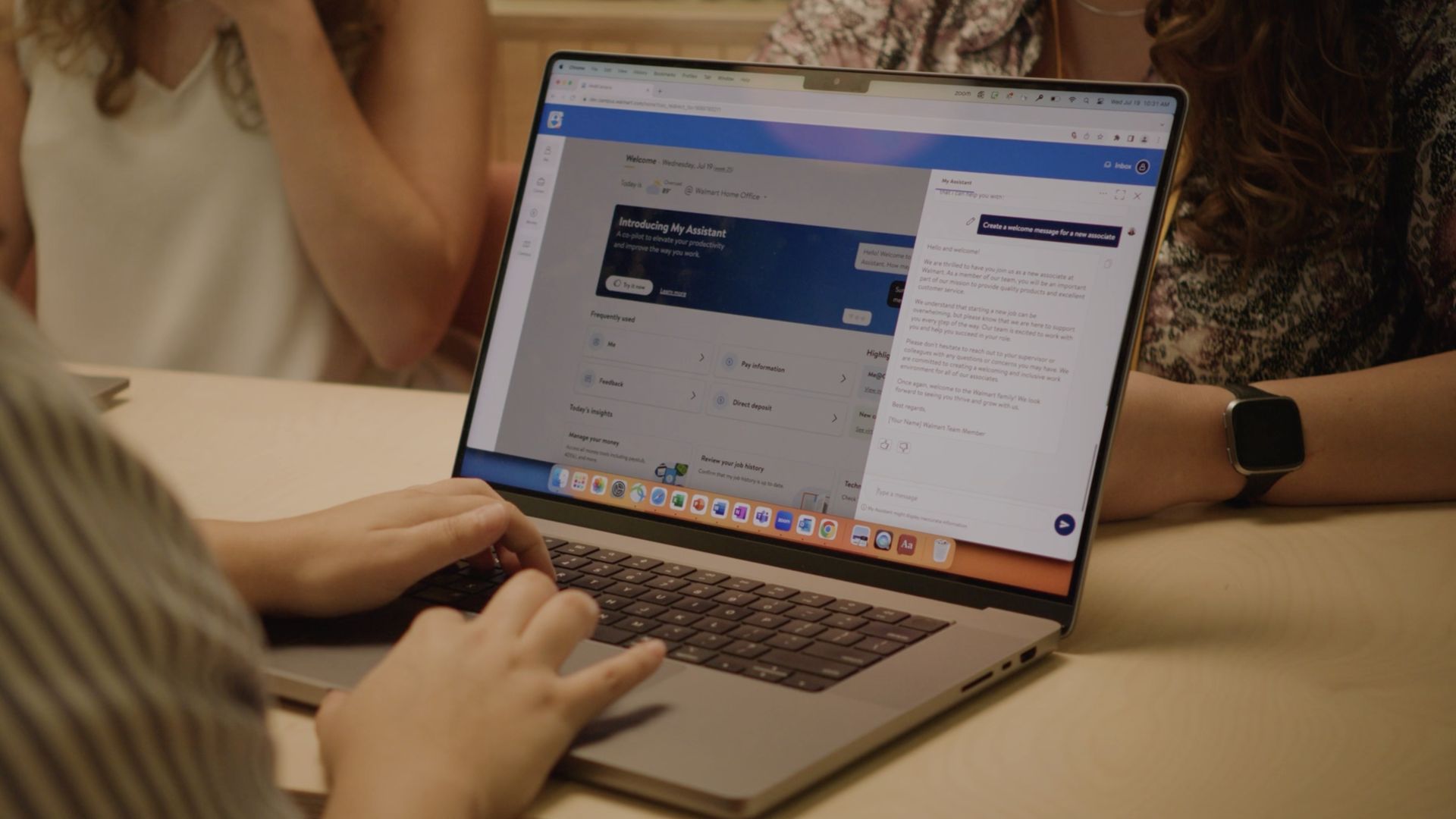
Image: Walmart
Walmart is announcing a program Wednesday that will give its roughly 50,000 non-store employees access to a generative AI app trained on corporate information.
Why it matters: The move shows one of America's biggest companies sees value in providing broad access to the tech industry's hottest new product.
Details: Walmart said its new "My Assistant" feature can help with a range of tasks, from summarizing long documents to assisting in the creation of new content.
- The generative AI feature is part of the company's broader "Me@Campus" app for employees and works on both computers and smartphones.
- It combines data from Walmart with third-party large language models. Walmart declined to say whose AI technology it was using.
What they're saying: Walmart says the move is about more than just boosting productivity and hopes the app will free workers from monotonous, repetitive tasks.
- "Here's our belief: It will take both people and technology to deliver on our purpose to help people save money and live better," Walmart chief people officer Donna Morris and executive vice president Cheryl Ainoa wrote in a blog post.
- "GenAI can help us work faster and more efficiently, but it also has limitations: it lacks judgment, has a limited understanding of context and is only as good as the data it's trained on."
The big picture: Whether and how to embrace generative AI for business use is a pressing debate today among CEOs and in board rooms.
- Companies are taking a range of approaches, from aggressive adoption of the technology to prohibiting users from using consumer AI services like ChatGPT for fear of leaking confidential information.
Flashback: Walmart has often leaned on technology to improve its processes, both in the office and within its stores.
- Starting in 2021, the company provided more than 740,000 smartphones to workers to ensure store workers could access its internal app to check schedules, clock in, communicate with one another and locate merchandise.
What's next: Walmart says it wants to use the app for more worker tasks, beginning with orientation and including activities ranging from booking a conference room to choosing benefits during annual open enrollment.
- Walmart's blog post also hinted at applications for customers as well.
- "The possibilities with GenAI are broad, especially when we think of how this can benefit not only our associates, but also how we engage with customers and members, enabling more personalized interactions," Morris and Ainoa said in the blog post.
2. FBI takes down one of world's largest botnets

FBI director Christopher Wray during a press conference in September 2020. Photo: Olivier Douliery/Pool/AFP via Getty Images
The FBI has disrupted and dismantled one of the largest botnets in operation as part of an international cybercrime investigation, Axios' Sam Sabin reports.
Driving the news: FBI director Christopher Wray announced the bureau had infiltrated and redirected traffic flowing through servers belonging to the Qakbot botnet, which is believed to have allowed hackers to target financial institutions, government contractors and other critical infrastructure.
- The Justice Department also said Tuesday it had seized more than $8.6 million in cryptocurrency profits from Qakbot operations.
Why it matters: Malicious actors use botnets — or a network of computers where they've installed malware to give them control of the device — as a foothold to launch ransomware and other kinds of cyberattacks.
- Disrupting a botnet can stymie any attacks hackers had up their sleeves, leaving them to rebuild their operations.
Details: The FBI said it identified more than 700,000 computers worldwide that actors infected with the Qakbot malware, including more than 200,000 in the U.S.
- The bureau infiltrated Qakbot's servers, redirected their traffic to FBI-controlled servers and downloaded a malware uninstaller file onto each device as part of the operation.
- The uninstaller also prevents the installation of any additional malware onto these devices, the bureau said.
The big picture: Qakbot's financial impact on businesses has been heavy. Between October 2021 and April 2023, the botnet's administrators had received roughly $58 million in ransoms paid by victims during attacks, according to the Justice Department.
Between the lines: Wray noted that this is the first time the FBI has used this technique in its operations, and the bureau partnered with both private sector and international law enforcement on the takedowns.
- Before today's announcement, only the Pentagon's U.S. Cyber Command had carried out a botnet disruption of this kind.
Yes, but: Botnet disruptions don't last forever, and Qakbot's operators are expected to attempt to rebuild their networks.
3. Yahoo's renaissance under new owners

Illustration: Sarah Grillo/Axios
Yahoo is on a buying spree to bolster its core products, most of which have miraculously survived nearly three decades of internet tumult, Axios' Sara Fischer reports.
Why it matters: Yahoo was all but left dead by Verizon when it was sold to Apollo Global Management in 2021. Under its new owners, the company — founded in January 1994 — is getting a rare chance to reinvent itself.
Driving the news: The tech giant on Tuesday said it had acquired StrictlyVC for its news site TechCrunch, marking Yahoo's fourth acquisition in the past year.
How it works: The StrictlyVC move is a reflection of how Yahoo is transforming its legacy properties with small, incremental deals.
- Yahoo acquired social investing platform CommonStock last week in an effort to make Yahoo Finance a premiere destination for retail investors.
- In April, it purchased Wagr to bring gaming opportunities to Yahoo Sports.
- Last year, it bought Factual to add news credibility ratings to its vast pool of syndicated news content.
Be smart: Most of Yahoo's core products have been reorganized over the past two years to operate independently under a single general manager or president.
- In June, Yahoo hired former ESPN and BetMGM executive Ryan Spoon as the new president of Yahoo Sports.
- Last year, the company named longtime Silicon Valley executive Tapan Bhat as general manager of Yahoo Finance.
- StrictlyVC's founder Connie Loizos was named general manager of TechCrunch Tuesday, in addition to editor-in-chief.
Between the lines: Driving that transformation is Yahoo CEO Jim Lanzone, the former CBS Interactive executive and Tinder CEO, with the backing of Yahoo's new owners.
By the numbers: Axios reported last year that the company generates roughly $8 billion in revenues with a significant profit margin.
- It's worth noting that many of Yahoo's existing businesses — including ones long neglected by the internet elite — are still very profitable.
- AOL, for example — which was merged with Yahoo under its previous owners — still drives hundreds of millions of dollars of free cash flow, a source told Axios.
- Overall, Yahoo's traffic ranked fifth across desktop and mobile last month, according to Comscore, trailing only Google, Microsoft, Facebook and Amazon.
Catch up quick: Apollo acquired Yahoo and AOL collectively from Verizon for $5 billion, a sum smaller than the combined annual revenues of both companies at the time. Apollo has said that the Yahoo deal marks one of its fastest ever returns on investment.
What's next: Yahoo is looking to get competitive again in the search space, 23 years after originally striking a deal to outsource its main search engine to Google. (That deal eventually ended and Yahoo later struck a search deal with Microsoft, which still exists today.)
- "We're really inspired by the original mission of the company," Lanzone told Axios.
4. Training data
- Apple made official a Sept. 12 press event where it will debut the iPhone 15 family, Apple Watch and other products. (Axios)
- OpenAI is on pace to generate more than $1 billion in revenue over the next 12 months. (The Information)
- The Columbus Dispatch is pausing its use of AI-written sports stories amid less-than-stellar results. (Axios Columbus)
- Potentially risky AI-generated books about mushroom foraging have shown up on Amazon. (404 Media)
5. + This

ChatGPT endured a brief outage Tuesday morning, but the worry was real among those who posted to Downdetector during its period of unavailability "I need to do my homework dawg," wrote one aggrieved student. "I am NOT doing 30 questions on properties of logarithms," the poster added.
Thanks to Scott Rosenberg for editing and Bryan McBournie for copy editing this newsletter.
Sign up for Axios AI+

Scoops on the AI revolution and transformative tech, from Ina Fried, Madison Mills, Ashley Gold and Maria Curi.