Axios AI+

May 23, 2024

1 big thing: Americans don't trust social media firms with AI

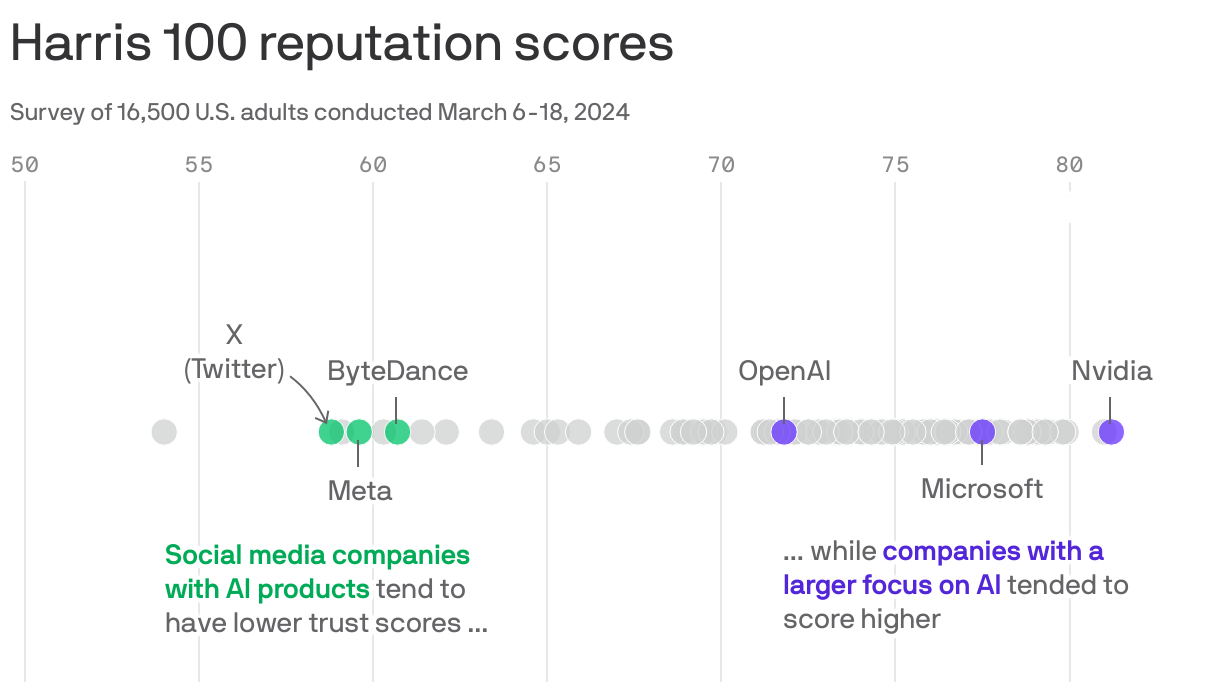
The U.S. public trusts tech companies leading the generative AI wave — like Nvidia, Microsoft and OpenAI — more than firms chiefly known as social media platforms, like Meta, ByteDance and X.
Why it matters: These findings — part of the 2024 Axios Harris Poll 100 reputation rankings — show that continued fallout from public disenchantment with social media could hamper companies' effort to reinvent themselves as AI innovators.
Stunning stat: Nvidia, the AI chips powerhouse, is a newcomer to the list in 2024 — and also No. 1 in overall reputation, as well as "vision" and "growth." The firm came in at No. 8 for trust.
By the numbers: In overall reputation scores, Nvidia earned 81.2 and Alphabet came in at 77.6, followed closely by Microsoft at 77.5. OpenAI's score was 71.8.
- Meanwhile, ByteDance scored only 60.7, Meta ranked 59.6, and X/Twitter is second to last on the list, with a reputation score of 58.8.
- The three social media companies all saw their reputations drop since last year — and were all in the "very poor" range.
Catch up quick: Meta, ByteDance and X have all been working on AI for years, but they are still best known for Facebook, Instagram, TikTok and the social network formerly known as Twitter.
- Facebook and Instagram have faced a trust crisis with users since the techlash that started with 2018's Cambridge Analytica scandal and was refueled by the ad boycotts of 2020.
- ByteDance plummeted from "fair" in 2020 to "poor" in 2024 on the reputation scale, as political leaders from both parties have denounced the company's ties with China and a new law requires it to sell TikTok or face a ban.
- Elon Musk is increasingly making AI the focus of X, even as he courts extremists and fails to moderate hate speech on the platform.
- Even Gen Z no longer trusts social media.
The big picture: The promise (and perils) of AI have come into focus in the past few years, as its moral, safety and business ramifications will define the future reputation of companies.
- While over half (58%) of respondents to the poll recognized the importance of integrating AI into products, only 30% said they would be more likely to buy the product or service just because it uses AI.
Public trust in AI is sinking overall. That means companies that rush to show they're innovative by adding AI to products could also harm their reputations.
- Google and Meta both suffered blowback from new tools that generate AI images.
- Apple wanted to highlight how thin its latest iPad is — but the ad promoting it reminded customers of the perils of AI instead.
Zoom out: Deepfakes and misinformation are stoking AI fears, and more and more Americans worry that AI will replace their jobs, or creative jobs in general.
- 74% of respondents to the survey agreed with the statement: "Human creativity is what makes many products and services amazing — and AI won't be able to replace that."
How it works: This survey is the result of a partnership between Axios and Harris Poll to gauge the reputations of the most visible brands in America, based on 20 years of Harris Poll research.
Go deeper: Full results and poll methodology
2. Nvidia earnings keep the party going




Nvidia's quarterly earnings, released yesterday, once more bested Wall Street's expectations, keeping the punchbowl out for AI's investment party.
Why it matters: Dubbed the most important stock on planet Earth by Goldman Sachs, the company has become a key bellwether for the pace of AI-driven growth.
Driving the news: Last quarter's revenue topped $26 billion, up 18% from the prior quarter, and the company now expects the current quarter's sales to top $28 billion — both numbers beating expectations.
- Share prices soared in after-hours trading, breaking $1,000 per share for the first time. The firm also announced a 10-for-1 stock split.
Between the lines: Nvidia's profit margins are the envy of the corporate world — it made $14.9 billion of net income on revenue of $26 billion last quarter.
- By contrast, Nvidia's net income was just $0.7 billion in the final quarter of 2022.
- Nvidia earned more last quarter than corporate behemoths like JPMorgan, Berkshire Hathaway or Amazon, all of which rank consistently among America's most profitable companies.
The big picture: The only U.S. companies to make substantially more money than Nvidia are Apple, Microsoft and Alphabet.
- Outside the U.S., state-owned oil companies Saudi Aramco and Petrobras can beat Nvidia — but Taiwanese chipmaking giant TSMC cannot.
The bottom line: Almost never in history has any company managed to increase its profits this quickly to such an astonishingly high level.
3. A digital pet for your Apple Vision Pro
4. Training data
5. + This
Axios AI+
