Most Twin Cities Gen Z renters spend 30% of income on rent

Add Axios as your preferred source to
see more of our stories on Google.
Illustration: Natalie Peeples/Axios
Homeownership doesn't feel in the cards for many Twin Cities twenty-somethings.
Why it matters: Steep prices and mortgage rates pose seemingly insurmountable hurdles to homeownership — and renting isn't necessarily an affordable alternative.
- While rents in the Twin Cities are growing much slower than other big metros, they're still eating up a large share of young peoples' incomes.
Driving the news: One in three Gen Zers (34%) surveyed by Freddie Mac say owning a home feels impossible in their lifetime, up from 27% in 2019.
- Saving for a down payment is the biggest obstacle, they say: It's one reason the typical first-time homebuyer last year was a record-high 36 years old, per the National Association of Realtors.
Zoom in: Watching mortgage rates inch closer to 8% "is one of the most disheartening things in my life," says Nicolette Serbus, 26, who tells Axios she and her partner have hoped to leave their one-bedroom apartment for about two years.
- The Minneapolis-area middle school teacher says 23% of her income goes toward her half of the rent.
What's happening: Across the U.S., pinched young people are fanning out from big cities, returning to their childhood bedrooms or moving in with partners.
- Fannie Mae researchers found 30% of young workers are willing to live farther away from the office for more inexpensive housing.
- Nearly a third of Gen Z adults say they're living at home long-term, The New York Times reports.
Zoom out: America's housing shortage has helped hike the cost of both buying and renting.
Reality check: The vast majority of young renters are renting for lifestyle reasons, preferring the flexibility to move, RealPage chief economist Jay Parsons tells Axios.
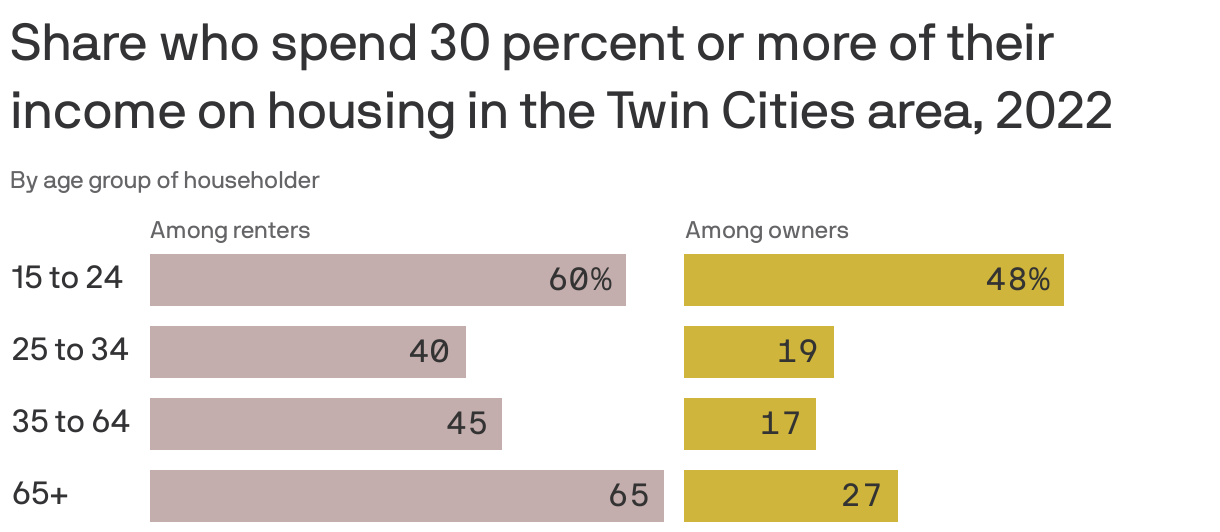
Most of the Twin Cities' youngest renters are spending at least 30% of their income on rent, according to the latest U.S. census data.
- In all of the 100 biggest U.S. metros, over a third of 15- to 24-year-old householders who rent spend 30% or more of their income on housing, Axios' Simran Parwani reports.
The big picture: Many Gen Z renters have lower incomes but also lower bills beyond rent, which allows them to live in pricier locations, according to Parsons.
Between the lines: Older Americans on fixed incomes are especially burdened by high housing costs, contributing to rising homelessness among Baby Boomers, The Wall Street Journal reports.
What they're saying: A sweet deal for a North Loop apartment swayed Caleb Petersen, 24, to postpone his plans to buy an investment property this spring.
- "Socially, I would prefer not to buy a house," says Petersen, who tells Axios he enjoys his building's amenities and walkable location.
- He expects to buy a duplex, triplex or large home where he would both live and rent eventually, because paying rent means "that money isn't going to do anything for you."
Go deeper: Student loan interest has started again, adding to affordability pressures.