As Florida abortion amendment fails, supporters vow: "This is not over"

Add Axios as your preferred source to
see more of our stories on Google.
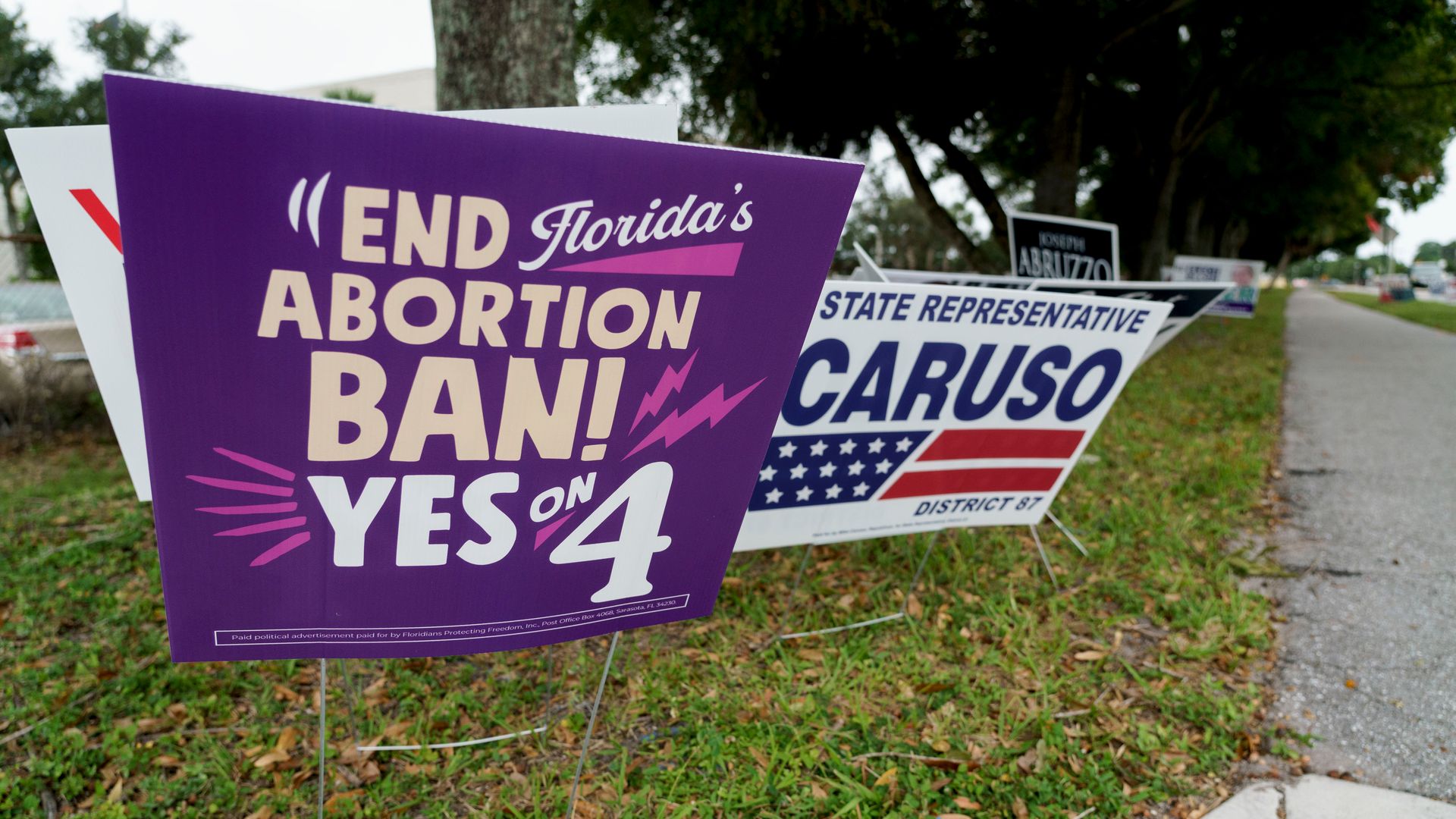
Signs for Amendment 4 at an elections office in Palm Beach. Photo: Josh Ritchie/Bloomberg via Getty Images
A majority of Floridians voted to enshrine the right to an abortion in the state constitution. It wasn't enough.
Why it matters: Abortion rights advocates across the Southeast had seen Amendment 4 as a lifeline for restoring access that was curtailed after Roe v. Wade fell.
- Instead, most abortions will remain illegal in Florida after six weeks of pregnancy.
Between the lines: It's a victory for opponents of abortion access, including Gov. Ron DeSantis, who in the months leading up to the election poured public money, time and legal firepower into defeating the measure.
What they're saying: "Floridians' commonsense, family-focused values prevailed," No on 4 campaign spokesperson Taryn Fenske said in a statement that also credited the governor with the victory.
- "We protected our constitution because of the singular vision and steadfast leadership of Governor Ron DeSantis."
The other side: Supporters of the measure wiped away tears and hugged each other as Amendment 4 organizers conceded the loss at an election night watch party in St. Petersburg.
- Yes on 4 campaign director Lauren Brenzel emphasized that the amendment got majority support in what was otherwise Florida's most conservative election in recent history.
- "Republicans, Democrats and independents do not support these extreme bans on abortion," Brenzel said to cheers and applause.
State of play: The rejection comes six months into the state's six-week ban, which has forced patients to seek care out of state and narrowed options for women throughout the South.
- Such a landscape puts anyone who can get pregnant in danger, abortion rights advocates argue.
- At least four women in Georgia and Texas died because they couldn't access timely medical care under those states' similarly restrictive abortion bans, according to recent reporting by ProPublica.
Catch up quick: Florida, once a haven for abortion access in the South, is one of many states that restricted access before and after the Supreme Court overturned Roe v. Wade in June 2022.
- In April of that year, DeSantis signed into law a 15-week abortion ban that abortion rights advocates soon challenged in court.
- They argued the ban violated a 30-year-old right to privacy in the state constitution that Florida Supreme Court justices had twice ruled applied to abortion access.
- As the lawsuit played out, DeSantis and Republican lawmakers passed a six-week ban that would go into effect only if justices upheld the 15-week restriction and reinterpreted the right to privacy.
Meanwhile, abortion rights advocates began collecting signatures to place a constitutional amendment on the ballot as a last-ditch effort to restore abortion access.
- In April this year, Florida justices upheld the 15-week ban, paving the way for the six-week ban to go into effect.
- Justices also approved the ballot language for Amendment 4, setting up the high-stakes election that played out Tuesday.
What's next: Amendment 4 supporters plan to lobby lawmakers to ease the six-week abortion ban, Brenzel said, armed with Tuesday's result signaling that a majority of Floridians don't support it.
- "Tonight, hug your friends, hug your families, hug your loved ones, but you get out there tomorrow," organizer Sarah Parker told the crowd of supporters.
- "This is not over for a minute, for a second."