How corals from Honduras have given new hope to Florida's reef crisis

Add Axios as your preferred source to
see more of our stories on Google.
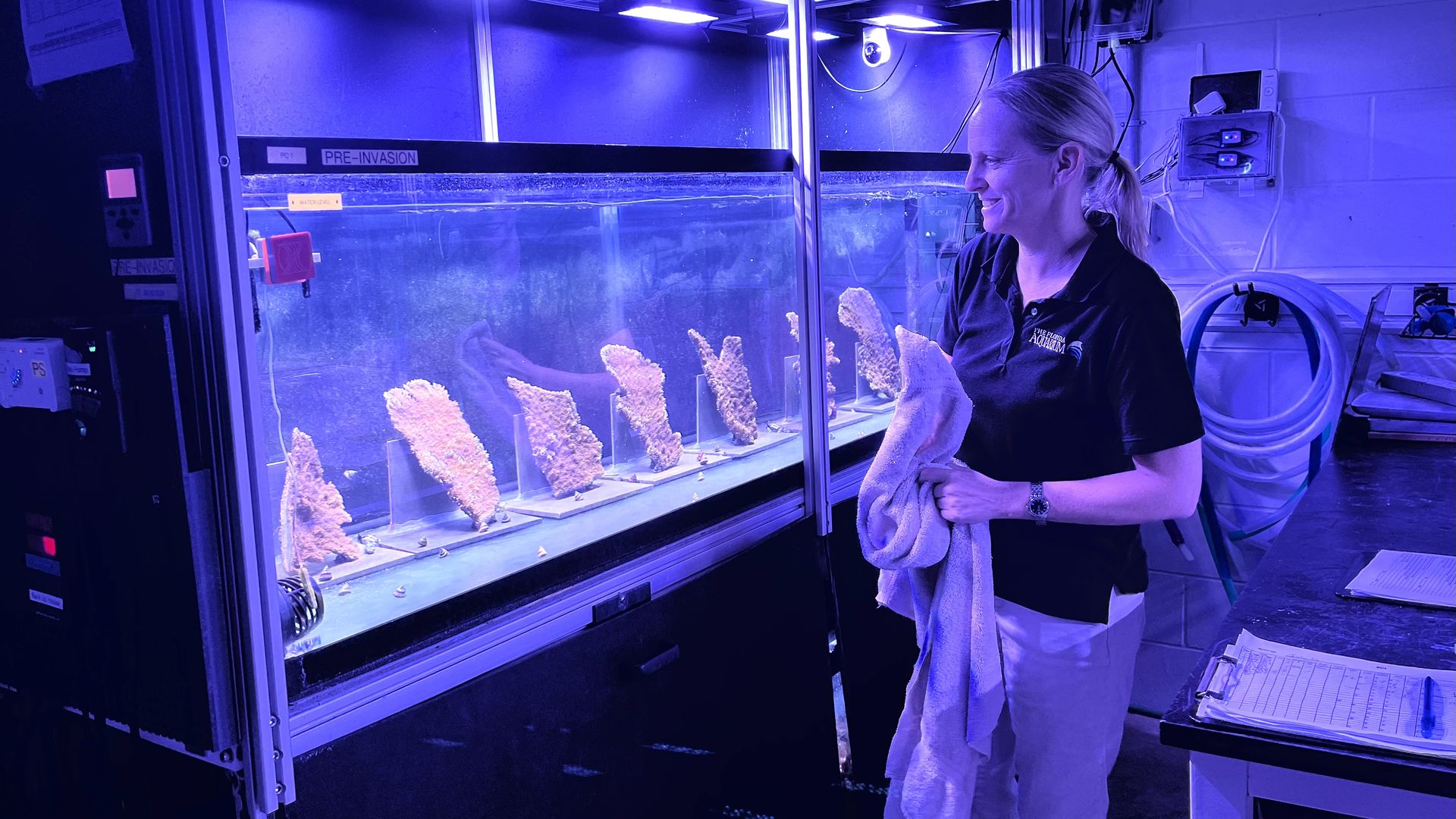
Keri O'Neil, director of The Florida Aquarium's Coral Conservation and Research Center in Apollo Beach, looks at seven elkhorn coral fragments from Honduras. Photo: Kathryn Varn/Axios
In a temperature-controlled tank of sterilized seawater at a nondescript building in Apollo Beach — 1,000 miles from their native Honduras — lie seven potential solutions to Florida's coral crisis.
Why it matters: The seven elkhorn colonies, now at The Florida Aquarium's Coral Conservation and Research Center, may be the key to saving Florida's reefs from skyrocketing ocean temperatures caused by climate change.
Catch up quick: Last summer's record-breaking marine heatwave pushed coral reefs in the Florida Keys to the brink.
- One reef was completely wiped out, and many more corals have turned white, a phenomenon known as coral bleaching.
- The troubling die-off led scientists to transfer thousands of corals to labs to keep them alive until temperatures returned to normal.
Threat level: A quarter of ocean animals depend on coral reefs for shelter. They're also a big driver of tourism in Florida.
- "Last summer, you might as well have sped up time by 50 years," research center director Keri O'Neil told Axios. "It made everyone realize we probably don't have as much time as we thought we did."
- "You can throw your hands up ... or you can let it light a fire under you."
Zoom in: At O'Neil's lab, that means trying a new possible solution called "genetic rescue."
- Scientists from the University of Miami collected the elkhorn fragments from a reef in Tela Bay off the northern coast of Honduras, where the corals have somehow thrived in the same extreme heat that's eradicating their relatives in Florida.
- The hope is that breeding the Honduran corals with the lab's Florida elkhorn corals will create a new variation that can better withstand rising ocean temperatures.
Yes, but: First, the corals have to spawn, O'Neil said.
How it works: Elkhorn coral reproduction happens after the full moon in July or August. This month's full moon comes on July 21, O'Neil said, so she and her colleagues will begin monitoring for spawning activity the next day.
- It's a lot of watching and waiting. To help the process along (or, really, to entertain themselves), they sometimes turn to a playlist of sultry hits from Barry White and Marvin Gaye.
- In this line of work, "you have to have some humor," biologist Jessica Kelly said.
Flashback: Five years ago, the aquarium was part of a coral cross-breeding effort in which elkhorn corals from the Caribbean island of Curaçao were fertilized using coral sperm from Florida.
- The effort was successful, producing hundreds of offspring, but they couldn't be released onto Florida's reefs because of genetic differences between the populations.
What's next: The Honduran corals are more closely related to Florida corals, so O'Neil hopes the offspring from this experiment will clear regulatory hurdles to release them into the sea.