What a Florida health agency gets wrong about the abortion ban

Add Axios as your preferred source to
see more of our stories on Google.
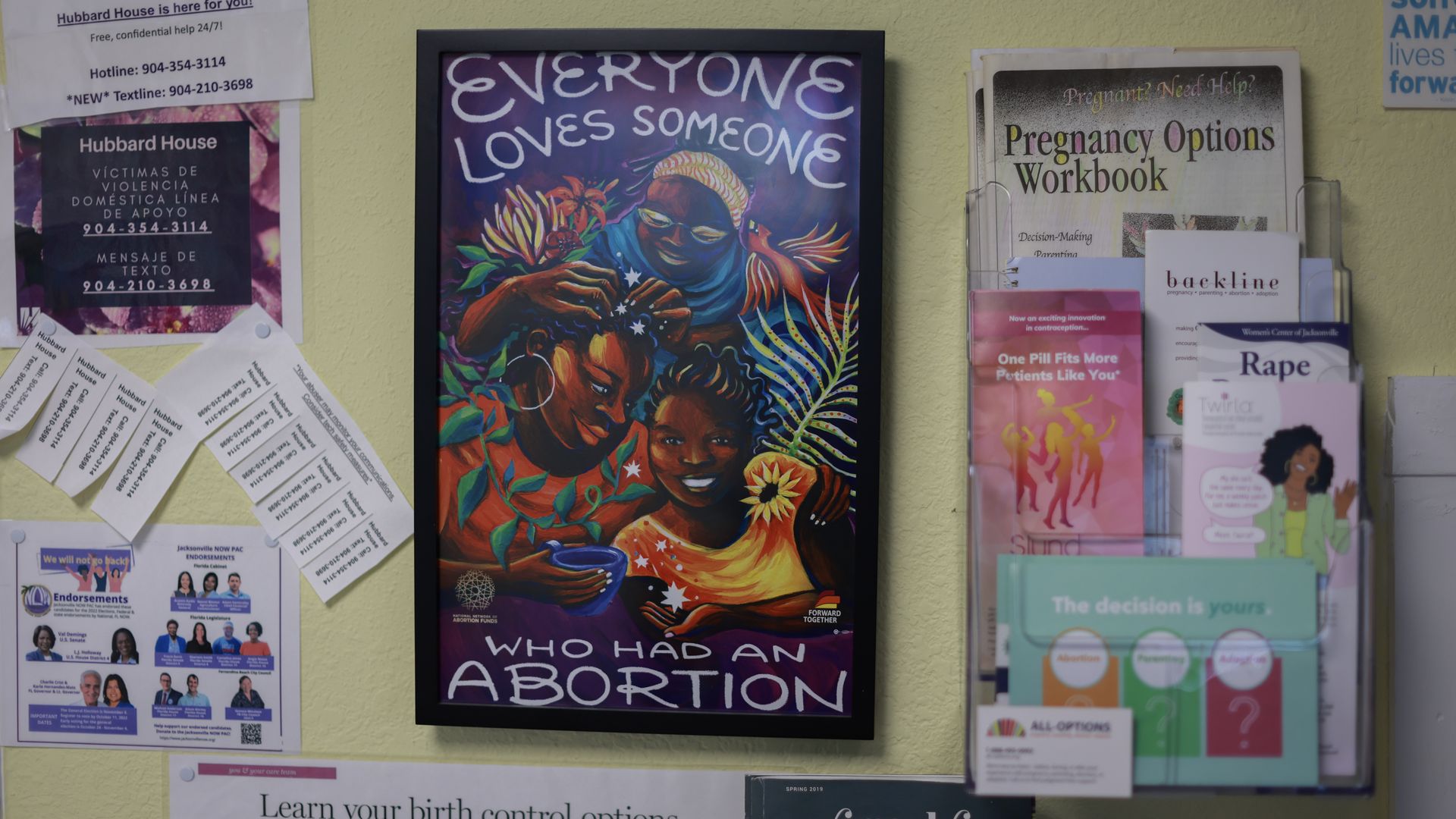
Supportive messages hang on a wall of the group counseling room in A Woman's Choice of Jacksonville clinic, which provides abortion care. Photo: Joe Raedle/Getty Images
As Florida's six-week abortion ban went into effect last week, the state's health care regulation agency sought to refute one of its main criticisms: that many women won't know they're pregnant by that cutoff.
Why it matters: Far from setting the record straight, the agency's rebuttal was itself a misleading oversimplification, experts say.
State of play: "Pregnancy tests have evolved substantially over the years," the Agency for Health Care Administration said on May 1 on X, formerly known as Twitter. "Trace levels of [the pregnancy hormone] hCG can now be detected as early as eight days after ovulation."
- The statement was included as part of a "Myth vs. Fact" information sheet shared on the state agency's official account to combat "lies and misinformation," per the post.
- "Don't let the fearmongers lie to you," the sheet says in all caps.
Reality check: While pregnancy testing technology has improved, folks who aren't planning to get pregnant wouldn't know to use a test, said Sameera Mokkarala, a fellow with Physicians for Reproductive Health.
- At-home early-detection tests are typically used by women hoping to become pregnant, Mokkarala, a Philadelphia-based abortion provider and gynecologist, told Axios.
- And the earlier the test, the greater chance of a false negative.
What they're saying: "They're confusing the failure to recognize pregnancy with the ability to diagnose it early," retired Tampa obstetrician-gynecologist Bruce Shephard told Axios.
- "Yes, you can diagnose it early, but if you're not looking for it — many patients are not," he said, adding that nearly half of pregnancies are unintended.
The other side: The agency's communications office did not return Axios' request for comment Wednesday.
By the numbers: In a study analyzing more than 17,000 pregnancies over 23 years, the mean gestational age by which respondents learned they were pregnant was 5.5 weeks.
- Almost a quarter of women became aware of their pregnancy at or after seven weeks.
- That late pregnancy awareness was more common among young people, Black and Hispanic women, and those experiencing poverty.
How it works: Gestational age is calculated using the first day of a patient's last period.
- That leaves patients who don't want to continue their pregnancy with just two weeks after a missed period to arrange for abortion care before the six-week cutoff, Mokkarala said.
- In Florida, that requires attending two in-person appointments at least 24 hours apart, per state law.
- The six-week ban also prohibits patients from receiving abortion medication in the mail, although abortion-by-mail providers told the Tampa Bay Times they intend to continue sending pills under the protection of "shield laws" in states like California and Illinois.
Between the lines: That narrow timeline becomes more complicated when a patient doesn't have a regular, 28-day menstrual cycle, Mokkarala said. Up to a quarter of U.S. women don't, so a missed period wouldn't register.
- Some patients also experience spotting early in pregnancy, which patients could misread as a lighter period.
The bottom line: "A six-week ban sets folks up for failure," Mokkarala said.