1 Florida panther's death may point to species' recovery

Add Axios as your preferred source to
see more of our stories on Google.
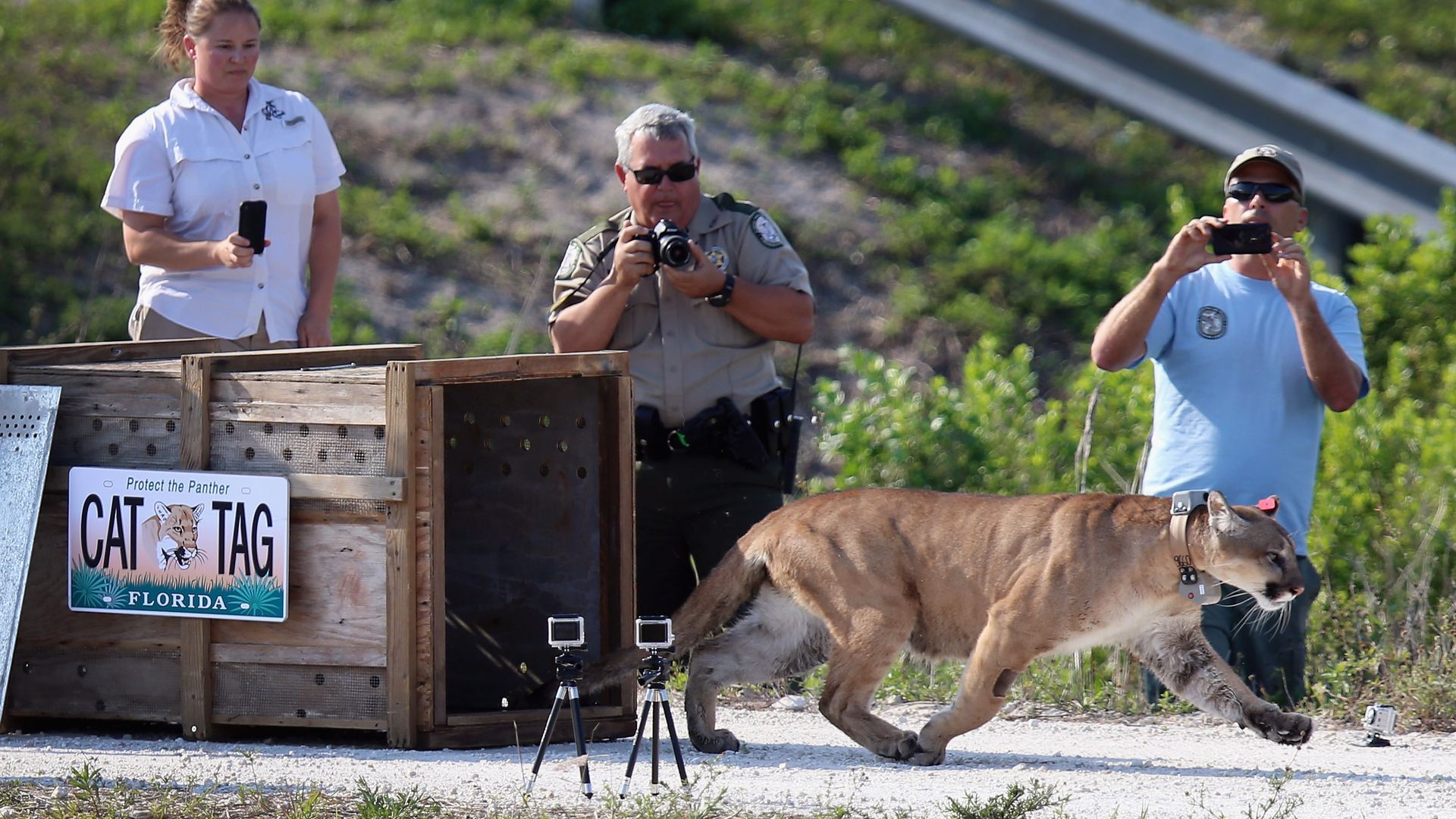
A 2-year-old Florida panther is released into the wild by the Florida Fish and Wildlife Conservation Commission in April 2013 in West Palm Beach. Photo: Joe Raedle/Getty Images
A dead Florida panther is rarely a good thing, but one found this month has given scientists hope that the endangered species could be recovering.
Driving the news: On Dec. 1, the Fish and Wildlife Conservation Commission (FWC) collected the remains of a 2-year-old male panther — dead after being hit by a vehicle — from Keysville Road in eastern Hillsborough County, near the Polk County line.
- It was the 26th panther killed so far this year on Florida roadways.
Why it matters: It was found about 90 miles north of the Caloosahatchee River, long considered the northern boundary of the panther's range.
- And it was the first recorded panther death in Hillsborough County since a male panther was killed in 2003 trying to cross Interstate 4 east of downtown Tampa. That panther was the first confirmed sighting in Hillsborough County in three decades.
- What they're saying: "Its presence highlights that there is still functioning landscape connectivity in Central Florida," Tori Linder, managing director of Path of the Panther, told Axios. "It also underscores the vital need to protect the missing linkages in the Florida Wildlife Corridor."
Context: Draw a line from Fort Myers to Lake Okeechobee — scientists believe 98% of the panthers in Florida have been isolated south of that line.
Yes, but: Occasional sightings or confirmed deaths have been reported in Polk County over the years, and now, though a rarity, Hillsborough.
Between the lines: Male panthers' breeding range is five times greater than females' and scientists have seen them moving north at far greater rates.
- The species can be considered recovered from endangered status only when three distinct breeding populations are established across the state. That requires males and females.
- There's one established breeding population, south of the Caloosahatchee. But biologists found panther kittens north of the Caloosahatchee in 2017.
The intrigue: Arnie Bellini, the wealthy Republican philanthropist behind the popular Florida Wildlife Corridor, swears he saw a Florida panther on the boardwalk behind his home in Avila, 10 miles north of downtown Tampa, in 2006.
- It's an experience that compelled him to pledge his energy and money toward trying to preserve and protect wild migration routes in interior Florida.
Flashback: Panthers, once abundant between Louisiana and the Atlantic, have been decimated by people.
- In 1832, before Florida became a state, each county offered a bounty for panthers.
- By 1874, journalists noted that the panther had become scarce.
- In 1887, the state offered $5 for panther pelts.
- In the early 1900s, panther and black bear hunts were big business in Florida.
- By 1958, the population had fallen so low that the species was placed on the list of animals fully protected.
The low point: In the mid-1970s, officials believed there were between 10 and 50 Florida panthers left. They disagreed on their whereabouts, however.
- The most common sightings back then were in the Everglades National Park, where six tame panthers had been released.
- The population has rebounded from an estimated low of 10 animals to over 200 animals since it was put on the first Endangered species list in 1967.