6 things about Golden Gate Park that might surprise you

Add Axios as your preferred source to
see more of our stories on Google.
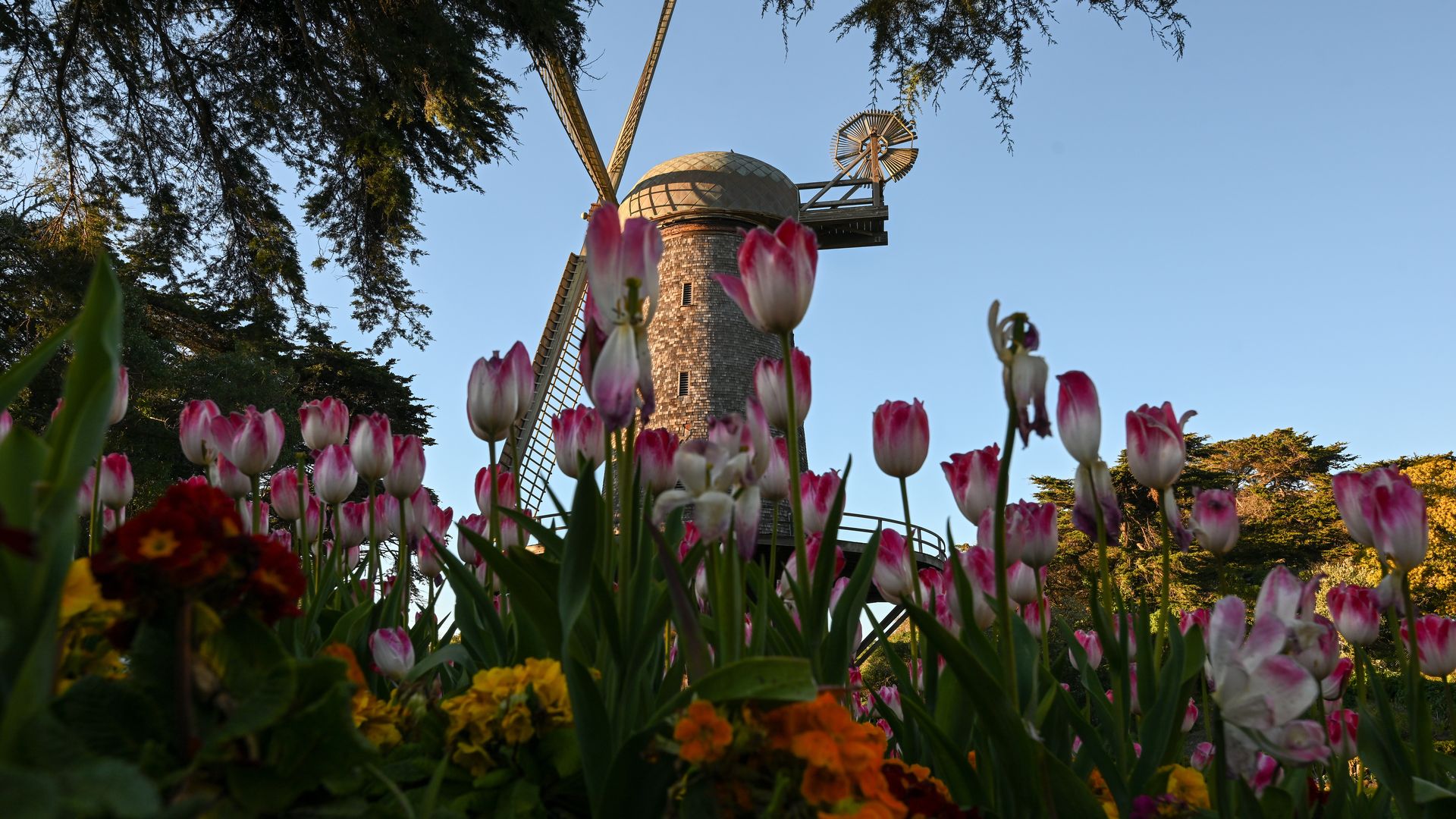
A view of Queen Wilhelmina Tulip Garden and the Dutch Windmill at Golden Gate Park. Photo: Tayfun CoÅkun/Anadolu Agency via Getty Images
Golden Gate Park, one of San Francisco's most illustrious landmarks, celebrates its 155th anniversary Friday.
Why it matters: First proposed in the 1860s, the park spans 1,017 acres and ranks among the most visited urban parks in the U.S.
Flashback: Golden Gate Park was designed by civil engineer William Hammond Hall and horticulturist John McLaren, who set their sights on windswept sand dunes in an unincorporated area of the Peninsula, known as the Outside Lands.
- To transform the dunes into a parkland, McLaren imported bent grass seeds from France and planted them over the sand to prevent the grounds from shifting.
- McLaren is also credited with creating an open walking space along the Pacific shoreline by stacking thousands of tree boughs over 20 years to build an esplanade that could withstand heavy tides and winds.
State of play: Today, the park is home to several gardens, commemorative tree groves and cultural institutions, ranging from the National AIDS Memorial to the De Young Museum.
My thought bubble: Walking through the park, it's easy to forget how much detail went into designing its landscape.
- Hall, McLaren and their assistants took extreme care to make sure the park would be well preserved and maintained for generations to come.
Here are some lesser-known facts about our beloved park:
1. Two brothers opened a casino near the Conservatory of Flowers in 1882, hoping to capitalize on the park's growing popularity.
- Yes, but: It didn't go over well and soon closed after gaining a reputation for alleged moral corruption.
2. In 1995, 40% of the conservatory's iconic glass shattered during a storm with winds up to 100 mph. Restoring the building took eight years.
3. Legend says there's buried treasure somewhere.
- In 1982, writer Byron Preiss buried a dozen ceramic vases protected by plexiglas in parks across North America. It's believed Golden Gate Park was one of them.
- Each vase is said to contain a key that can be redeemed for a jewel estimated to be worth $1,000, but you have to solve specific riddles in Preiss' puzzle book, "The Secret," to figure it out.
- As far as we know, no one has been able to hack it.
4. Golden Gate Park is arguably the birthplace of Twitter.
- While testing an early version of Twitter in 2000 that let him repost an email to as many people as he wanted, co-founder Jack Dorsey walked through the park and sent an email to several friends with the subject line, "I'm at the Bison Paddock watching the bison."
- Dorsey launched Twitter six years later.
5. The infamous Japanese Tea Garden was briefly renamed Oriental Tea Garden during World War II.
- The garden originated as an exhibit for a 1894 international expo. Afterwards, Japanese landscape architect Makoto Hagiwara struck a deal with McLaren to oversee the development and care of a permanent Japanese-style garden.
- In 1942, Hagiwara and his family were among the 120,000 Japanese Americans forced into incarceration camps. The garden's name was changed, and structures linked to Japanese culture were demolished, including the original Shinto Shrine.
- Hagiwara was not allowed to return to his home or the garden after the war, but the garden's original name was reinstated in 1952.
6. A beloved Albino alligator named Claude is a longtime resident of the Cal Academy of Sciences.
- The 200-pound alligator was born in Florida but had a low likelihood of surviving in the wilderness due to his condition.
- He moved into Cal Academy's swamp in 2008 and is now 29. There's even an adorable picture book about his life story.
What's next: Check out the San Francisco Parks and Recreation Department's weekend guide for ways to celebrate the anniversary.