What the Lurie administration could mean for SF's future

Add Axios as your preferred source to
see more of our stories on Google.
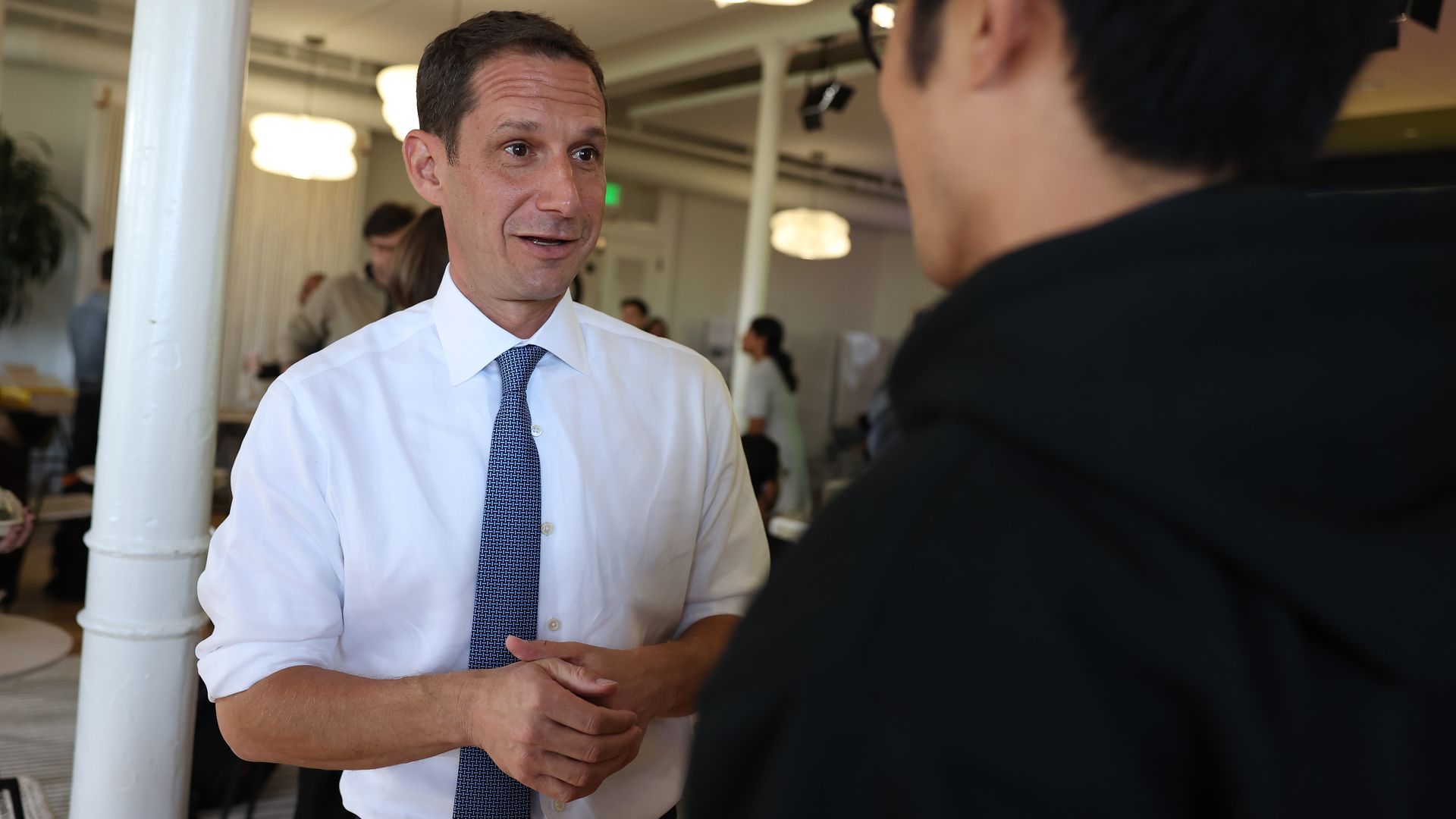
Daniel Lurie, now mayor-elect, talks with a voter during a campaign event on Oct. 30 in San Francisco. Photo: Justin Sullivan via Getty Images
Mayor-elect Daniel Lurie took to the streets Friday to interact with his new constituents and set the tone for San Francisco's next four years.
Why it matters: Lurie ran on a public safety campaign and positioned himself as an outsider who would bring accountability and transparency to local government. Now, it's time to deliver.
Context: Considered a moderate Democrat in San Francisco, Lurie was born and raised here. He is heir to the Levi Strauss fortune by way of his stepfather Peter E. Haas.
- In 2005, he founded the anti-poverty nonprofit Tipping Point Community, which would later commit $100 million to cut chronic homelessness in San Francisco in half by 2022.
- Reality check: They did not meet their objective.
State of play: Lurie, 47, has never held an elected office. His status as a political newcomer seemed to work in his favor, however.
- He pitched himself as the antithesis to corruption and set himself apart by highlighting his ability to deliver results through Tipping Point.
What he's saying: At a Friday news conference, the philanthropist vowed to declare a "fentanyl state of emergency" on day one.
- "We are going to get tough on those that are dealing drugs, and we are going to be compassionate but tough about the conditions of our streets as well," Lurie said.
- "We're going to work with state, federal and city law enforcement to make sure that we close these open-air drug markets."
We've compiled a list of some other policy stances based on comments he's made and data from the San Francisco Chronicle's Vote Compass tool.
On public safety: Lurie told Axios this year that boosting businesses and tourism won't happen unless San Francisco's streets are "safe and clean."
- His approach would be to fully staff police and sheriff departments as well as 911 dispatchers to reduce emergency response times. He said he'd also build workforce housing for first responders with rent and child care subsidies.
On homelessness: He told the San Francisco Standard July that he would've "cleared encampments years ago."
- His plan is to create 2,500 units of shelter, including tiny homes, and help connect people to services while prioritizing cost-effective and dignified shelter over more expensive permanent housing.
On drugs and crime: He opposes city-run indoor spaces where people can use illicit drugs under medical supervision, a tactic advocates say could prevent overdoses.
- He also believes sanctuary city laws should not protect undocumented fentanyl dealers and that the public shouldn't have access to city parks in high-crime areas after dark.
On housing: Lurie has indicated that he believes environmental laws can limit development and that high-rise construction in historic districts shouldn't be off the table.
- His plan includes creating a "shot clock" that sets maximum review times for processing permits and a user-friendly online approvals tracker.
- He opposes expanding limits on rent increases to all residential units in the city. (They currently only apply to pre-1980 buildings.)
On immigration: He does not support authorizing City Hall to provide shelter to all new asylum seekers who are unable to afford housing.
On taxes: He strongly agrees that San Francisco should give large businesses tax cuts to deter them from leaving the city.
On reparations: He remains neutral on whether San Francisco should pay Black residents.
Caveat: San Francisco is struggling with a yearslong budget deficit that has left many programs and services fighting for funding.
- It remains to be seen how that will affect Lurie's proposals.
What to watch: Lurie said Friday that he doesn't anticipate taking a salary but needs to first speak with the city attorney.
- Mayor London Breed earned $364,582 in wages last year, making her the highest-paid mayor in California, according to the California State Controller.
Catch up quick: Lurie's candidacy turned the election into the city's most expensive modern mayoral race, per the San Francisco Chronicle.
- More than $13 million was spent on his campaign, including a $1 million donation from his mother and almost 9 million from Lurie's own pocket. Other donors included WhatsApp co-founder Jan Koum and biotech investor Oleg Nodelman.
- Though he was expected to get a boost from second-choice votes, preliminary results show that he surpassed Breed in first-choice votes by roughly 3 percentage points.
- Lurie has two children with his wife, Becca Prowda, who is Gov. Gavin Newsom's director of protocol.