San Francisco projected to permit fewer new housing units this year


Add Axios as your preferred source to
see more of our stories on Google.
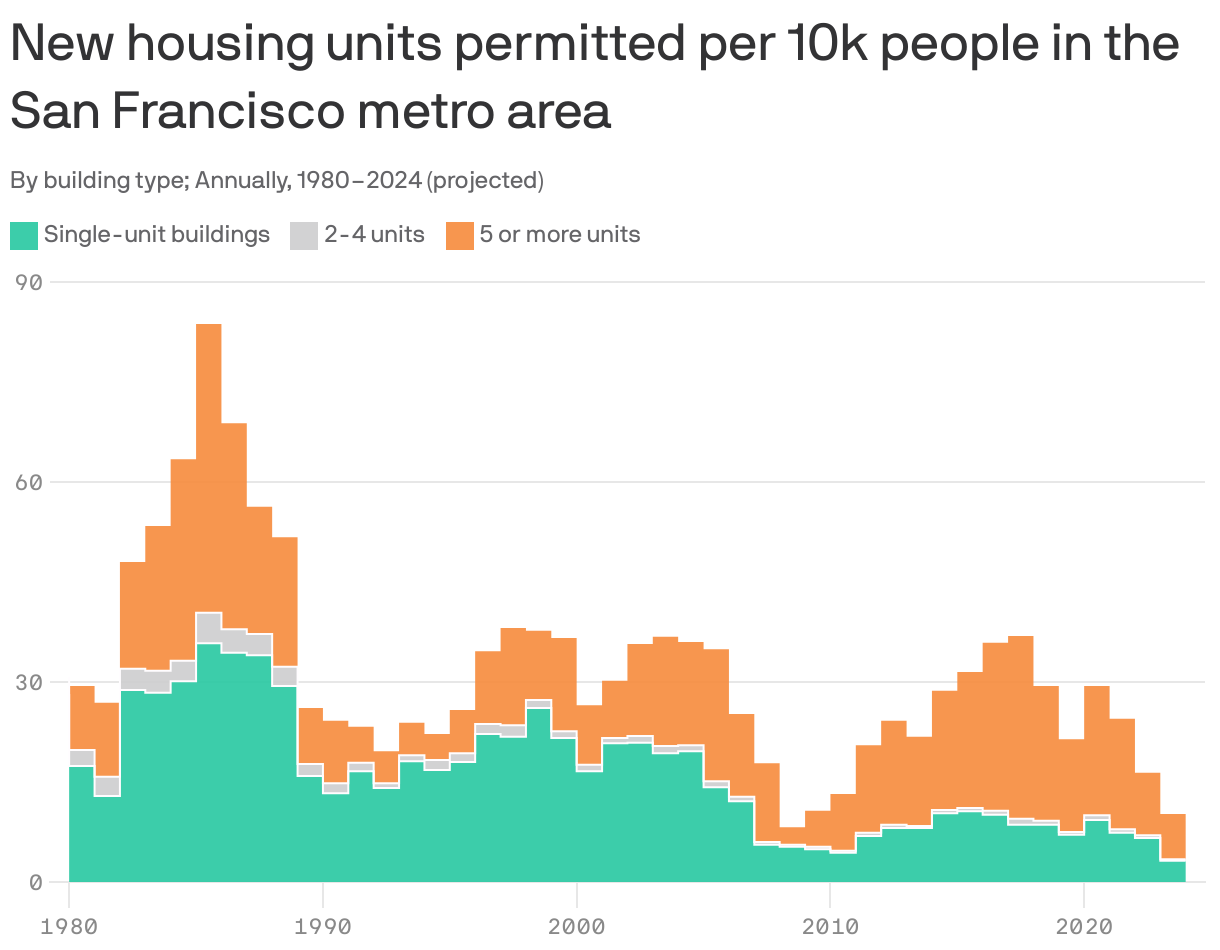
The San Francisco metro area is on track to permit fewer new housing units this year compared to 2023, according to U.S. Census Bureau data.
Why it matters: That's a problem for people facing steep housing prices, with fewer permits resulting in a smaller inventory.
- Plus, the city's approval process for new housing permits is already among California's longest.
Zoom in: The San Francisco metro area, which includes the city, Oakland and Fremont, is projected to permit over 4,600 this year compared to almost 7,500 in 2023.
- That means a projected 10.1 new units permitted per 10,000 residents, down from 16.4 in 2023 — a 38% decrease in total new units permitted per capita.
What to watch: San Francisco might see a reversal in the next year after triggering a new state law that will expedite the permitting approval process for developments that meet certain criteria under the city's planning department.
- These projects will no longer need to undergo discretionary hearings, review through the California Environmental Quality Act or Neighborhood Notification.
- San Francisco is the first city to trigger the law, which mandates an expedited process if the California Department of Housing and Community Development determines that a city is falling short of its state-mandated goals for new housing.
The big picture: Higher interest rates for loans are slowing new home and apartment construction, according to the National Association of Home Builders.
- Labor and lot shortages are also weighing on builders, per the group's latest survey. Experts estimate America is short over 3 million units of housing, either to rent or to buy.
Yes, but: Homebuilding has proved resilient, partly because there's low inventory of existing houses for sale.
- 1.3 million units nationwide were permitted in 2023 — most of which (60%) were single-family homes, the data shows.
Zoom out: Some areas, particularly fast-growing U.S. metros in the South, are seeing more homebuilding than others.
- Cape Coral, North Port and Lakeland, all in Florida, are projected to lead large metros this year in total new units permitted per capita.
Between the lines: A cascade of new apartments, financed when interest rates were lower, helped recently to slow rent growth across the nation.
- With the peak of the construction wave behind us, per an analysis from real estate services firm Cushman & Wakefield, landlords could raise rents.