America's housing shortage explained in one chart

Add Axios as your preferred source to
see more of our stories on Google.
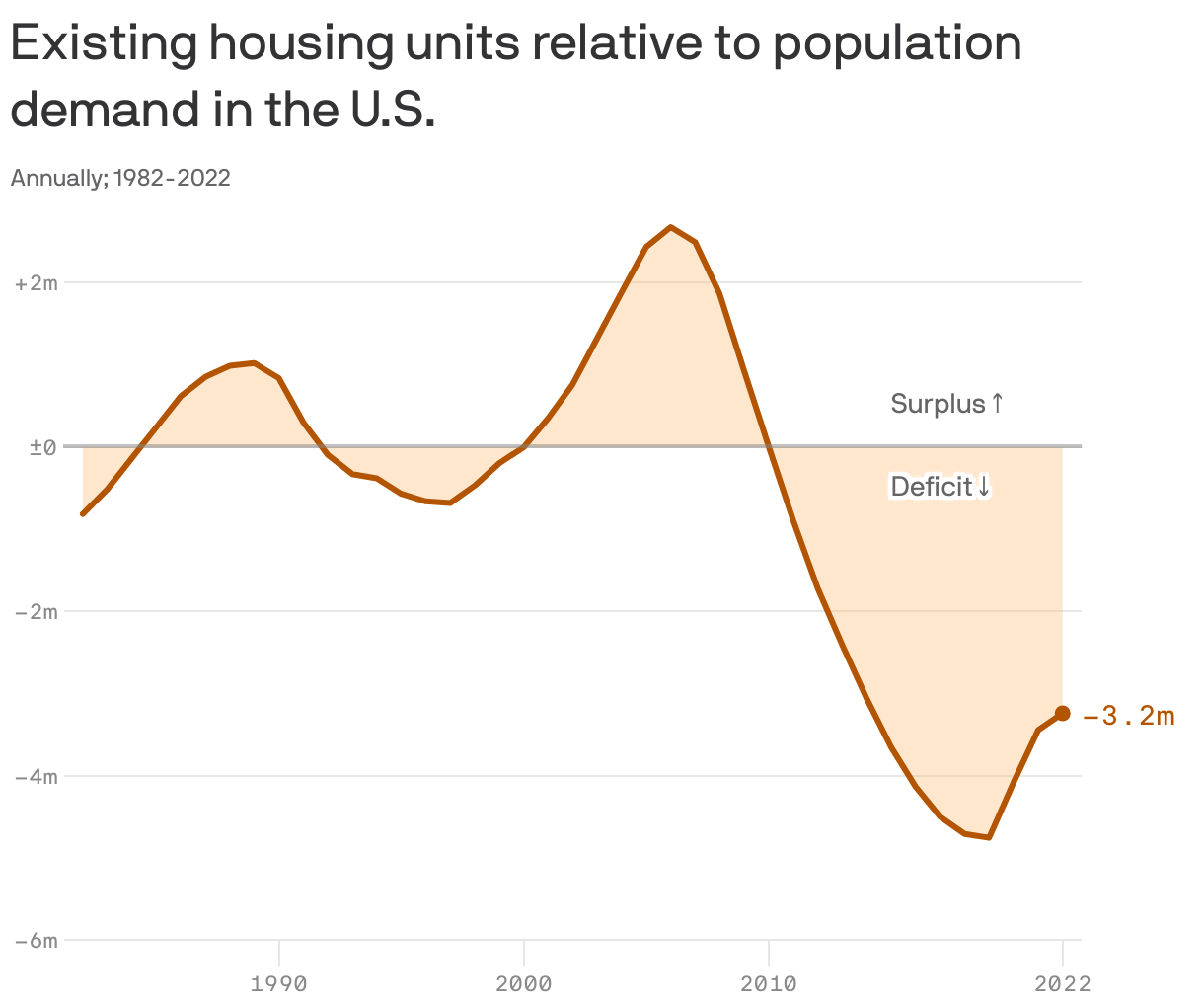
America is short around 3.2 million homes, a big reason why prices are still high.
- That's 2.5% of existing U.S. inventory as of 2022, according to figures that Hines, a global real estate developer and investment company, shared with Axios.
Why it matters: There aren't enough homes to keep up with the increase in households.
- Other estimates also put the size of the country's housing shortage in the millions.
What they're saying: "We're not going to overcome this deficit anytime soon just building single-family housing," Hines managing director Ryan McCullough tells Axios.
Between the lines: Apartment construction surged in recent years.
- Yes, but: Most newly built housing is high-end, and not widely affordable.
Of note: Hines compared the stock of existing homes, either to rent or buy, with what they calculated is the population's housing demand.
- The analysis includes all housing units as defined by the census, which excludes dorms, skilled nursing facilities or other group quarters arrangements.
Zoom out: Greater New York and Los Angeles saw the biggest housing deficits among the 55 major markets Hines analyzed, nearly all of which came up short.
- The exceptions: New Orleans, Austin and Nashville showed slight surpluses that McCullough says put them closer to equilibrium.
What's happening: Housing starts across those 55 metros have plunged since the 2008 financial crisis, McCullough says.
What we're watching: There's a wave of younger millennials and Gen Zers in the homebuying pipeline.
- "Where's the supply going to be?" chief economist Matthew Gardner at Windermere Real Estate asked at a November conference.
- "Could they build it? Yes. Will they build it? No," Gardner said, citing steep construction costs.
