California has highest share of new residents from foreign countries


Add Axios as your preferred source to
see more of our stories on Google.
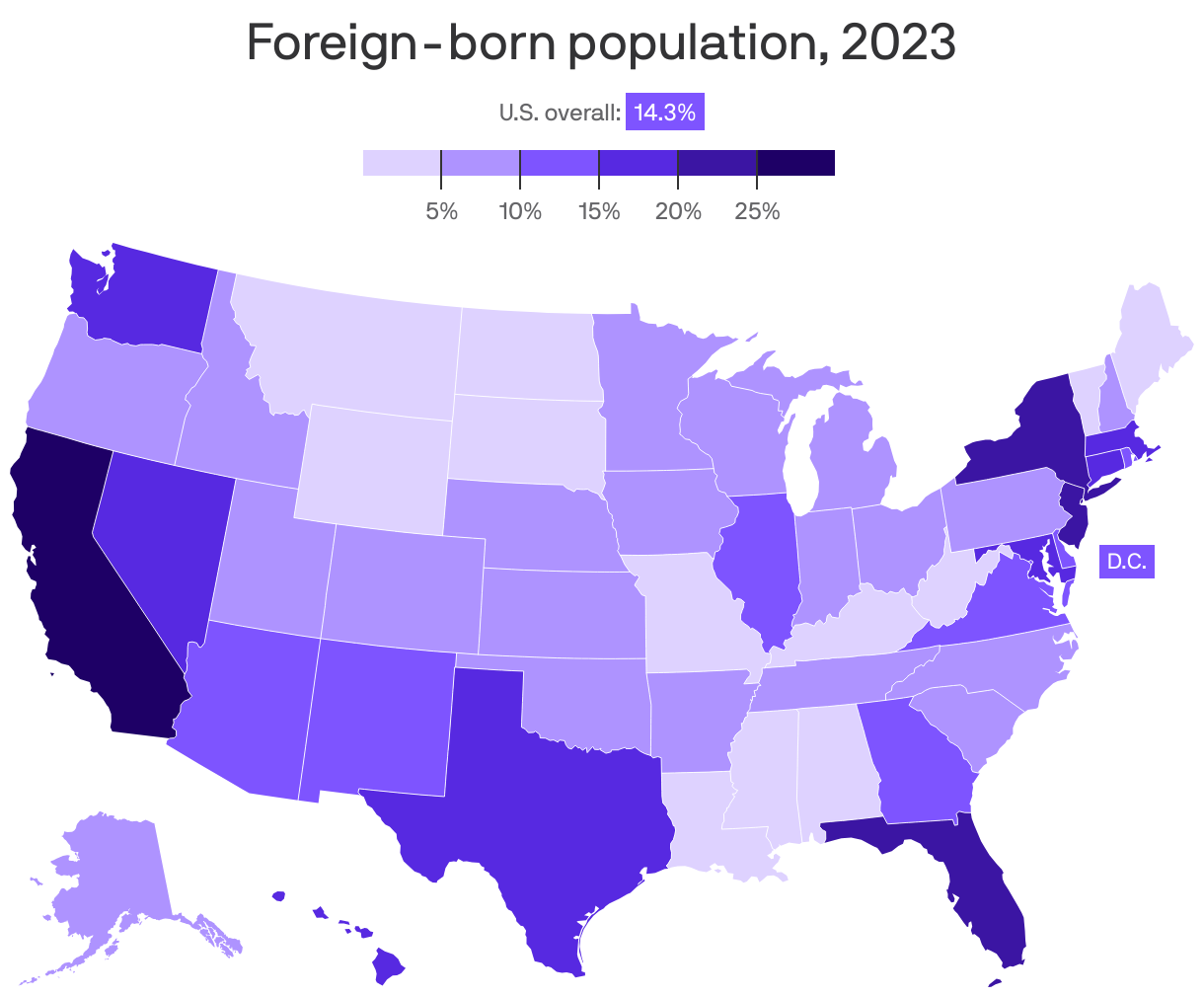
Nearly half of California's new residents last year came from foreign countries, new Census migration data shows.
Why it matters: Immigration is a pressing and divisive political issue across the U.S., but there are massive gaps between the states in terms of how many new arrivals are actually settling there.
State of play: California saw the country's highest share of new residents from foreign countries in 2023 at 42%.
- Other states with large shares of immigrants were New Jersey (37%), New York (35%), Illinois (32%), Massachusetts (31%), Florida (31%) and Texas (30%).
By the numbers: About 11 million people or 27% of California's 2023 population was foreign-born, compared to about 14% nationally.
- That's about the same share of the state's population as 10 years ago.
Zoom in: Internationally born-residents made up about 35% of San Francisco's residents last year, down from pre-pandemic levels.
- Nearly 63% were naturalized while roughly 37% were non-citizens.
- The majority were born in Asia (64%), followed by Latin America (18%) and Europe (12%).
Yes, but: Chinatown, Japantown, the Mission and North Beach have all experienced declines in the share of foreign-born residents, a 2023 San Francisco Chronicle analysis found.
- Bayview Hunters Point and the SoMa have seen some upticks, however.
The intrigue: Chinese-born residents remain the most common immigrant group in San Francisco, but Indian-born residents are among the fastest-growing.
The big picture: While most of California's immigrants are naturalized citizens, the state has the largest population of undocumented immigrants in America.
- Unlike other states, that number decreased in recent years.
- Non-citizens also include lawful permanent residents, students or workers on temporary visas and refugees.