Why produce isn't easy to find at San Antonio farmers markets

Add Axios as your preferred source to
see more of our stories on Google.
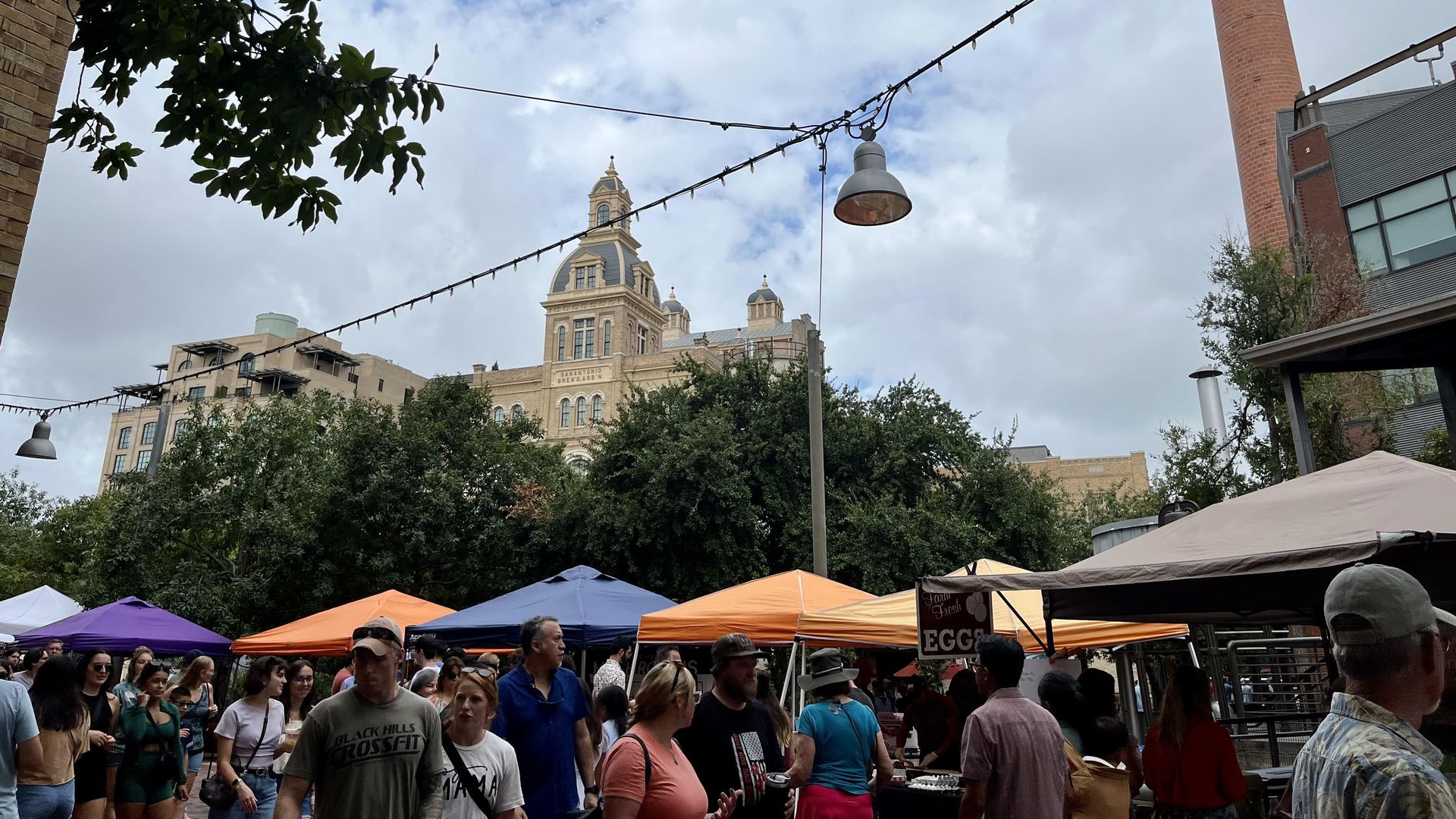
The Pearl Farmers Market is every Saturday morning. Photo: Megan Stringer/Axios
There's a range of offerings at San Antonio's premier farmers market at Pearl: homemade salsa and bread, beeswax soap, tamales, rice pudding and plants. You can get farm-fresh honey, eggs, meat and cheese. But there's only a handful of produce vendors.
Why it matters: The shift is happening as the number of overall farms in the San Antonio area is declining and their operators face numerous challenges.
- There's a shrinking pool of farm workers, land is expensive in a fast-growing region where development continues to sprawl outward, and the area has grown hotter and faced drought in recent years.
The big picture: Eating locally grown produce has numerous benefits. It's nutrient-dense because it cuts down on shipping time from farm to table while supporting the local economy.
- San Antonio has long struggled with health issues like diabetes — linked in part to poor diets — leading local leaders to try to improve fresh produce access.
- And as inflation has hit the supermarket aisles, farmers market produce often isn't much more expensive.
Zoom in: The Seguin-based Braune Farms is one of a handful of produce vendors at Pearl on Saturdays. It's run by Julie Braune, her husband, Jeffrey Braune (a fifth-generation farmer), and their children.
- They've been at the Pearl Farmers Market since it launched in 2009. But Julie Braune has seen other local farmers around her close up shop.
- It's more difficult to make a living as a family farm now than it was a decade ago, she says.
Threat level: "If people don't start supporting farms like ours, they eventually will just go away," Julie Braune tells Axios.
By the numbers: The number of farms in Bexar County dropped 16% from 2017 to 2022, per the U.S. Department of Agriculture.
- In Guadalupe County, home to Braune Farms, the number of farms fell from 2,543 in 2017 to 2,369 in 2022 — a nearly 7% drop.
- Over the same time, the region's population grew 7.4%, Census Bureau data shows.
State of play: There are currently up to 59 vendors at the Pearl Farmers Market, per an updated list shared with Axios.
- Of those, at least 10 (or 17%) sell produce, per an Axios review. That doesn't include vendors that sell only meat, eggs or dairy products.
- In 2009, 11 of 27 vendors, about 41%, sold produce.
Zoom out: After a steady increase of 7% annually in the number of farmers markets nationwide, growth has slowed since 2011, per U.S. Department of Agriculture data.
What they're saying: "Over the years, we have worked with our vendor partners as they have faced a pandemic, unpredictable weather and changes in consumer behavior," Pearl CEO Mesha Millsap tells Axios in a statement.
- "Through these challenges, we have focused on the important role that local farmers and ranchers play in the sustainability of our community and local economy. We have evolved our offerings to speak to the changing needs of the providers and our community."
- Many restaurants at Pearl source ingredients from local farms and ranches, she added.
Interest in urban farming grows
The intrigue: Even as traditional family farms are shuttering, more people appear to be gaining interest in at-home gardening and urban farms since the pandemic.
Case in point: The Garcia Street Urban Farm on the East Side had its first harvest in 2020. It's a partnership between Opportunity Home San Antonio and the William R. Sinkin Eco Centro at San Antonio College.
- Housed on about 4 acres that formerly held public housing, it serves an area long known as a food desert.
- "Right now there's this kind of renaissance of small farmers and gardeners," Rose Flores, who oversees farm operations, tells Axios.
How it works: The Garcia Street team distributes produce through its monthly, low-cost markets at its farm in the spring and fall.
- They also provide produce for free to some San Antonio College students.
- The farm has seen increased interest in its food since it launched, Flores tells Axios.
Reality check: Even so, Garcia Street still faces challenges — turning a strong profit is hard, even more so in extreme weather.
- Garcia Street grows and sells flowers between produce seasons to sustain revenue, and the sale of marigolds in October (around Día de los Muertos) is important for them, Flores says.
- But last year they lost a whole crop of marigolds to the heat.
Still, Flores remains committed to proving the worth of a produce-focused market to San Antonio.
What's next: Garcia Street will begin its monthly farmers markets again in September.
The bottom line: "I think farmers markets are a way for us to build community," Flores says.