Court: Rio Grande buoy barrier can remain for now

Add Axios as your preferred source to
see more of our stories on Google.
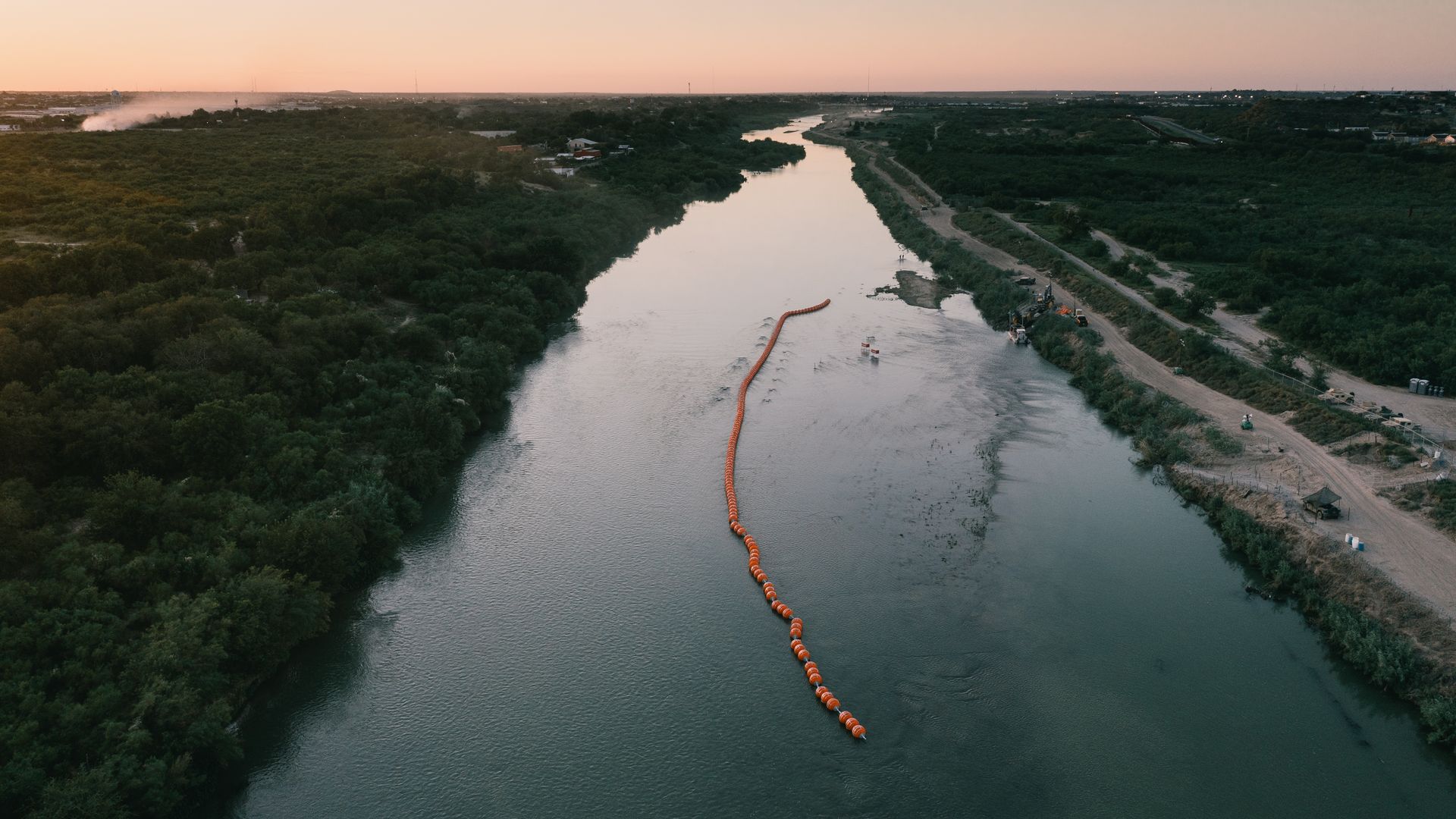
A string of buoys for border control on the Rio Grande in Eagle Pass. Photo: Jordan Vonderhaar/Bloomberg/Getty Images
Texas can keep a floating barrier of buoys in the Rio Grande to deter immigrants from crossing the border into the U.S., a federal appeals court ruled Tuesday.
Why it matters: The decision from the 5th U.S. Circuit Court of Appeals, the latest in a yearlong legal battle between the Biden administration and Texas Gov. Greg Abbott, reversed a September ruling that said Texas must move the controversial barrier.
Reality check: The buoys had remained in the water even before this week's ruling, Abbott said on X.
Catch up quick: The Department of Justice sued Texas in July 2023 over the string of buoys, saying it violated federal environmental law and threatened public safety.
- In addition to the 1,000-foot floating barrier, Texas had set up miles of razor wire barriers along crossing points on the river near Eagle Pass.
- Separately, the U.S. Supreme Court in January granted the Biden administration's request to cut the razor wire.
- Last August, a body was found stuck in the buoys and another body was found nearby.
How it works: The ruling from the 5th Circuit, considered the most conservative federal appeals court, came after a divided 5th Circuit panel sided with the district court ruling to move the buoys.
- The new ruling reversed that decision for now, but it did not rule on the merits of the broader case.
Zoom in: The 5th Circuit disagreed with the district court's conclusion that the barrier is a "threat to human life," pointing out that news articles about deaths related to Rio Grande crossings reported the specific cause of death as unknown.
What they're saying: "Biden tried to remove them. I fought to keep them in the water," Abbott posted Tuesday. "That is exactly where they will stay."
- A spokesperson told Axios the Department of Justice had no comment on the ruling.
Zoom out: The use of buoys and barbed wire is just one of Abbott's approaches to blocking immigrants and asylum seekers from crossing the southern border into Texas in recent years through his Operation Lone Star.
- Texas also enacted a strict new immigration law that gives state and local authorities the power to arrest and seek the deportation of people suspected of illegally crossing the border, although it's currently on hold and unenforceable.
- The push came after years of unprecedented levels of migration across the U.S.-Mexico border.
- But monthly border crossings have since declined following the start of new Biden-era asylum restrictions in June.
What's next: A trial in the broader case is set to begin Tuesday. That could determine a more permanent future for the buoy barrier.
Editor's note: This story has been updated with a response from a U.S. Department of Justice spokesperson.