Young kids make up less of the Richmond area population


Add Axios as your preferred source to
see more of our stories on Google.
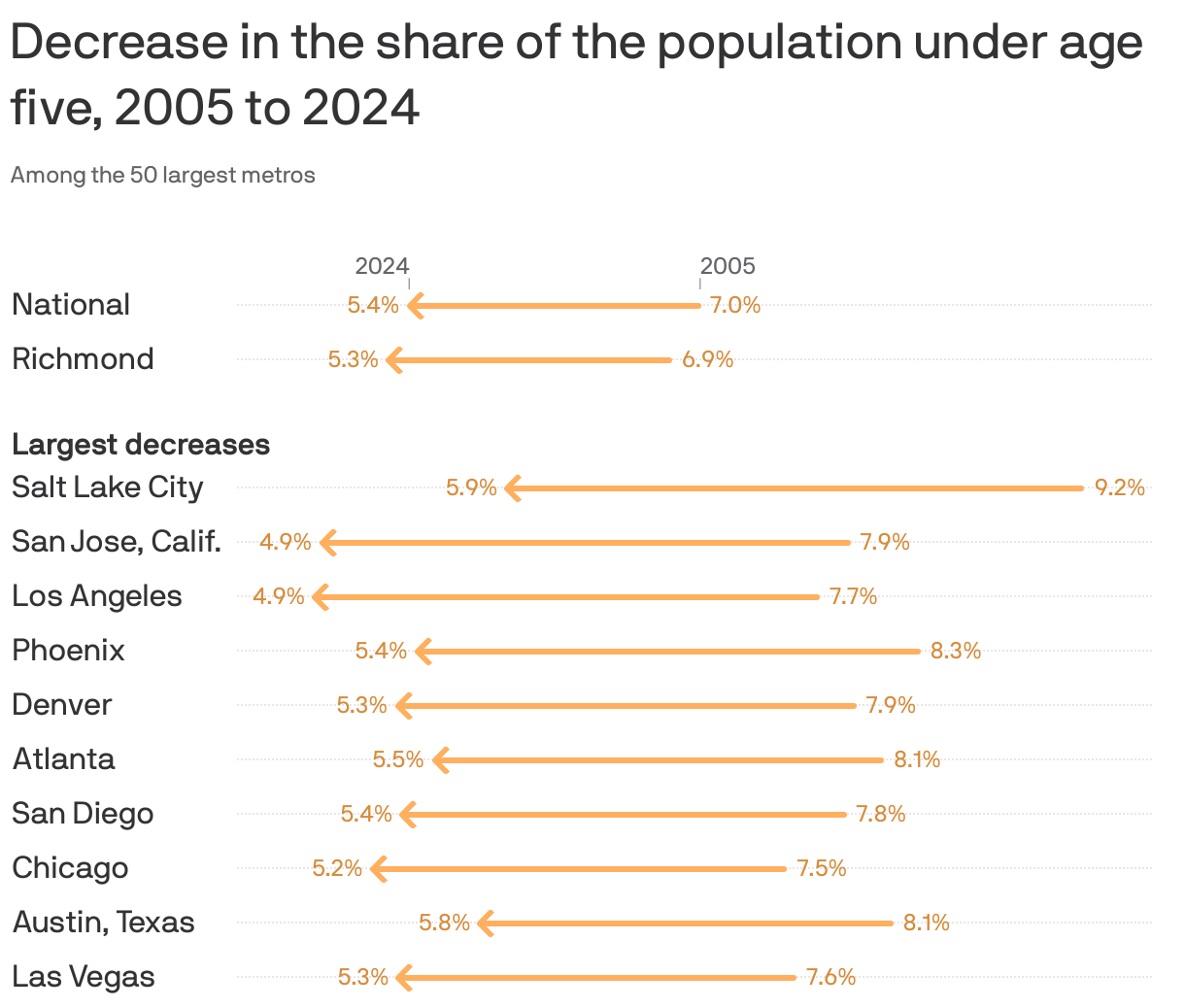
The share of young children in metro Richmond has fallen over the past two decades, mirroring a national decline, census data shows.
Why it matters: The child population trend can reflect cities' ability to attract, retain and support families.
- But larger nationwide factors are also at play, including birth and death rates as well as immigration.
By the numbers: The Richmond area's share of residents under age 5 fell by 1.6 percentage points between 2005 and 2024, from 6.9% to 5.3%.
- That's in line with the national decline.
- Among the 50 biggest U.S. metros, Salt Lake City saw the biggest dip in its population of young children (-3.2 percentage points), followed by San Jose (-3pp) and Los Angeles (-2.8pp).
State of play: Fewer children ultimately translate into smaller enrollment numbers for local school districts, something playing out across Virginia.
- Public school enrollment is projected to continue to decline in the state through 2028, according to recently updated numbers shared by the Virginia Department of Education last week, the Virginia Mercury reports.
- Locally, enrollment in Richmond, Henrico and Hanover school districts has hovered below its pre-pandemic numbers and been basically flat post-pandemic, per the latest VDOE data.
- Chesterfield — which added more than 30,000 residents since 2020 — is the only local school district to see enrollment growth over 2019.
The big picture: The U.S. birth rate hit a record low in 2024, while life expectancy is approaching 80 following a pandemic-era dip.
- Those data points might suggest children will make up less of the overall population over time — fewer kids, more older folks.
- Yet the country grew around 1% between 2023 and 2024 — breakneck speed, as such things go — driven primarily by immigrants (including children, complicating the births vs. deaths picture).
Between the lines: Falling birth rates are fueling concerns about economic growth and societal change in some corners, particularly among "pro-natalist" conservatives.
Flashback: Back in 2015, urbanist Richard Florida found that "kids are far more prevalent in metros where immigrants and Latinos make up larger shares of the population."
What we're watching: The Trump administration's efforts to clamp down on and dissuade illegal immigration could affect kids' population shares in ways not yet well understood.