Richmonders are driving even more than we did before COVID


Add Axios as your preferred source to
see more of our stories on Google.
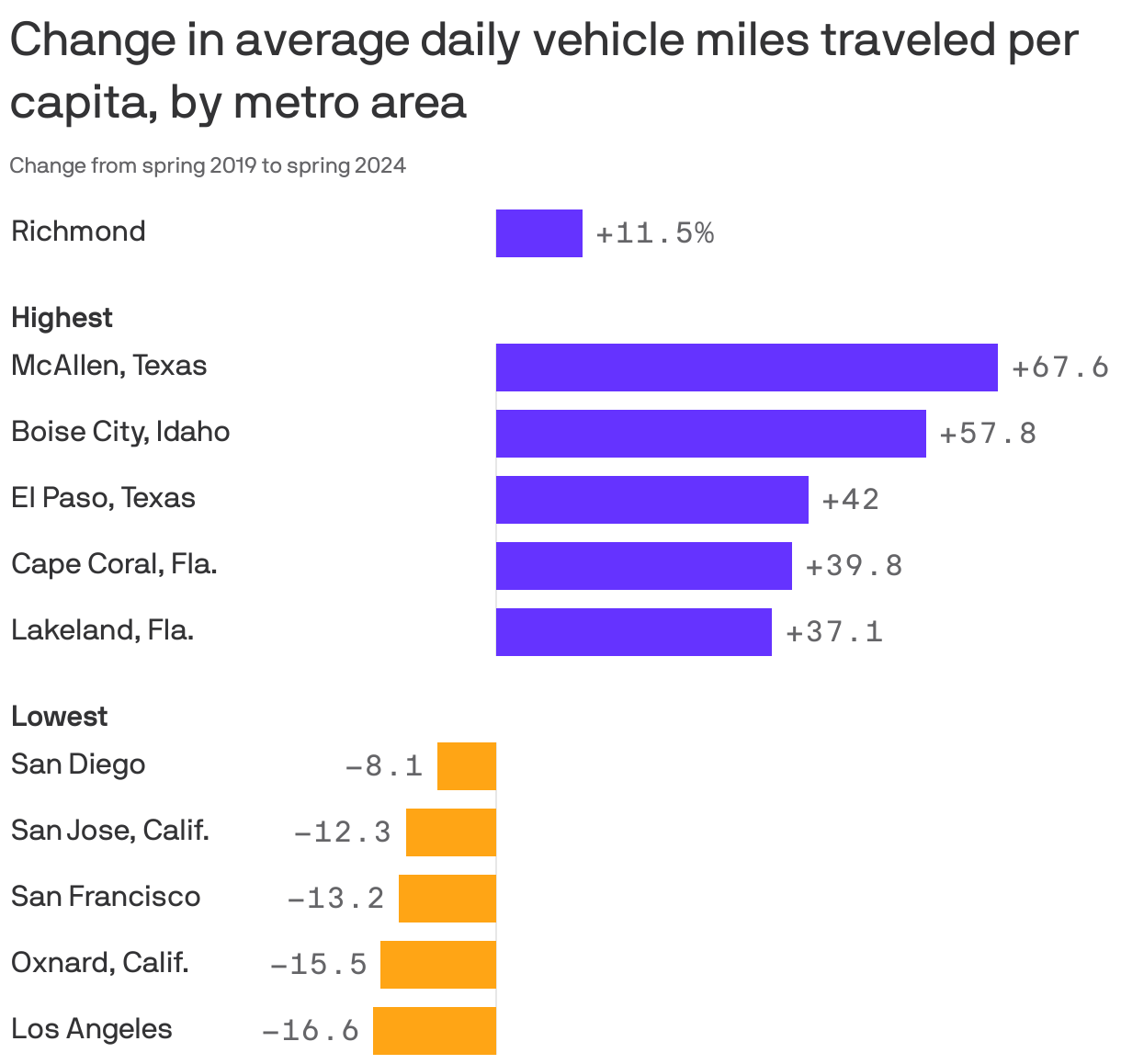
Richmonders are driving more than they were before the pandemic, a new analysis finds.
Why it matters: The COVID-19 pandemic, when driving plummeted as people sought to "stop the spread," was a unique chance for cities to get a lasting handle on transportation-related emissions.
- They didn't.
Driving the news: Average daily vehicle miles traveled (VMT) per capita increased 12.3% across the 100 biggest U.S. metro areas this past spring compared to the same period in 2019.
- In Richmond, it was an 11.5% increase.
- That's according to a new report from StreetLight Data, a transportation analytics firm.
- VMT fell in just 12 of the metros.
Worth noting: A separate study out earlier this year found Richmonders logged the sixth highest rate in the nation for daily miles traveled
Zoom in: VMT per capita has increased the most in McAllen, Texas (+67.6% VMT per capita); Boise City, Idaho (+57.8%) and El Paso, Texas (+42%).
The other side: The metros with the biggest reductions in VMT per capita are concentrated in California, like Los Angeles (-16.6%), San Francisco (-13.2%) and San Jose (-12.3%).
- Standouts elsewhere include Springfield, Mass. (-6.1%), Memphis (-4.1%) and the Twin Cities (-2.9%).
The intrigue: VMT is up 14% in the New York metro area, where a first-in-the-nation "congestion pricing" plan meant in part to reduce driving and gin up funds for public transit was shelved indefinitely at the eleventh hour.
Between the lines: While higher VMT tends to mean more vehicle-related emissions, it can also be a sign of changes generally perceived as positive, like more economic activity.
- Lower VMT can be a sign of successful public transit or cycling projects — or an indication that lots of people are still working hybrid or remotely.
Yes, but: "GDP now stands above 2019 levels even in the metros where VMT is still down," per StreetLight's report.
- "This is a signal that GDP growth can be decoupled from VMT growth."
The bottom line: "It's not just that [VMT] is back up, but we're actually seeing a bit of an acceleration compared to the previous couple of years," Emily Adler, director of content at StreetLight, tells Axios.
- "So that suggests that we're not peaking, that whatever efforts we've strived for to keep VMT down, they're not quite working — or they're not working yet."