Where IVF stands in Virginia after the Alabama ruling

Add Axios as your preferred source to
see more of our stories on Google.
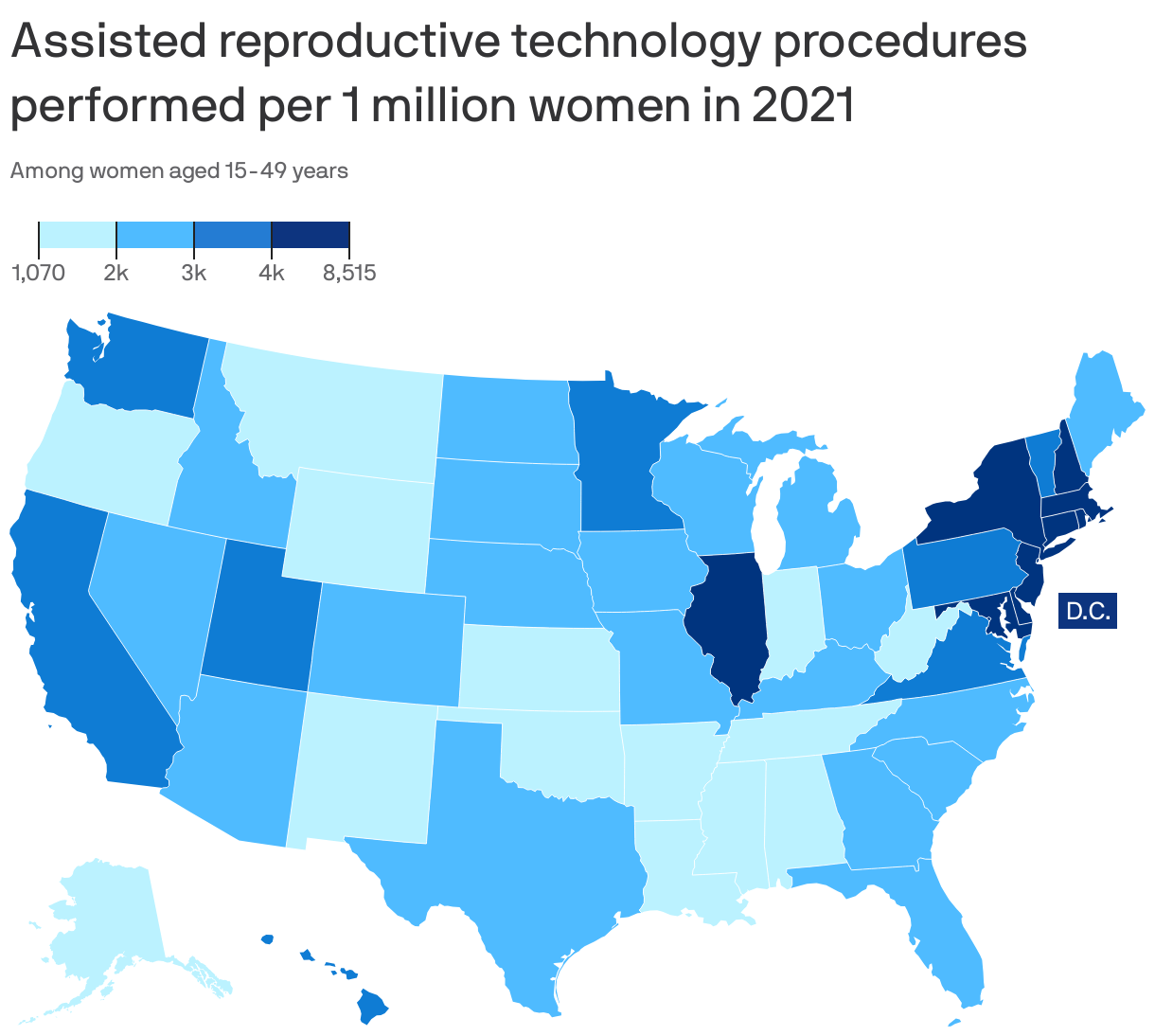
Nearly 2,400 babies were born in Virginia with the use of assisted reproductive technologies like in vitro fertilization in 2021, according to the most recent CDC data.
- Providers performed close to 6,000 embryo transfers to get that number of infants, which accounted for 2.5% of all births statewide that year.
The big picture: Alabama's Supreme Court ruled in February that frozen embryos created through IVF are children under state law, meaning fertility clinics in the state could be held legally liable for disposing of surplus embryos, reports Axios' Carly Mallenbaum.
- But IVF typically takes more than one embryo to safely achieve pregnancy — and unused embryos are often discarded.
- Of the embryos that thaw and pass genetic testing, about half to two-thirds lead to pregnancy in an ideal scenario, Lucky Sekhon, reproductive endocrinologist and infertility specialist at RMA of New York, tells Axios.
Why it matters: Without the ability to discard surplus embryos, IVF — already expensive and out of reach for many Virginians — could become even less accessible.
State of play: Several Virginia leaders have spoken out in defense of IVF since the Alabama ruling, including Youngkin, whose office said he "unequivocally supports access to IVF for Virginians" in a statement to WTKR.
- But a federal bill that Virginia Sens. Mark Warner and Tim Kaine co-sponsored to protect IVF treatment failed last week in Congress.
- Other states are considering so-called fetal personhood bills, which Virginia lawmakers have repeatedly — and unsuccessfully — introduced in past years.
- Perhaps the most infamous instance was a proposal last year that would have counted a fetus as a car passenger in our HOV lanes.
Fun fact: Norfolk is where the first American IVF baby was born in 1981.
- Her name is Elizabeth Carr, and she'll be Kaine's guest at the State of the Union address on Thursday.