North Carolina hemp shops push ahead despite looming THC ban

Add Axios as your preferred source to
see more of our stories on Google.
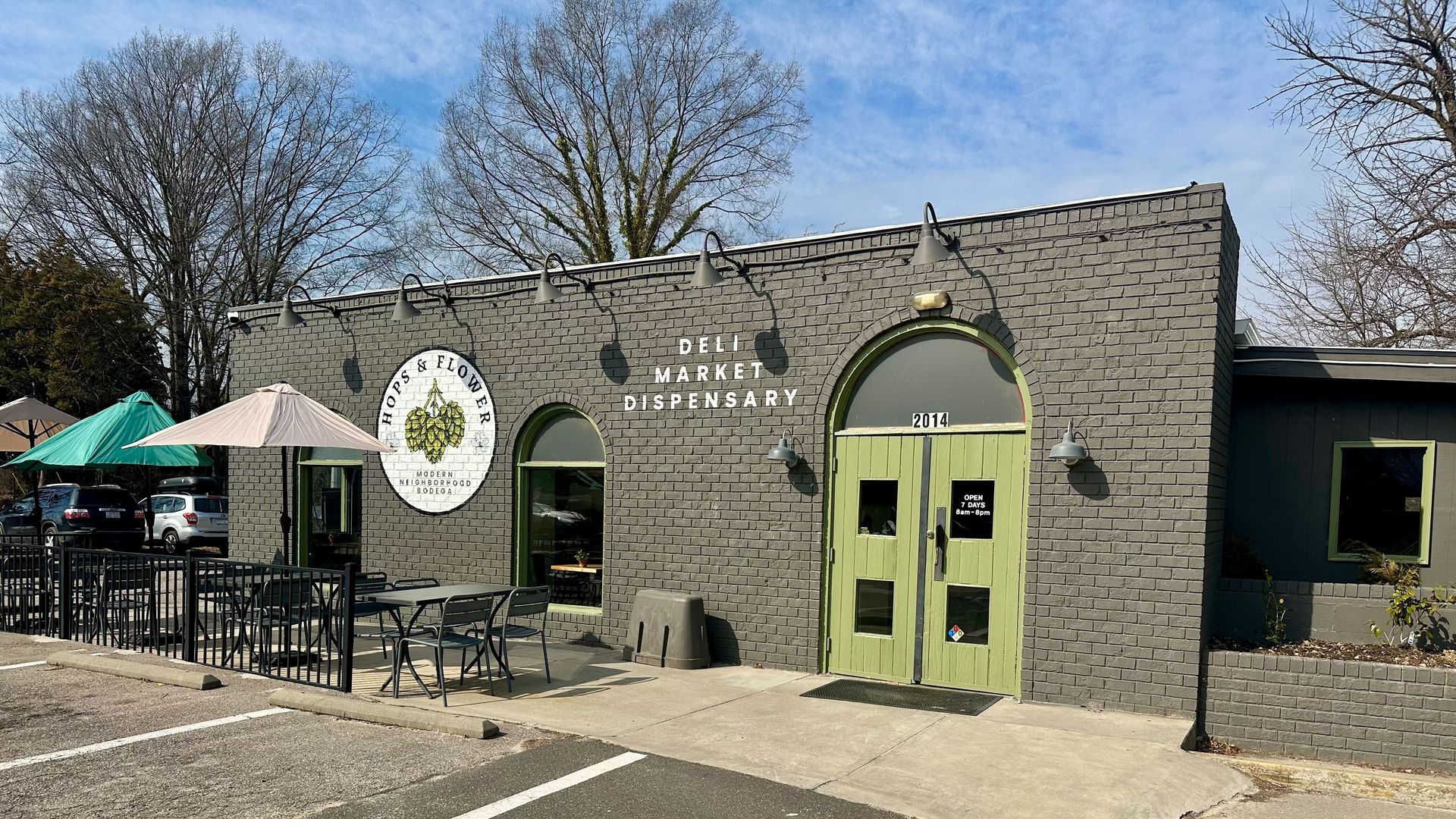
Hops & Flowers opened earlier this year near Durham's Ninth Street. Photo: Zachery Eanes/Axios
Shawn Stokes was past the point of no return when a provision in a November deal to end the federal government shutdown essentially banned intoxicating hemp-derived THC products.
- Stokes, who owns the Durham restaurant Luna Rotisserie, was knee deep in renovations on what would become the now-open Hops & Flower — a combo deli, market, taproom and hemp dispensary near Duke's campus.
Why it matters: Now he and hundreds of entrepreneurs, breweries and farmers who operate hemp-focused businesses in North Carolina and beyond are waiting to see if a ban comes into effect later this year.
What they're saying: "I'd already signed all the documents on loans and everything. There was no going back," he said. "Now I'm reaching out to all my elected officials at any given moment" on this issue.
- Stokes said he thinks a compromise will be found. "But I don't know if I am delusional," he added. "I have to be optimistic."
Between the lines: Hops & Flowers is not alone in opening a hemp-focused venture at this time. It's not even the only one to open near Durham's Ninth Street in recent months.
- The industry, in some ways, is marching forward, hoping that a compromise is found soon.
The big picture: If it takes effect, the ban could wipe out 95% of the nation's $28 billion hemp industry, costing more than 300,000 jobs, according to the U.S. Hemp Roundtable advocacy group, NPR reported.
- "It's possible a state could still try and keep the hemp industry alive as it stands now after the federal ban," UNC's School of Government professor Phil Dixon told Axios in November, "but even then, it would be massively altered."
State of play: There has been a strong desire to regulate hemp-derived THC products in North Carolina, especially closing loopholes that make it possible to sell to those under 21. But still, a final bill hasn't materialized.
- Many business owners hope the state can create some clear regulations that hopefully protect the industry, much like how marijuana remains federally illegal but is still sold in states that have legalized it.
For his part, Stokes argues that regulating THC in this state is far safer than sending all of its users back to the black market.
- And he believes it's misguided to ban these THC products when you could easily buy alcohol at the same establishment.
- "My intent [is] to help normalize a product that has been maligned and misunderstood for decades," he said. "While other products we serve in our shop, such as beer, vodka, and whisky, are not only legal but their consumption is also glamorized and socially encouraged."